Personalized Learning Apps Reviewed by Adaptive Features
Most personalized learning apps use marketing hype instead of actual adaptation technology.
A parent downloads an app that promises to "meet your child where they are." The pitch sounds right: every kid learns differently, so the software should bend around the kid, not the other way around. Then the child answers a question in two seconds flat, and a few minutes later struggles through another one, and the app plays the exact same star animation both times. Nothing about the lesson changes. Nothing about the pace changes. The app branched the child to an easier or harder level after a wrong answer, and that is a decision tree, not adaptive instruction. The category is moving fast enough that a glowing review from even a few years ago may already describe a product that no longer exists in the same form, and the integration of AI in education is prompting a full reevaluation of what "personalized" learning terminology actually means. What this piece sets out to do is replace the marketing word with a working test: what does a genuinely adaptive app actually need to respond to, and how would a parent recognize one when they see it?
The reading skills the science of reading requires
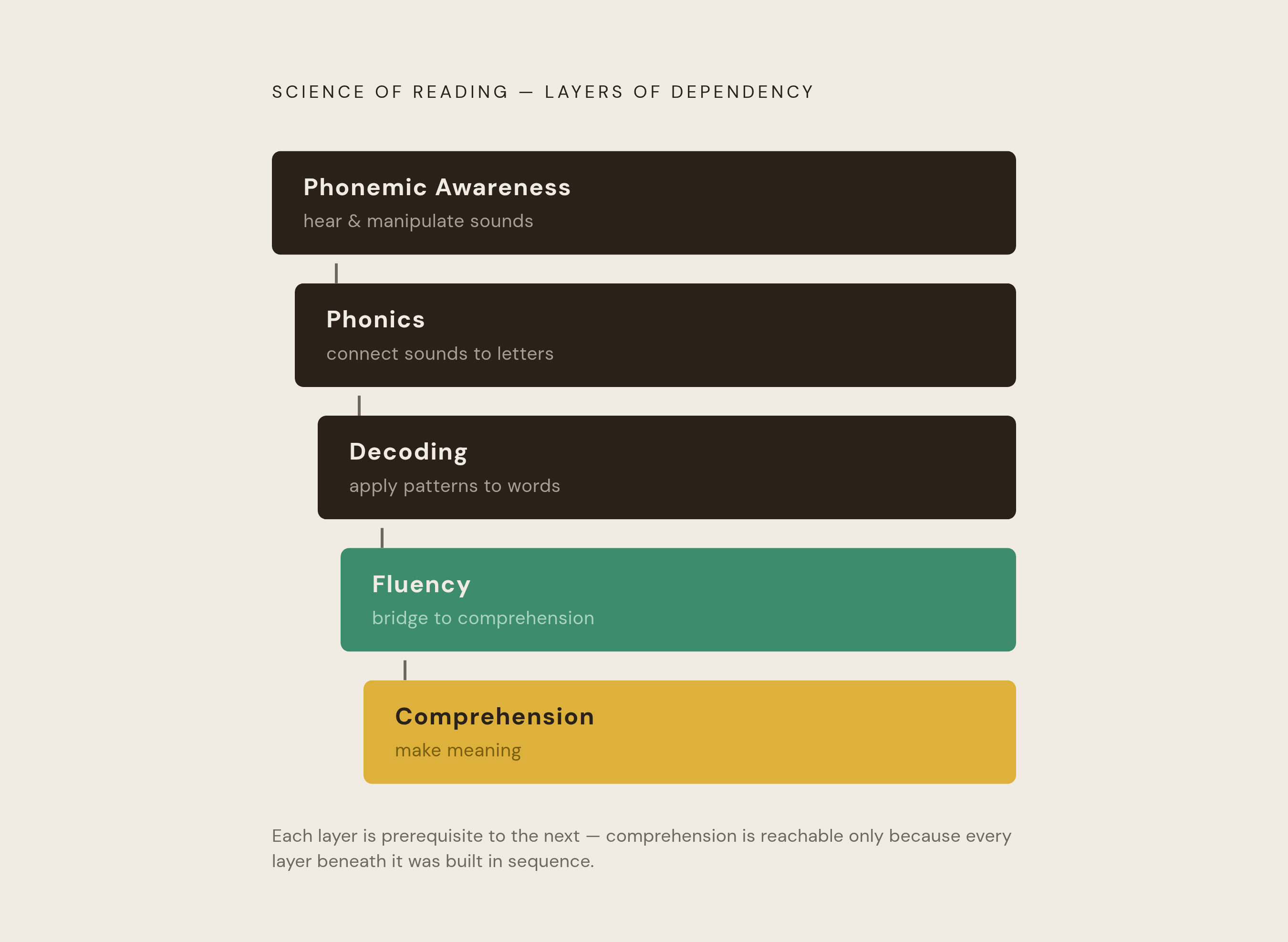
Reading is not one skill sitting on top of a child's brain waiting to switch on; it is a stack of interdependent abilities that has to be built in a specific order, and skipping steps in that order does not speed a child up, it leaves gaps. The National Reading Panel identified five components that make up this stack: phonemic awareness, phonics, fluency, vocabulary, and comprehension. These five do not work like a checklist a child completes once and moves past. Phonemic awareness supports phonics, phonics supports accurate decoding, and accurate decoding frees up the mental energy a child needs for fluency and comprehension. Phonemic awareness comes first because a child has to hear and manipulate individual sounds in spoken words before those sounds can be connected to letters on a page. Early-skill assessments, done even before a child can read a single word, can flag which children are likely to struggle with decoding if nobody steps in. An app that has no way to screen for those pre-reading skills is already working from behind, regardless of how polished its interface looks. Fluency gets misunderstood just as often. It is not a milestone a child hits once decoding is solid. A 2026 scoping review in Frontiers in Education describes fluency as a multidimensional, developmentally variable, context-sensitive bridge between decoding and comprehension. That means an app measuring fluency purely in words per minute is tracking speed while missing the actual skill. Decoding keeps mattering long after a child "learns to read," too: older students still rely on decoding when they encounter unfamiliar or complex vocabulary, so the sequence never fully closes out, it keeps getting called back into use. For a parent sizing up a reading app, this sets a clear bar: a curriculum grounded in the Science of Reading has to address all five components in sequence, and an app that only offers story time with comprehension questions, or only drills phonics in isolation, is not aligned with what the evidence says reading instruction requires.
How adaptive AI actually works inside a learning app
Once the standard for what a child needs is clear, the next question is what the technology is actually doing to meet it. Genuine adaptive instruction depends on three things working together at the same time: a learner profile that accumulates detail over weeks and months, real-time sensing of how the child is performing and how engaged they are right now, and a decision engine that can change not just how hard the next question is but how the material gets taught. That third piece is where most products quietly fall short. Many platforms build learner profiles and feed them into models that recommend an instructional sequence, but a recommendation is not the same thing as a live response. A recommendation can sit in a report a teacher reads later.
There is a simple test a parent can run without reading a single spec sheet: watch what happens the moment a child gets an answer wrong. A genuinely adaptive app shows its work. It explains why the answer was wrong, walks through the correct reasoning, and gives the child a similar problem to try again. A weaker app plays a sad sound effect and moves straight to the next item. That single moment separates corrective instruction from simple error logging, and it is observable in about thirty seconds of watching a child use the app.
Voice responsiveness sits even further out on the difficulty curve. An app that listens to a child read aloud and reacts to hesitations, mispronunciations, and the rhythm of their speech, rather than only registering taps on a screen, is working at a different level of sophistication than an app built around multiple-choice buttons. Storiza, a platform presented at the 2025 International Conference of the Learning Sciences, is documented as one of the first research-grade tools to apply generative AI to oral reading fluency in this way. Math apps face a version of the same challenge. Genuine adaptation in early numeracy means tracking not just whether the answer was correct but how the child got there, whether they counted on their fingers, recognized a quantity at a glance, or pulled the answer from memory, because two children can land on the same correct number while standing at very different points in their understanding.
What the evidence says adaptive platforms produce
The research on adaptive platforms is genuinely encouraging, and it comes with real conditions attached. Outcomes depend on how much time a child actually spends in the app, whether the underlying curriculum is evidence-based, and what kind of adaptation is actually happening under the hood. A 2025 systematic review found that AI-adaptive platforms produced meaningful gains in performance, stronger engagement, and faster task completion, though the spread of results across different studies was wide: the strongest platforms pulled far ahead of the average performer, rather than every adaptive tool delivering similar results. For children with learning disabilities, the picture looks even more consistent in direction. A review covering multiple studies and thousands of participants found that personalized and adaptive systems were among the most studied AI interventions for dyslexia and other specific learning disorders, and every study in that review reported a positive outcome, even though the size of the benefit varied from study to study. A separate meta-analysis of 119 studies by Silverman and colleagues in 2025 found that educational technology interventions improved decoding, language comprehension, and overall reading skill in elementary-age children. Quill.org, a writing tool, offers a concrete illustration of what this looks like at scale: studied across a large sample of students in thousands of schools, its users improved their writing skills faster than comparison groups who did not use it.
None of this evidence licenses a parent to hand a tablet to a child and walk away. No digital platform, however well-designed, replaces an adult reading aloud with a child or sitting present during learning. Research on reluctant readers found that bringing them back to reading required rich, human social interaction, something no app can replicate on its own. The most effective tools work alongside a parent, not instead of one. That caveat is not a knock against the technology.
The four features that determine whether an app's adaptation is real
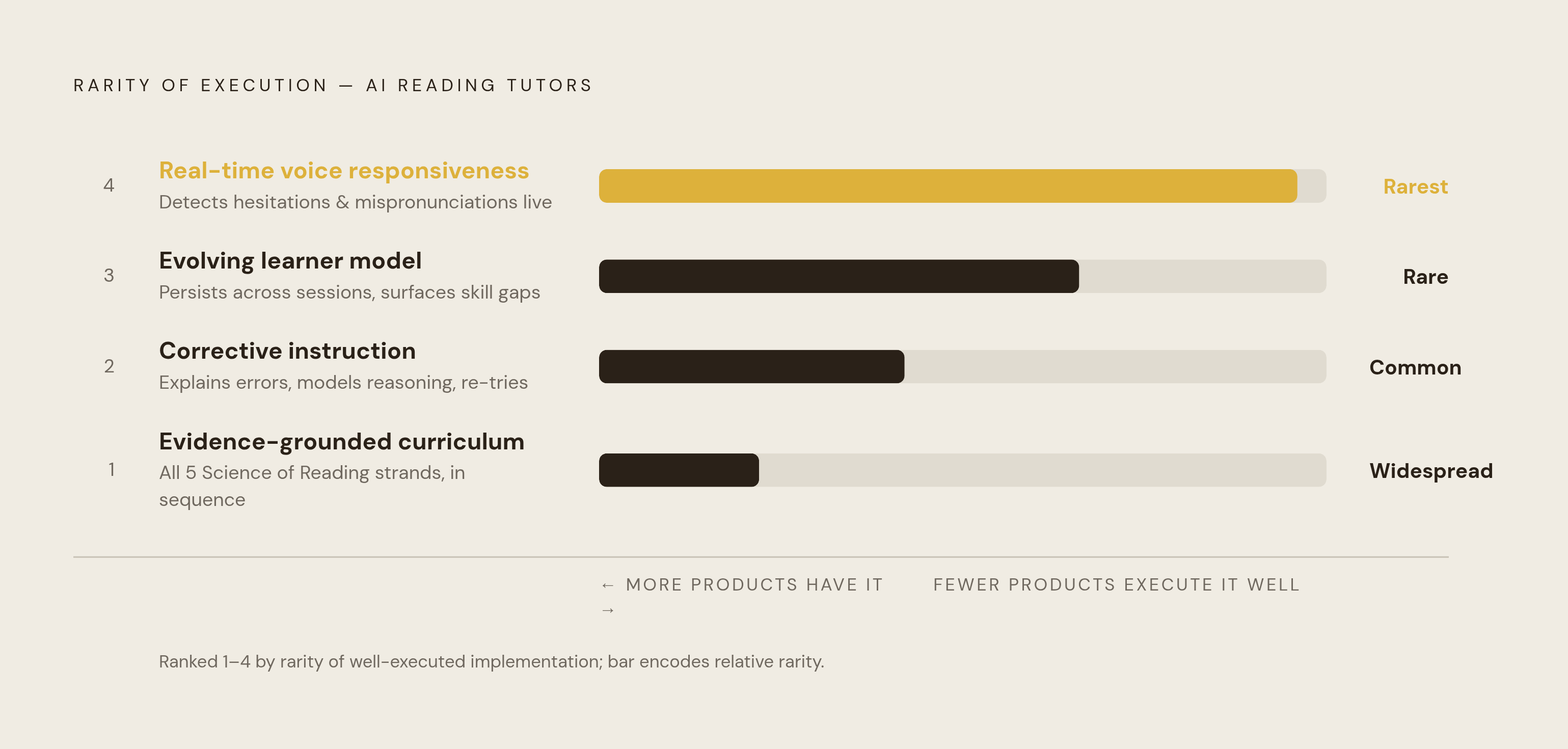
Four specific, observable things separate an app that genuinely adapts from one that only claims to: a curriculum grounded in evidence, real-time responsiveness to a child's voice and pace, instruction that corrects rather than just logs errors, and a learner model that evolves instead of resetting every session. Each one can be checked by a parent without any technical background, just by watching how the app behaves.
Evidence-grounded curriculum is the foundation. For a reading app, the test is whether it addresses all five Science of Reading components in sequence, phonemic awareness, phonics, fluency, vocabulary, and comprehension, or whether it only touches some of them. For a math app, the test is whether it follows a developmental sequence, building number sense and mathematical language before moving into formal operations, and whether that sequence lines up with a recognized standard such as Common Core. A useful signal here: curriculum built by subject-matter experts in reading or math, with AI layered on top to deliver and adjust it, is a fundamentally different product than a general-purpose AI model dressed up in an educational skin.
Real-time responsiveness to voice and pace is the second test, and it is the rarest one to find well executed. It asks whether the app listens to a child read aloud and responds to hesitations, mispronunciations, and expression, or whether it only reacts to taps and multiple-choice selections. It also asks whether the app can change its instructional approach in the middle of a session, not just adjust difficulty between one session and the next. Storiza, presented at the 2025 International Conference of the Learning Sciences, is at the research frontier of generative AI applied to oral reading fluency, and it gives parents a real benchmark for what voice responsiveness looks like when it is built properly.
Corrective instruction, rather than error logging, is the third test. When a child gets something wrong, does the app explain the reasoning behind the correct answer, model it, and then offer a similar problem to practice on? Or does it simply mark the answer wrong and move along? A strong app also distinguishes between a careless slip and a real gap in understanding, and responds to each one differently rather than treating every wrong answer the same way.
An evolving learner model is the fourth test. Does the app carry forward a persistent picture of a child's strengths, interests, and pace across weeks of use, rather than starting fresh each session? Can a parent actually see that model reflected in progress reports that go beyond time spent in the app, showing which skills were practiced, which gaps were found, and what the app plans to work on next? Building that kind of model requires collecting real data about a child, which makes privacy a prerequisite rather than an afterthought. Compliance with COPPA and GDPR is the floor, not the ceiling, and parents should be able to see what data is being collected and opt out of it without running into what amounts to a maze designed to make them give up.
Prodigy Math and other named apps against the four-feature framework
Prodigy Math wraps math practice inside a wizard-battle adventure game, and it works for exactly the kids who tend to resist a worksheet: the game format pulls them in willingly. On Feature 2, responsiveness to pace, that engagement is a real strength, since the game adjusts to keep a child moving through content at a pace that holds their attention. The framework also raises a fair question for Feature 3: when a child answers incorrectly, does Prodigy explain why the answer was wrong, or does the game narrative simply continue regardless? That is worth a parent's direct observation rather than an assumption either way. On Feature 1, curriculum grounding, the useful check is whether Prodigy's sequence of math content lines up with a recognized standard such as Common Core, rather than trusting the game's own internal leveling to reflect sound developmental order. On Feature 4, the game format naturally throws off a large amount of interaction data simply because children play it so readily, and the real question for a parent is whether that data turns into progress reporting that actually says something useful, rather than staying locked inside the game's own scoring system.
Zooming out across the category, the framework exposes one gap more clearly than any other: voice responsiveness during oral reading, Feature 2 in its hardest form, remains the rarest capability on the market. Most consumer apps respond to taps and selections. Very few respond to a child's actual spoken voice in real time, and that single difference separates products designed around listening from products designed around clicking. For a parent evaluating any app in this category, that gap is the sharpest dividing line to check first, since it is the hardest feature to fake with a good interface and a clever animation.