COPPA Compliance Risks in AI Classroom Tools
Voiceprints and hidden data collection expose a legal gap in classroom AI tools.
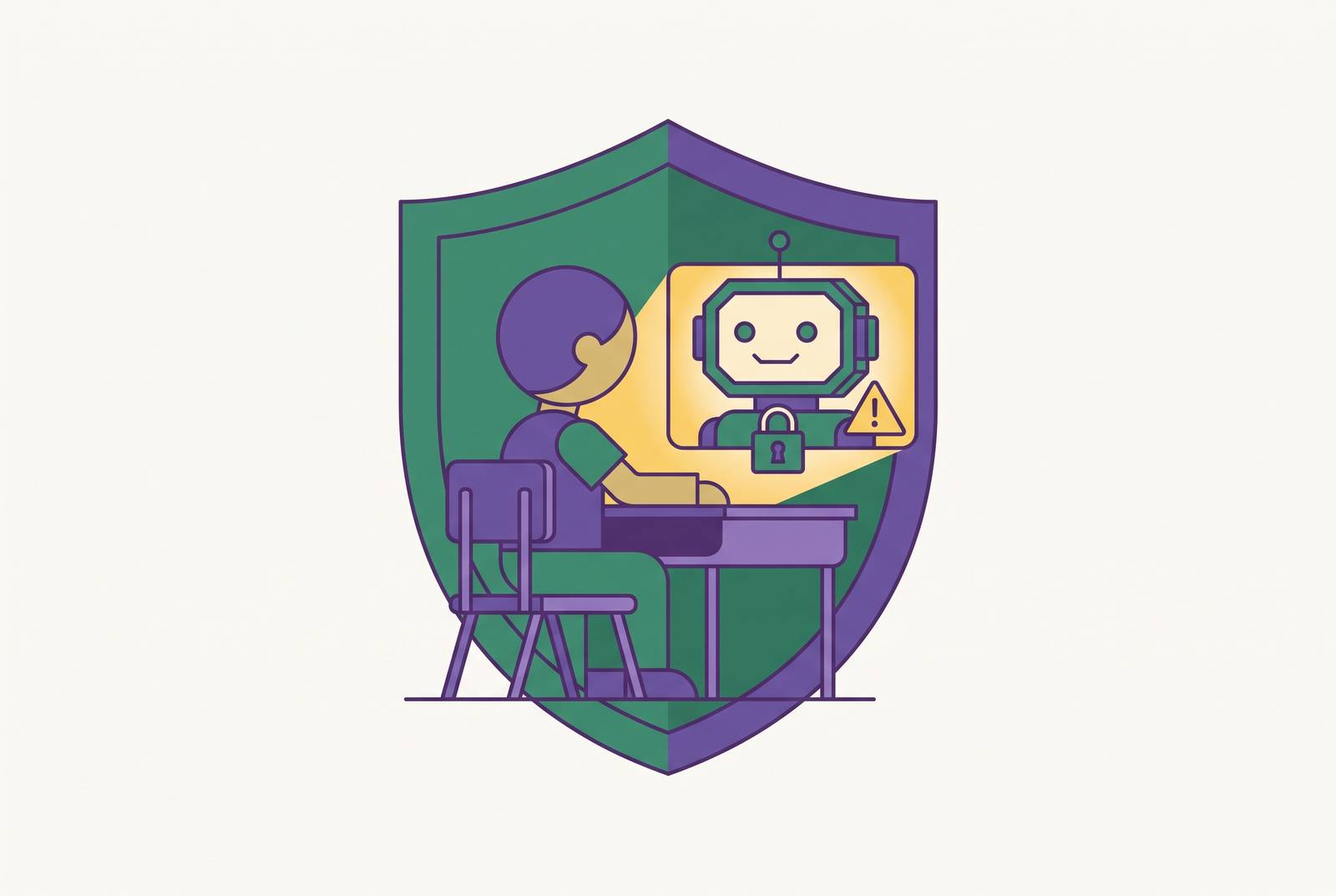
AI classroom tools collect far more than test scores and login times. They pull in voice recordings, typing patterns, emotional cues buried in chat prompts, and sometimes biometric data that most parents never agreed to hand over. COPPA, the federal law meant to protect kids under 13 online, was written for a web of static forms and cookies, not for chatbots that listen to a child read aloud and quietly build a voiceprint. The gap between what the law expects and what these tools actually do is where the real risk sits.
AI tools in classrooms and hidden data collection
Start with something obvious that most people overlook anyway. When a kid types a question into an AI chatbot for homework help, that message might include their name, their school, how well they read, or how frustrated they sound. All of that counts as personal information under COPPA the moment it's stored somewhere.
Voice is the sharper edge of this problem. Reading and language apps that listen to kids in real time are collecting biometric data; the company's privacy policy may not say so. Under the FTC's April 2025 amendments to COPPA, the first major rewrite of the rule since 2013, voiceprints are now explicitly classified as personal information. A lot of platforms built their consent screens years before that update, and haven't gone back to fix them.
Then there's the part almost nobody asks about: model training. Plenty of AI companies say they don't train their core models on classroom data. Fine. But that statement doesn't cover fine-tuning, analytics dashboards, or quality-assurance review, three places where student inputs often get used without much daylight on the process. Some AI developers hold onto data for long stretches and train on it without telling anyone clearly. And large language models trained on scraped internet text can memorize snippets of personal information and spit them back out to a different user. That's the same basic failure mode as the documented incident where an employee's code, pasted into a chatbot, ended up stored on the vendor's servers under a policy that allowed the data to be retained. Swapping "employee code" for "a child's essay with their name and school in it" produces the identical mechanism.
Most compliance reviews fail to catch third-party SDKs. An app can have a clean, careful privacy policy of its own and still ship with embedded code for analytics, ad tracking, or engagement measurement built by someone else. Behavioral advertising runs on persistent identifiers and cross-app tracking, and that's hard to square with COPPA unless there's real notice and real parental consent behind it. It's often not the app's own code that gets a company in trouble. It's what's bolted onto it.
The gap between FERPA and COPPA that puts children's data at risk
FERPA and COPPA get lumped together constantly, and that's a mistake. FERPA covers records a school creates and keeps. COPPA kicks in the second a student starts interacting with a third-party platform, an app, a chatbot, a website. FERPA covers records a school creates and keeps, while COPPA kicks in the second a student starts interacting with a third-party platform, an app, a chatbot, a website, so these are two distinct protections. They're sequential, covering different moments in a child's digital footprint.
Most EdTech companies lean on something called the school-authorization exception: schools can consent to educational data collection on a parent's behalf, so the vendor doesn't need to chase down permission from every family individually. It's a useful shortcut, and it's also narrower than most people assume. That authorization only covers educational purposes. The moment a tool uses student data for advertising, profiling, or anything commercial, separate parental consent is required, no matter what the school signed off on.
This exception rests entirely on FTC guidance, not on the actual Code of Federal Regulations. The FTC proposed writing it into the rule in 2024. The final 2025 rule dropped that section. So the exception still exists in practice, but its legal footing is exactly as shaky as it was before, resting on guidance rather than codified law.
And schools can't simply hand the risk to someone else through a contract. Regulators have made clear that vendors cannot shift COPPA compliance obligations onto teachers or schools, a signal that districts can't outsource legal responsibility through clever vendor agreements. Below the federal layer, there's a tangle of more than 100 state student privacy laws restricting profiling, targeted ads, and automated decision-making, the very things AI systems are built to do. Since 2014, nearly 400 student privacy bills have been introduced across 49 states, amounting to an entire second legal system running underneath COPPA. Since 2014, nearly 400 student privacy bills have been introduced across 49 states, forming an entire second legal system that runs alongside COPPA and produces obligations most AI vendors haven't fully mapped. That legal system runs underneath COPPA, producing obligations most AI vendors haven't fully mapped.
Real enforcement actions that show what non-compliance looks like
The FTC's civil penalties for COPPA violations run up to $53,088 per violation, with per-child penalties reaching up to $51,744, figures the agency actively enforces. These aren't hypothetical numbers sitting in a regulation nobody enforces.
Enforcement actions have targeted vendors for collecting children's data for advertising without consent, and separately for attempting to push COPPA compliance responsibilities onto teachers rather than handling them as the vendor. NGL Labs got banned from offering its anonymous messaging app to anyone under 18, after regulators found deceptive claims about its AI content moderation, along with marketing aimed at kids and teens. Even Disney landed in enforcement trouble, for letting third parties collect children's personal data through its online services. Scale and brand trust don't buy a company out of compliance. If anything, the Disney case makes the opposite point: size makes the sprawl of embedded third-party code harder to track, not easier.
Why voice-collecting AI learning tools deserve particular scrutiny
Voice-based learning isn't some fringe feature anymore. Voice analysis has become a common feature across language learning and early reading tools. Plenty of young kids now read aloud to an app as a normal part of their school day.
Under the 2025 amendments, voiceprints and other identifiers derived from voice are explicitly classified as biometric personal information. A tool that listens to a child read and stores that audio, or stores anything derived from it, is handling biometric data and needs to treat it that way under the law. The trouble is that a lot of platforms built their consent flows well before the April 22, 2026 compliance deadline and may not have updated them to reflect this. A parent might click "agree" on a form that talks about general educational data collection with no mention that voice is being captured, stored, and legally classified in its own separate bucket.
Before trusting any voice-based tool, a parent should run through a short, specific list.
- Is the child's voice actually stored, or processed live and thrown away right after?
Does that audio get turned into a voiceprint or some other derived biometric template?
- Does the privacy policy name biometric data and reference the 2025 COPPA amendments directly, not just vague language about "audio data"?
- Does any of that voice data flow into model training, quality assurance, or analytics pipelines?
The teacher training gap that amplifies compliance risk in real classrooms
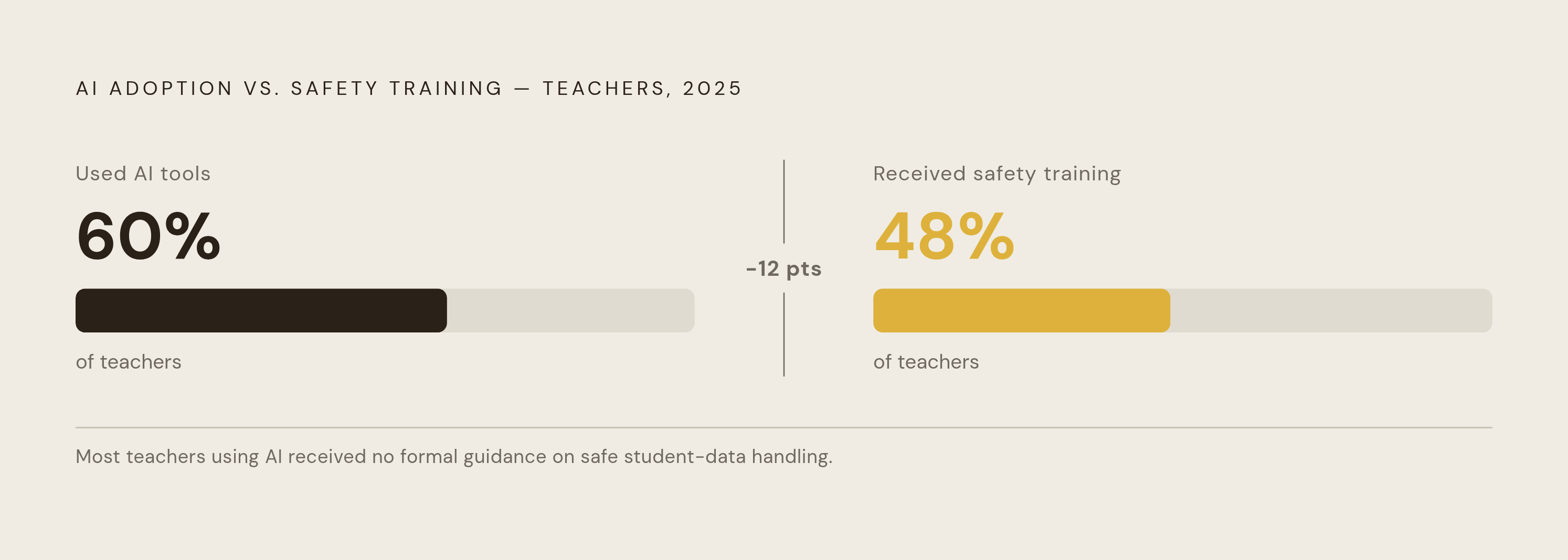
Roughly 60% of teachers used AI tools in 2025. Roughly two-thirds of them got no training at all from their schools on using these tools safely. A separate figure from the same reporting period puts the share of teachers who received any training at 48%, a different survey framing, but the same underlying picture: most teachers using AI in the classroom are doing it without formal guidance on what's safe to input and what isn't.
That gap appears in specific, avoidable ways. Teachers upload student work samples, sometimes with names and identifying details still attached, into consumer AI tools built for general use. They reach for free, off-the-shelf chatbots that sit completely outside their district's data agreements, running on privacy policies that look nothing like the education-specific versions the district may have vetted. Names, reading levels, behavioral notes, all of it can end up inside a tool that no signed Data Privacy Agreement ever covered.
As of August 2025, 33 states have released some form of AI guidance for schools, and several require districts to publish their own AI policies. Guidance is a start. It is not enforcement, and the space between the two is exactly where the classroom-level risk keeps living.
Specific questions parents should ask before trusting an AI learning app with their child's data
None of these questions are red tape for its own sake. Each one traces back to a specific failure mode already on the record: voiceprint collection, ad-driven data sharing, or student inputs quietly feeding a training pipeline.
On data collection:
- What exact data does the tool pull from a child, text, voice, behavior patterns, device ID, location?
- Is voice stored permanently, or processed and discarded in real time?
- Does the platform build any biometric identifier, a voiceprint, a facial template?
- How long does the company hold onto the data, and is there an actual, documented deletion process?
On consent and compliance:
- Is the tool compliant with COPPA as amended, including provisions that took effect by the April 22, 2026 deadline?
- Has the vendor signed a Data Privacy Agreement with the school district?
- Does the vendor ask for separate parental consent before using data for advertising or handing it to third parties?
- Can the vendor produce written documentation? "We take privacy seriously" "We take privacy seriously" is a slogan.
On third-party sharing:
- Does the vendor share data with any outside analytics provider, ad network, or SDK?
- Are those third parties bound to the same privacy standards under contract, or just loosely affiliated?
- Is student data, voice included, ever used to train or fine-tune models, even for quality-assurance testing?
Compliance standards for AI learning tools
The clearest dividing line in this whole space is between AI built for education from the start and consumer AI retrofitted for a classroom. One is designed around COPPA's constraints as a foundation. The other bolts compliance onto a product built for a completely different audience and a completely different business model.
A few structural signals separate the two. A company that earns money from ads has a built-in incentive to profile the kids using it, while a subscription model or a mission-driven free tier doesn't carry that same pull, so the advertising model affects how much a child's data gets collected. No in-app purchases aimed at children removes a whole category of data collection tied to purchase intent. A Public Benefit Corporation structure, or something equivalent, signals that the company's legal obligations point toward its mission rather than toward maximizing what it can extract from user data. And a written, explicit no-training commitment, stating that student inputs, voice included, never feed model training or improvement, is about as direct a signal as a parent can ask for.
Transparency backs all of that up. A privacy policy should name the 2025 COPPA amendments directly and address biometric and voice data by name, not bury them under generic language about "usage data." A signed Data Privacy Agreement should already exist, ready to hand over, not something a parent has to request and wait on. And parent-facing progress reports, showing what a child is actually doing inside the app, give families a window into both the learning and the data practices at the same time. That combination, mission-driven structure plus real transparency, is the closest thing to a reliable signal in a market moving faster than the regulations meant to govern it.
Sources
- AI privacy in education: A teacher's guide to protecting students
- EdTech AI Compliance: FERPA, COPPA & State Laws
- COPPA Compliance Guide: What Teachers Need to Know About AI Tools in the Classroom
- New COPPA Obligations for AI Technologies Collecting Data from Children | Akin
- COPPA & the School Operator Exception: What Elementary and Middle School Districts Must Know
- nea.org
- ftc.gov
- dataprotectionreport.com