Phonemic Awareness Sequencing Before Phonics Instruction
Teaching phonics and phonemic awareness together works better than teaching them separately.
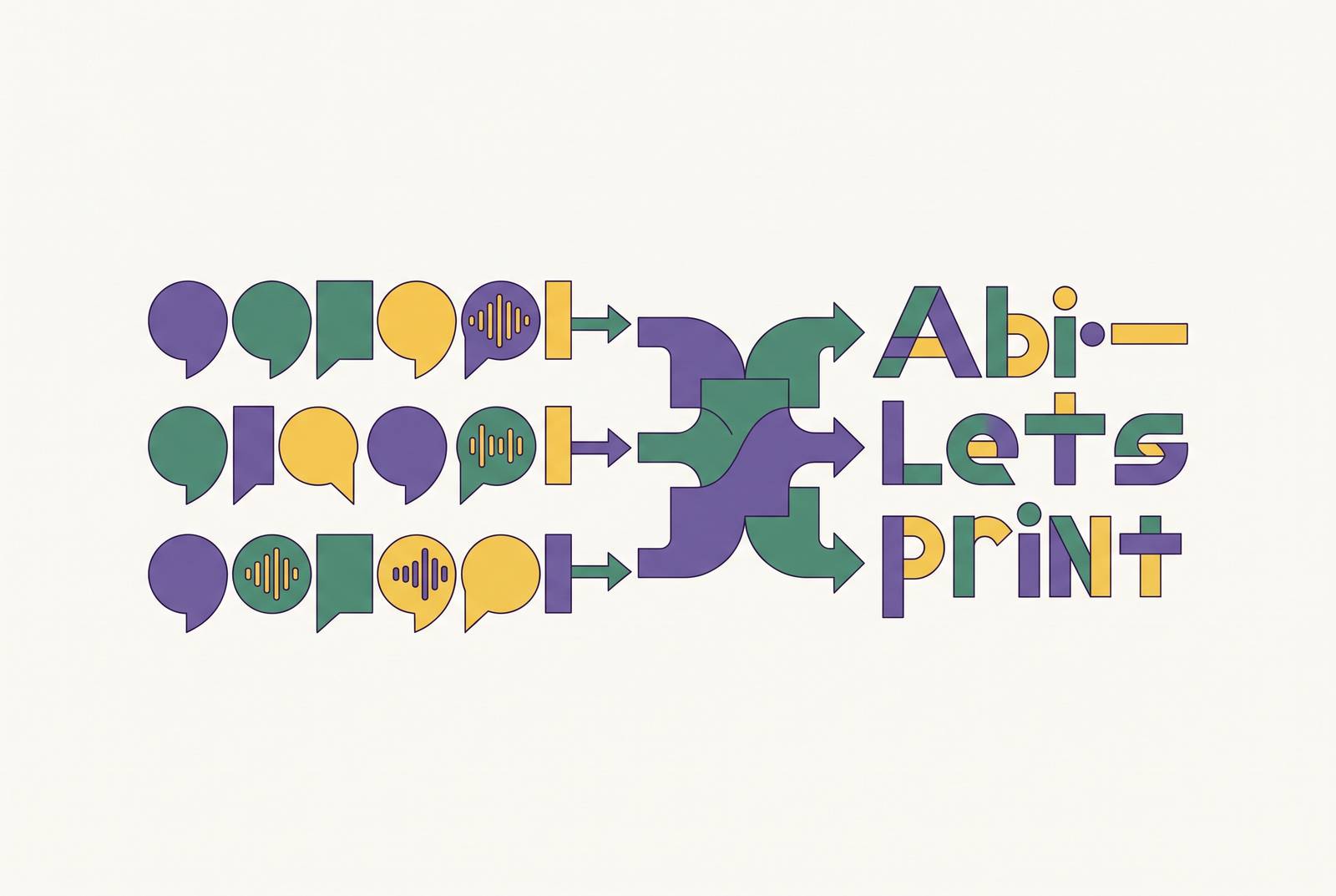
Phonemic awareness does not need to be mastered before phonics instruction starts. That is the finding from recent literacy research, and it contradicts what a lot of classrooms and home programs have been doing for years. The two skills develop together, feed each other, and work best when taught side by side rather than in sequence.
Get the definitions straight first, because the confusion starts here. Phonemic awareness, or PA, is the ability to hear and manipulate individual sounds in spoken words. It is purely auditory: no letters, no print, nothing on a page. Phonics is what happens when those sounds get connected to letters and letter patterns; it is the alphabetic principle put into action. Both can look like "letter and sound work" to a parent watching from across the room, but they are separate activities, and treating them as interchangeable is where a lot of the trouble starts.
Researchers like David Kilpatrick, Louisa Moats, and Lucy Hart Paulson have spent careers documenting what PA actually does. It predicts later decoding, spelling, and word recognition. Children with strong phonemic awareness build what's called orthographic mapping, which is the process of storing words in memory so they can be read automatically instead of sounded out every time. That is a genuine mechanical lever in reading development.
Where the "PA first" sequencing idea came from
Blame a good document for a bad reading. The National Reading Panel published its report in 2000, identifying five pillars of reading instruction: phonemic awareness, phonics, fluency, vocabulary, comprehension. Listed in that order.
Somewhere along the way, that list got treated as a sequence. Educators and program designers read it as: master phoneme awareness first, then move on to phonics. But the panelists never proposed that order as instructional sequencing, and the research reviews that built the report never tested or endorsed it either. The ordering was presentational. Somebody had to put the five items in some order on a page, and PA happened to go first.
This matters because it is a case of a rigorous, well-researched document getting misread at scale, and the misreading picking up institutional weight simply by being repeated often enough. The practical fallout: kindergarten and first-grade classrooms spending large chunks of the day on oral-only PA games, no letters or print in sight, holding back the print-based work kids actually need. The research supports early letter-sound integration; the misreading of the panel's list is what produced the delay.
What the 2024 research actually shows about teaching PA and phonics together
A meta-analysis published in January 2024 in Scientific Studies of Readinggets right to the point: teaching phonics and phonemic awareness at the same time beats teaching them separately. Devin Kearns, one of the researchers involved in this line of work, put it plainly: "We can teach phonics and phonemic awareness at once."
There's a term for this now. Nell K. Duke, Julia B. Lindsey, and Crystal N. Wise call it "instructional simultaneity" in the Handbook on the Science of Early Literacy. The idea rests on a fairly intuitive mechanism once you see it: a child who already recognizes some letters gets more out of phonemic awareness practice when those letters are sitting right in front of them during the exercise. Decades of research point this direction, yet plenty of programs still keep the two skills in separate boxes, on separate days, sometimes taught by different activities entirely.
Here's the part that trips people up. Adding a letter to a PA exercise is not the same as teaching phonics in the traditional sense. The target skill is still auditory, still segmenting and blending sounds. The letter sitting there on the table is doing something quieter: some researchers describe it as almost a subliminal introduction to phonics, present without being the focus. So where exactly is the line between PA and phonics once you start integrating them this way?
There isn't a clean one. The two skills blur together at this level of instruction, and trying to force a bright line between them may be exactly the kind of thinking that led to the "PA first" myth in the first place.
The sequence that does matter: the developmental order within PA itself
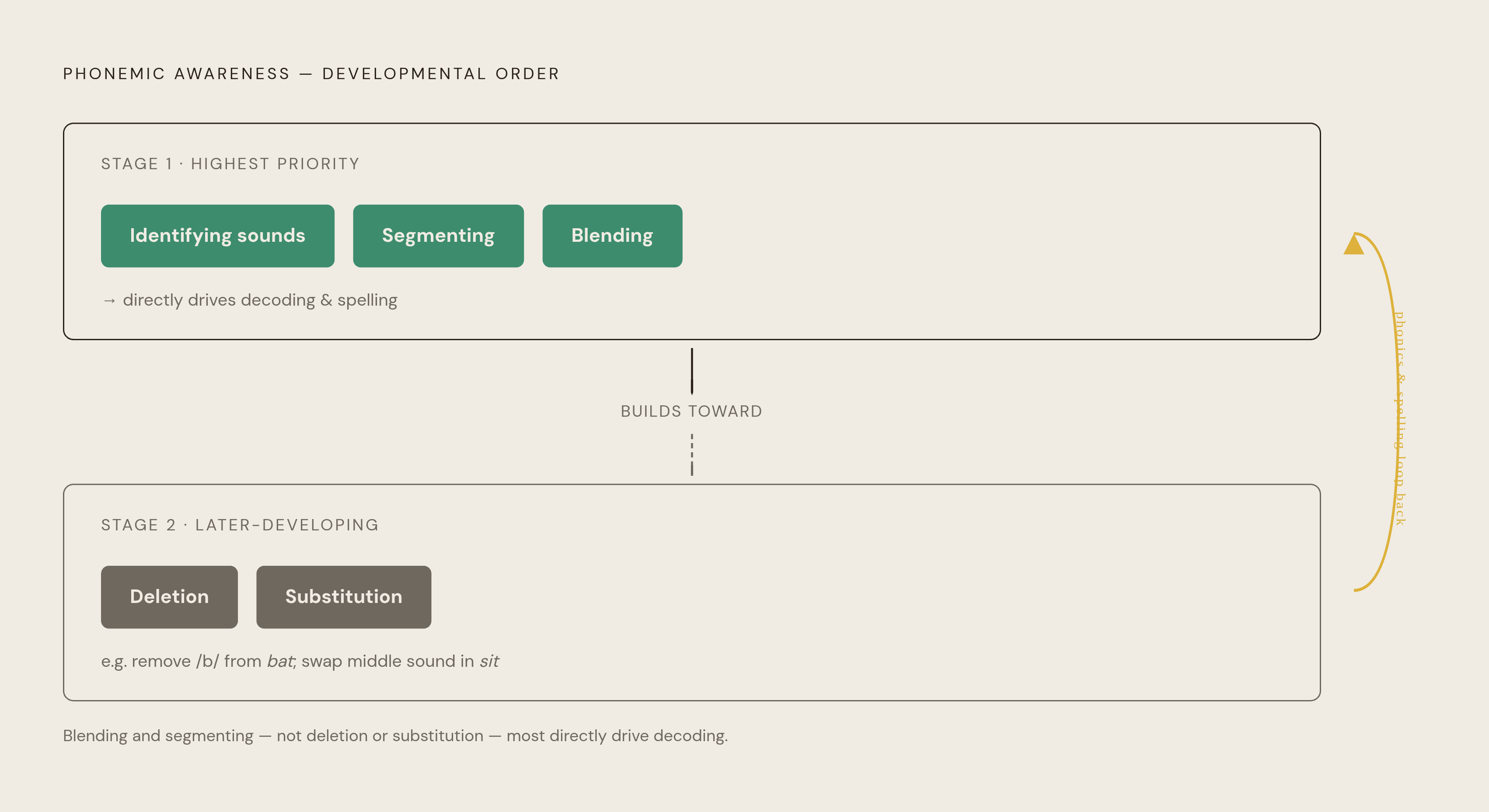
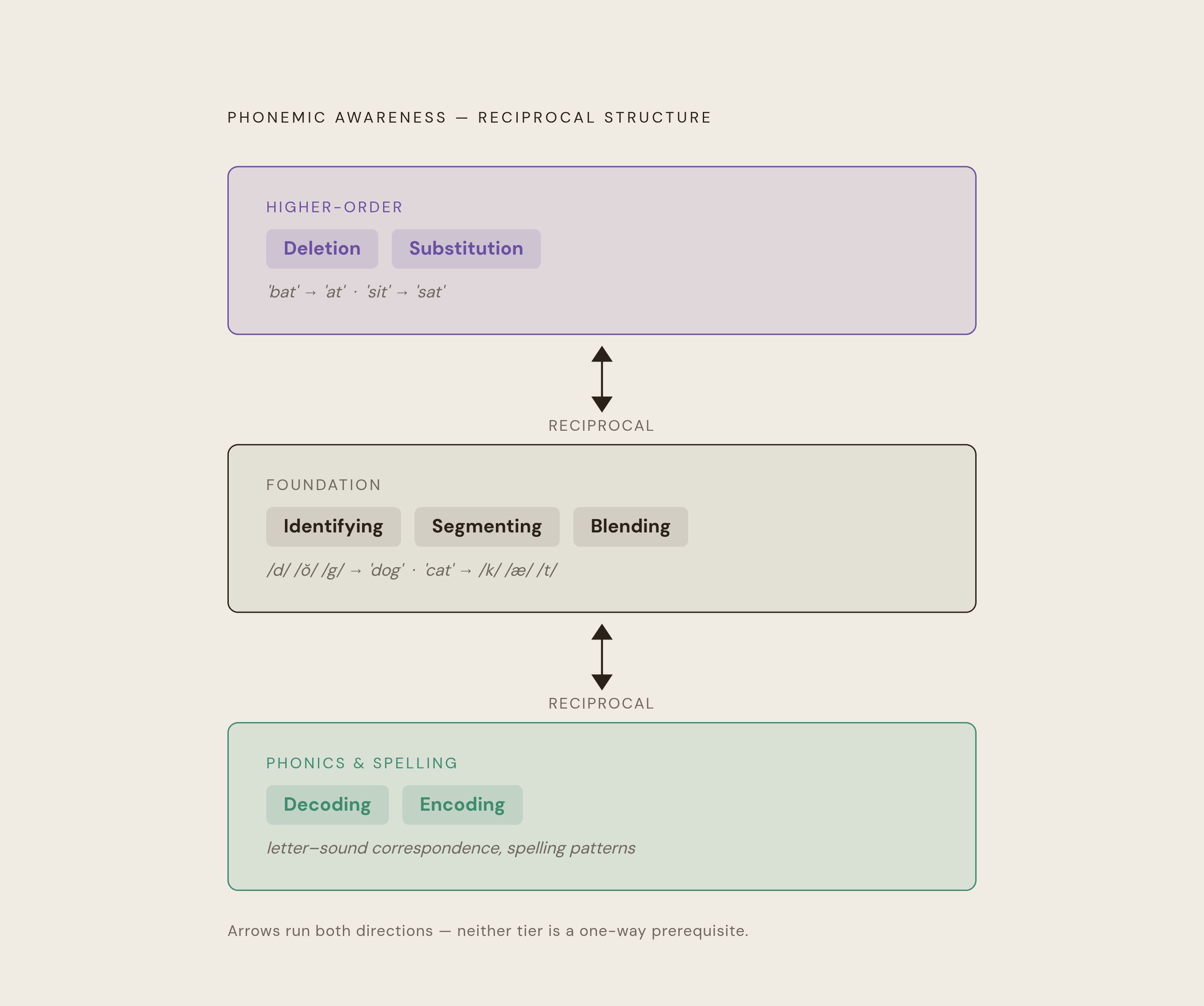
PA does have internal structure, just not the structure most people assume.
Early-developing skills come first: identifying sounds in words, segmenting a word into its individual phonemes, blending those phonemes back into a whole word. These form the foundation. Later, children develop phoneme deletion and substitution, which is higher-order work: take the "b" off "bat" and identify what's left, swap the middle sound in "sit" for something else. Research treats these manipulation skills as downstream developments rather than gatekeepers standing in front of phonics instruction.
Blending and segmenting deserve the lion's share of instructional attention, because they carry the strongest connection to actual decoding outcomes. If a teacher or a parent only has time for one type of PA activity, this is it.
And the relationship runs both directions, which is worth sitting with for a second. Strong PA supports phonics and spelling development. But phonics and spelling practice also loop back and strengthen the more advanced PA skills, the deletion and substitution work. The relationship is reciprocal. So the right question for a parent isn't "has my child finished phonemic awareness yet?" It's whether those auditory skills are growing alongside the letter-sound work, in tandem, feeding each other as they go.
How much PA instruction is actually enough
A separate 2024 meta-analysis, also focused on early phonemic awareness instruction, tried to answer a very practical question: how many minutes of PA instruction should a kindergarten or first-grade classroom actually run?
The honest answer is that the evidence base is thinner than anyone would like. Most classroom studies never tracked instructional minutes with any precision, which left researchers working from a small handful of high-quality studies, nearly all of them intervention research with struggling readers rather than typical classrooms. That's a real limitation, and it's worth naming rather than papering over.
Still, a pattern shows up. PA routines work best when they're short and tightly focused. Small-group activities running under five minutes in kindergarten, and around five minutes in first grade and beyond, show up as sufficient in the research reviewed, well short of a daily block carved out of the morning schedule.
That has a direct implication for any program still running long oral-only PA sessions: it's spending more time than the evidence justifies, and it's spending that time in exactly the isolated, letter-free format the newer research argues against. More PA minutes isn't automatically better. Quality of integration with print outweighs raw volume, and that's a hard thing for a "more is better" instinct to accept.
Why reading proficiency numbers suggest the old approach isn't working
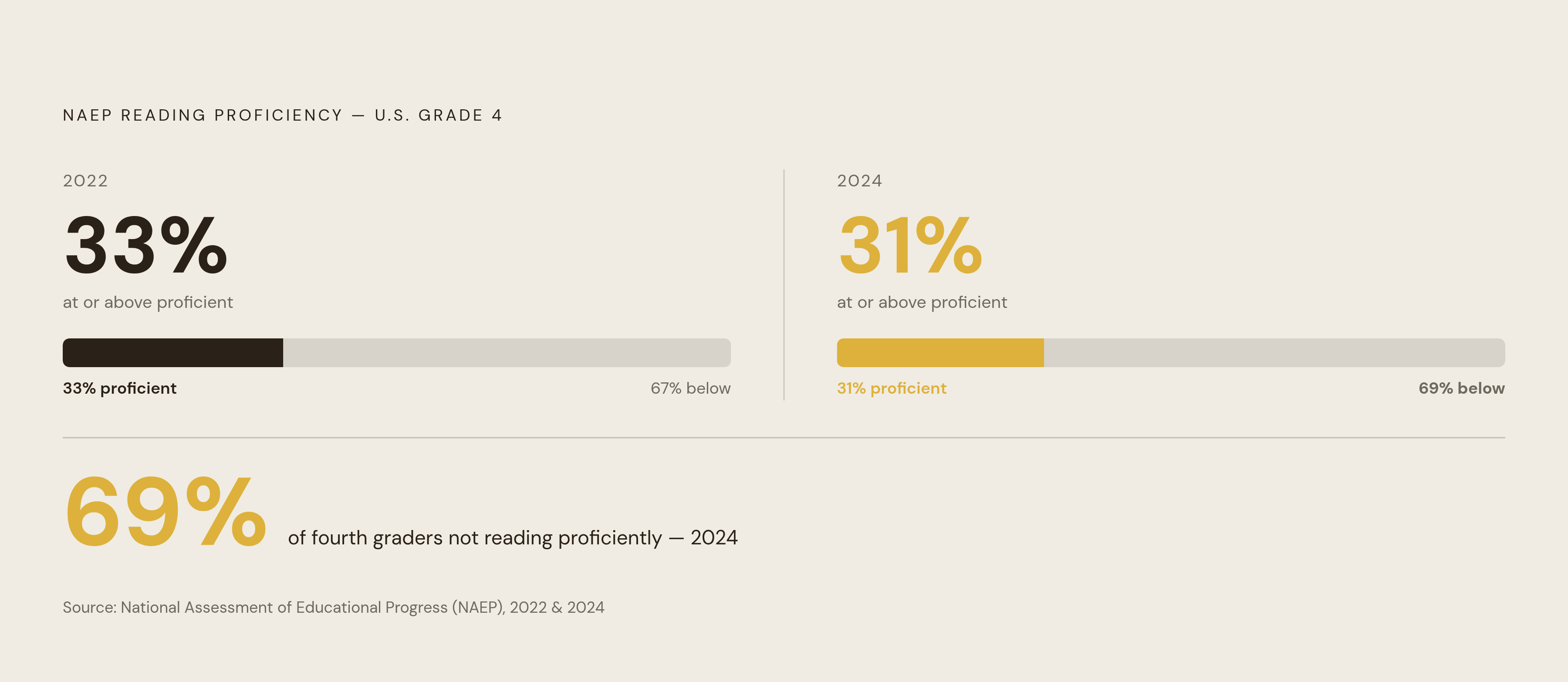
Look at where fourth-grade reading scores actually sit. In 2024, 31% of U.S. fourth graders scored at or above the NAEP Proficient level in reading, down from 33% in 2022. That's not a sudden collapse. It's a slow, persistent shortfall, and it's happening after decades in which phonemic awareness instruction has been a fixture in American classrooms.
So what does that tell us? The isolation appears to be the mistake: teaching PA as a stand-alone unit, disconnected from print, pushed the actual decoding work further down the calendar than it needed to be.
Synthetic phonics, the method of teaching kids to translate letters into sounds and blend those sounds into words, has measurably raised reading outcomes where schools have adopted it seriously. But a meaningful share of children still struggle even where synthetic phonics is in place, which is itself a clue. Neither phonemic awareness alone nor phonics alone gets the job done. They need each other.
The Simple View of Reading, a framework from Gough and Tunmer dating to 1986, lays out why. Reading comprehension is the product of word recognition and language comprehension, both required, neither sufficient alone. PA and phonics are both working the word-recognition side of that equation. Skipping one, or sequencing them so one waits for the other to finish, leaves that side of the equation weaker than it needs to be.
What this means for how parents read early literacy programs and apps
Parents shopping for early literacy programs run into a lot of marketing built around "phonemic awareness foundations," and the research above hands them a genuinely useful question to ask: does this program connect sounds to letters, or does it hold letters back until some later stage?
A red flag worth watching for: weeks or months of oral-only sound games before a single letter shows up. The simultaneity research suggests this delays reading development rather than preparing for it, no matter how polished the game design looks.
A green flag runs the other way: PA activities that put letters in front of the child while the auditory work happens, explicit and named practice in blending and segmenting, phonics instruction running in parallel from early on rather than waiting its turn.
A 2025 meta-analysis found that educational technology can genuinely improve decoding, language comprehension, and reading skills in elementary-age kids. The catch is that the benefit shows up specifically in apps built on phonics and structured literacy principles, not in passive video content or games with no instructional backbone. Worth pausing on that distinction, because "educational app" covers an enormous range of actual design quality.
And design quality varies more than star ratings suggest. Research from Kucirkova and colleagues in 2023 looked at top-rated educational apps and found that most offered minimal learning value, with roughly half showing low-quality design when measured against structured literacy criteria. A five-star App Store rating reflects how much kids enjoyed tapping the screen, which says little about whether the app is teaching reading the way the current research says reading gets taught.
What should a parent actually look for? Explicit, systematic phonics instruction, stated as such rather than implied. PA activities that use letter tiles, written letters, or connected print, not sound games floating free of any visual anchor. Blending and segmenting named and practiced as specific skills. And ideally, a curriculum that says outright it is grounded in the Science of Reading, since that phrase has become a reasonably reliable signal, though it's worth checking the specifics rather than taking the label on faith.
What integrated PA and phonics instruction looks like in practice, for families at home
None of this requires special equipment or a teaching degree. The simultaneity principle translates into something fairly simple at the kitchen table: when practicing a sound, show the letter that makes it. When reading a word together, tap out its phonemes on the table or on fingers.
If a parent has time for exactly one activity, make it blending and segmenting. Stretching a word apart into its sounds, then pushing it back together, whether or not letter cards are sitting there in view, is the single highest-value thing to practice regularly.
Duration doesn't need to be intimidating. The research points to five focused minutes in kindergarten as meaningful, provided it's consistent and connected to letters rather than floating in pure sound. Consistency and connection matter more than length.
For kids who are behind or struggling, the dosage research drawn from intervention studies suggests more frequent sessions, not necessarily longer ones. Connecting letters to sounds from the very start matters even more for these children, since they have less margin for instruction that wanders off into isolated sound play without an anchor in print.
There's a reassuring loop buried in all this for parents who worry they're not doing enough. Progress in phonics reinforces phonemic awareness. A child learning to spell and decode is, at the same time, strengthening the auditory skills underneath that work. Growth on one front feeds the other, so forward motion anywhere in this system counts for something.
For a child who resists sitting down for "phonics time," the fix is usually to stop calling it that. Clap out syllables while looking at word cards. Build words with letter tiles like it's a small construction project. Read decodable books aloud together. The research suggests the line between "sound time" and "letter time" barely exists anyway, so the child never needs to draw it.