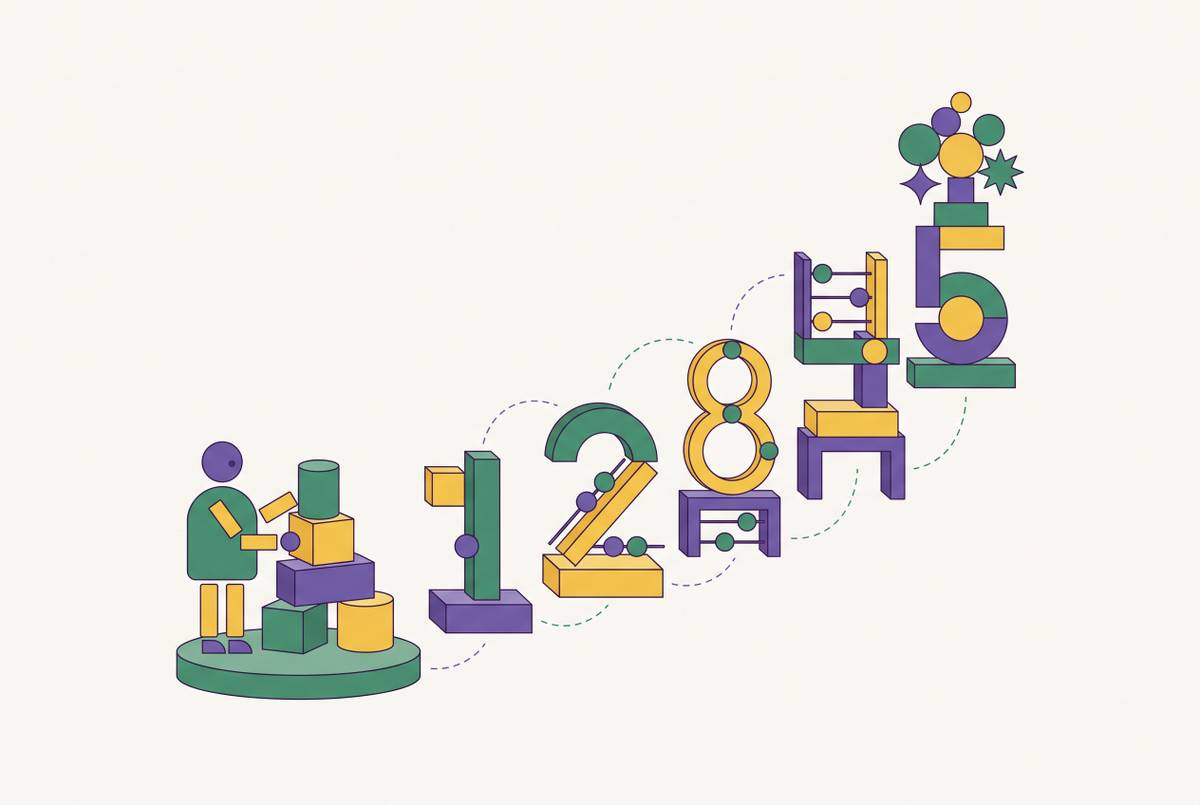
Number Sense Development in Preschool and Kindergarten
Number sense is a sequence of nine distinct skills that must develop in order, not a single ability.
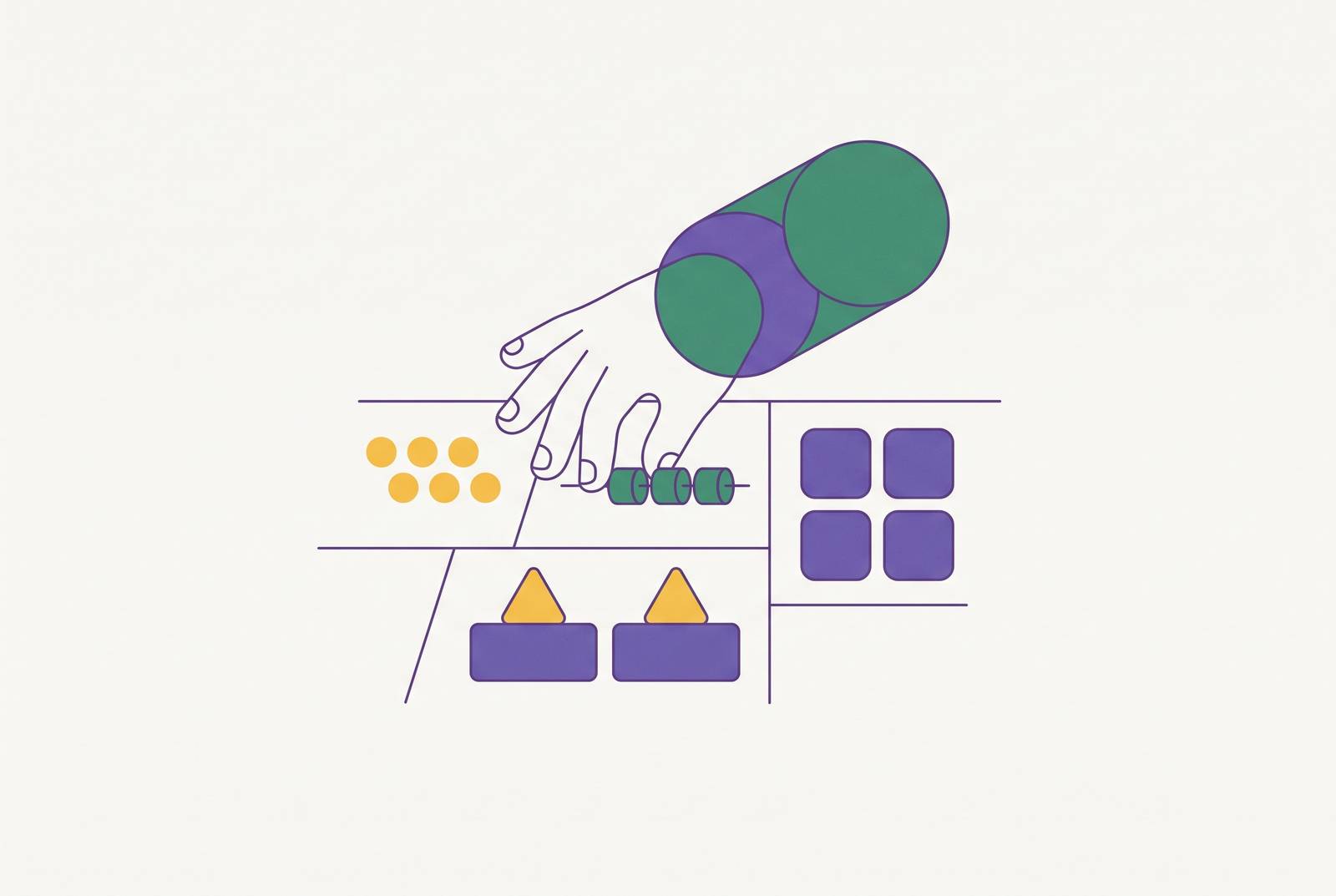
Number sense in preschool and kindergarten is a bundle of several distinct skills. It's a set of interlocking concepts, subitizing, cardinality, part-part-whole reasoning, and several others, that build on each other in a specific order. Miss that order, and instruction ends up targeting the wrong thing at the wrong time. Get it right, and a parent or teacher can tell almost exactly what a child needs next.
The confusion starts with the phrase itself. "Number sense" gets used casually to mean a kid is "good with numbers," a vague compliment with no operational meaning. Researchers mean something far more specific. The National Research Council frames it as three connected strands: number, number relations, and number operations. Work by Jordan, Devlin, and Botello (2022, in Current Opinion in Behavioral Sciences) confirms that the strands are meaningfully distinct rather than collapsing into a single trait. They reinforce each other while staying distinct, which is exactly why treating "number sense" as one lump skill misses what's actually happening in a child's head.
Underneath those three strands sit nine named components: subitizing, magnitude, counting, one-to-one correspondence, cardinality, hierarchical inclusion, part-part-whole, compensation, and unitizing. Subitizing is recognizing a small quantity instantly, without counting, across a limited range of small set sizes. Conceptual subitizing stretches this further, letting a child see six as "four and two" rather than counting one by one. Cardinality is the understanding that the last number said in a count names the total size of the group, not just the last item touched. Hierarchical inclusion is the recognition that each number in the sequence is exactly one more than the last, so the count is ordered and predictable, not arbitrary. Part-part-whole is the ability to break a number into pieces and put it back together, which is the conceptual root of every addition and subtraction problem a child will ever face. One-to-one correspondence means each object gets counted once and only once. Conservation of number means a child understands that spreading ten blocks into a wide row instead of a tight pile doesn't change the count.
Two other factors cut across all nine components. First is representation: nonsymbolic, meaning objects and pictures, versus symbolic, meaning spoken number words and written numerals. Second is set size. A concept that's easy with three objects can fall apart with eight. Both factors change how hard a task feels to a child at any given moment, and both need to be accounted for in how instruction gets built.
This definition also rules a few things out. Reciting "one, two, three, four, five" in order is not number sense. Naming a written numeral on a flashcard is not number sense. Both can be practiced and mastered without any real grasp of quantity underneath them, which is precisely the gap the NRC's framework was built to expose. Traditional early childhood curricula often treated math as incidental, something that showed up during calendar time or snack count, rather than as a subject deserving direct, planned instruction. The NRC's framework was a direct challenge to that approach.
How these components build on each other in a predictable sequence
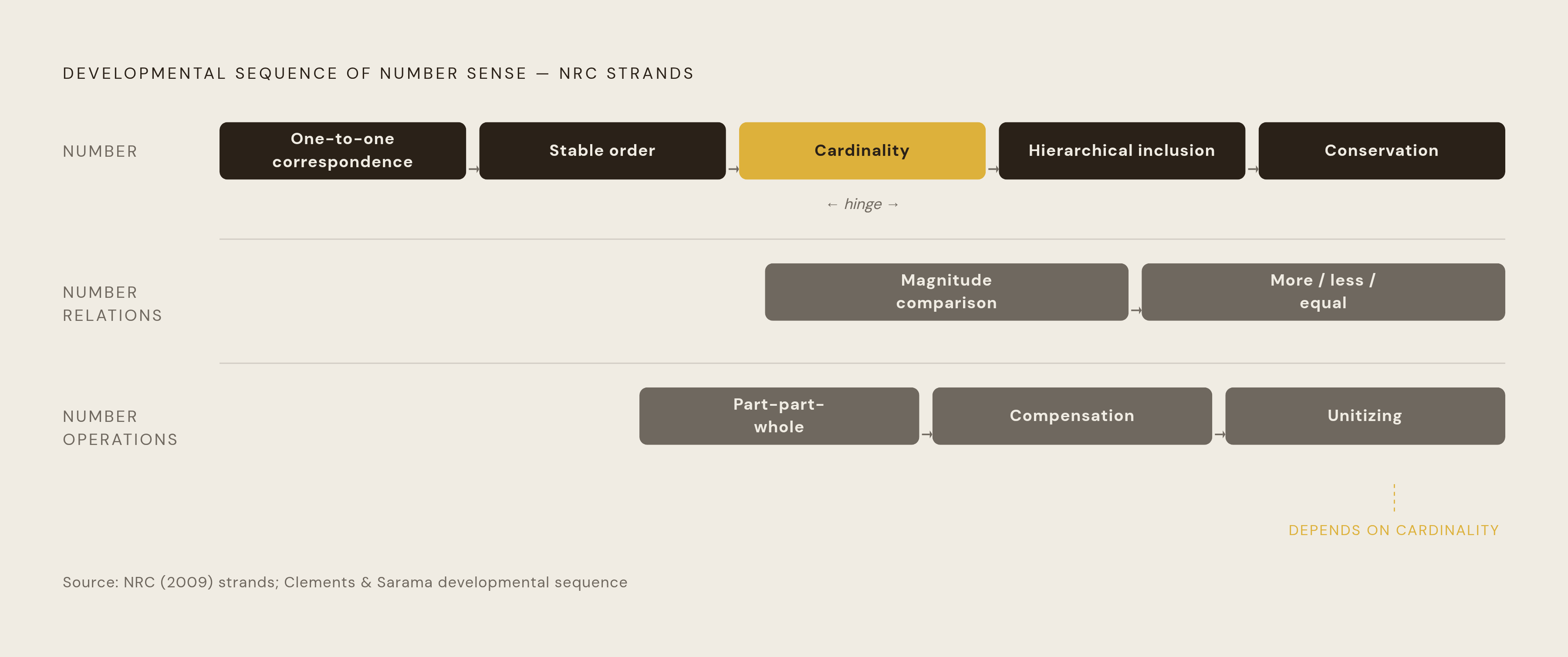
Order matters here, and it's not negotiable. A child who hasn't grasped cardinality isn't ready for part-part-whole work, no matter how much practice they get. A child who can't yet subitize small sets has no foundation for conceptual subitizing of larger ones.
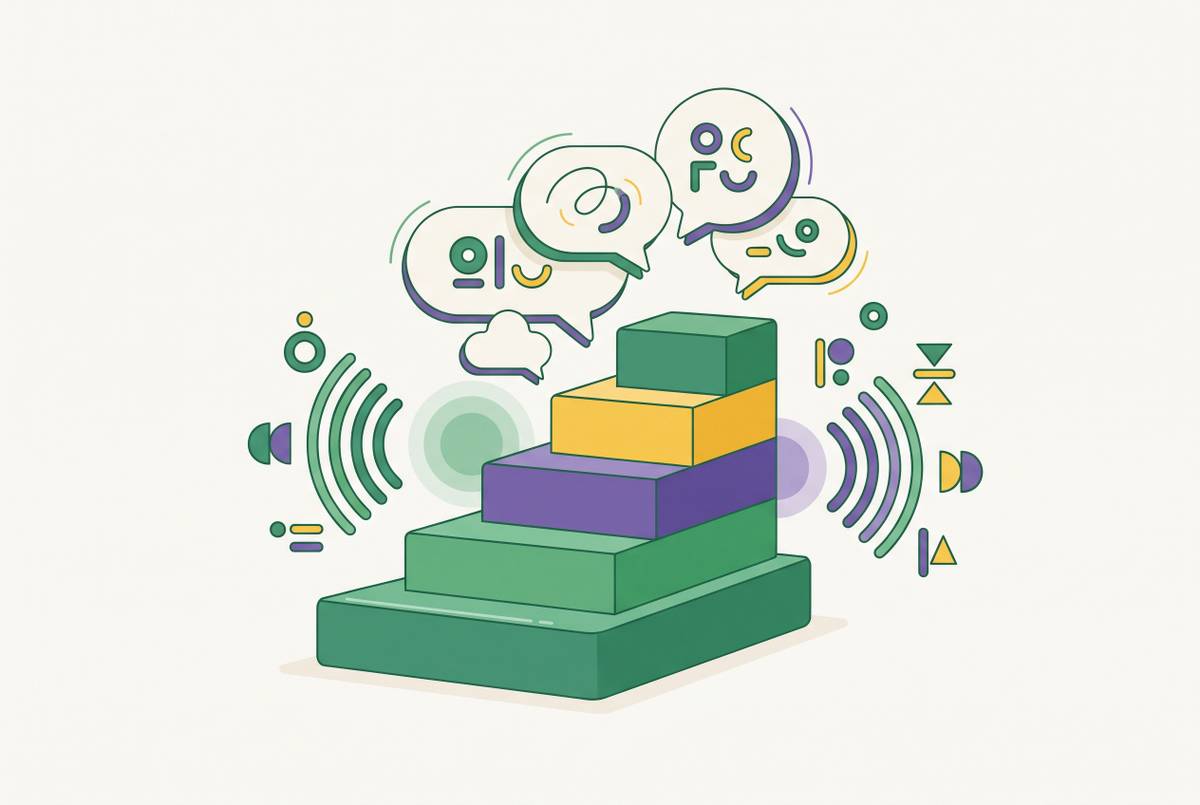
Inside the number strand, the sequence runs one-to-one correspondence, then the stable order principle (knowing the count sequence is fixed), then cardinality. These are the core counting principles, and they need to be solid before magnitude comparisons mean anything. Once cardinality clicks, meaning a child truly understands that the last number named is the total, they can start comparing sets: more than, less than, equal to. That's the entry point into number relations, and it's also roughly when a mental number line starts forming.
From there, number relations feed number operations. Part-part-whole understanding is what lets a child reason about a transformation, adding three more, taking two away, instead of re-counting the whole set from one every single time. Jordan and colleagues tracked 411 middle- and low-income kindergartners across four time points in a 2006 study published in Child Development, and found growth wasn't uniform. Three distinct trajectory classes emerged. The presence of three distinct trajectory classes confirms the sequence isn't just theoretical, differentiated growth patterns are observable in real longitudinal data.
Within each strand, nonsymbolic representation comes before symbolic. Children reason about quantity with real objects before they can do the same work with numerals on a page. Jump to symbols too early, and a necessary step gets skipped, leaving a shaky foundation underneath the abstraction. Hierarchical inclusion and conservation tend to arrive later in the sequence than people expect. Plenty of children pass cardinality tasks well before they fully grasp that rearranging a set of objects doesn't change how many there are.
The payoff of building this sequence correctly shows up clearly with doubles. A child who has genuinely internalized part-part-whole reasoning can look at 5+6 and reason: that's one more than 5+5, so it's 11. No re-counting required. Fluency here comes from repeated, meaningful practice rather than memorized flashcards. It's the product of structure, built one component at a time.
Why what happens before kindergarten sets the trajectory for years afterward
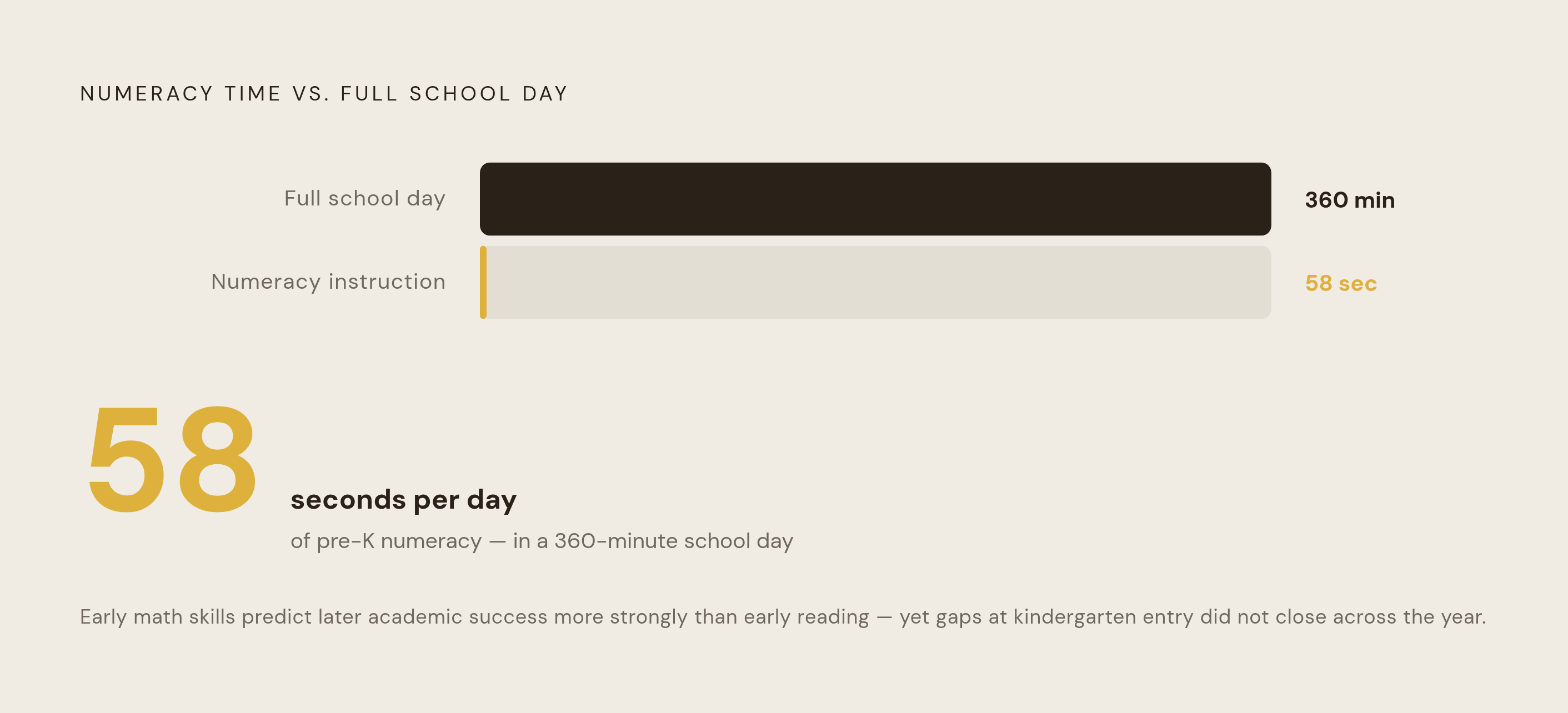
Research from the Marsico Institute at the University of Denver found that pre-K children spend an average of just 58 seconds a day on numeracy skills. Fifty-eight seconds, in a full school day, on the exact window when foundational number concepts are most malleable.
That absence has consequences that don't fade. Early number sense predicts later math achievement even after controlling for cognitive ability, behavior, and demographic background, a finding that holds across multiple lines of research, with effects documented well beyond the early grades. Jordan, Kaplan, Nabors Oláh, and Locuniak (2006) found low-income kindergartners performed significantly worse than middle-income peers on every number sense task measured, by the end of kindergarten. Both groups progressed at roughly the same rate across the year. The gap didn't widen, but it also didn't close, because it was already there at entry and nothing in typical instruction addressed it directly.
One exception stood out. On story problems specifically, the low-income group progressed more slowly than their peers. But when the same problems were presented nonverbally, with visual referents instead of spoken language, the two groups made comparable progress. That detail carries real weight. It's a direct instructional lesson: language load, not math ability, was driving part of the gap.
Individual differences in number sense show up before formal schooling starts, and research indicates that substantial individual differences in number sense are already evident during the preschool years, ages three to six. That's the exact window where the Marsico Institute found 58 seconds a day of instruction. The consequence cascades forward: a child who leaves preschool without solid cardinality and part-part-whole understanding doesn't just struggle with kindergarten arithmetic. Jordan and colleagues traced that same weak foundation forward to difficulties with fractions and algebra, years later.
The Centre for Independent Studies made this explicit in its 2025 report, "Early Numbers, Big Ideas" (Jordan & Dyson, July 2025): early math skills predict later academic success more strongly than early reading skills do. That should reorder how anyone thinks about the preschool years. Gaps in counting, number recognition, and basic arithmetic get harder and more expensive to fix the longer they sit unaddressed. Early intervention extends well beyond kinder. It's cheaper and more effective than remediation years down the line.
What young children bring to number learning before any instruction begins
Children don't arrive at this blank. The Approximate Number System, or ANS, gives infants a nonverbal, intuitive sense of relative quantity well before any formal instruction begins. Even very young children can distinguish between sets of different sizes without counting or knowing number words.
The ANS is nonsymbolic by nature. It supports rough comparisons, more versus less, but not exact counts. The developmental bridge from that intuitive system to precise symbolic number is the cardinal principle, and the relationship between the two remains an active area of research.
Executive function plays its own role, and it's a bigger one than most people assume. A meta-analysis of Chinese preschoolers found a correlation of 0.496 between executive function and math competence overall, with working memory carrying the strongest individual link at 0.432, ahead of cognitive flexibility at 0.370 and inhibitory control at 0.347. That has a direct classroom translation: a child who can't hold a counting sequence in working memory while simultaneously tracking which objects have already been touched is going to struggle with one-to-one correspondence, no matter how many times they've heard "one, two, three" recited aloud.
None of this arrives evenly across children. Substantial individual differences in number sense exist before any instruction happens, which means treating a preschool classroom as a uniform group is a mistake from day one. Palabiyik and Tertemiz (2024, in the International Online Journal of Primary Education) studied 114 kindergartners and found something worth sitting with: flexible, number-sense-based reasoning was not well developed, even where procedural skills had been practiced. Counting gets taught. Flexible reasoning doesn't automatically follow just because counting was covered.
How the home environment shapes number sense before a child enters a classroom
The home numeracy environment covers two kinds of activity: direct engagement, like counting games and number storybooks, and indirect engagement, like measuring flour for a recipe or comparing prices at a store. Both predict how a child's number sense develops, but neither works through sheer repetition alone.
The real mechanism is language. Research indicates that talking about math during these activities, not just doing them, is what mediates the link between home engagement and a child's actual number skills. Measuring cups of rice without ever saying "half" or "more than" strips most of the developmental value out of the activity. Research has found home numeracy to be a meaningful predictor of early math skills alongside other parent and child variables, with nonsymbolic magnitude comparison emerging as a notable individual predictor.
The effects don't stay contained to math either. A Finnish longitudinal study following 265 children from age 2.5 to 6.5 found early numeracy exposure improved not just later math skills but reading skills too, both within-domain and across domains. That tracks with how often reading and math difficulties co-occur, estimated somewhere between 30 and 70% of cases, since the two domains draw on overlapping cognitive foundations.
Parents themselves are part of this equation, and not always in a helpful direction. Math anxiety affects roughly 20% of the general population, and it shows up in children as young as five. When a parent transmits discomfort or dread around math during a shared activity, that undercuts the very benefit the activity was supposed to provide. What seems to counter this is autonomy-supportive parenting: taking the child's perspective, treating them as capable of reasoning it out rather than correcting from above. Research has linked this approach to better math outcomes.
There's a simple, practical takeaway buried in all of this. Naming an activity as math, out loud, matters as much as doing the activity itself. A child who hears "we're doing math right now" while sorting laundry by color starts to see math as something familiar, embedded in daily life, rather than a foreign subject that only shows up at a desk.
What explicit, structured instruction looks like at each stage of number sense development
The NRC's finding here is direct: number sense is malleable. Most preschoolers can build these competencies through instruction. The real question isn't whether instruction works, it's what kind actually does the job.
Discovery learning alone doesn't reliably build these components. Calendar time, rote counting songs, and unstructured play, without explicit, cumulative instruction layered on top, leave conceptual gaps. The Palabiyik and Tertemiz finding on rule-based reasoning is a symptom of exactly this gap: kids taught to count without being taught to reason flexibly about quantity default to rules because that's what got reinforced.
The Concrete → Pictorial → Abstract model, often shortened to CPA, gives a useful organizing structure for what explicit instruction should look like at each stage.
- Concrete: hands on real objects, blocks, snacks, buttons, physical collections that can be touched, moved, and re-grouped.
- Pictorial: representations like ten frames and number paths, bridging the gap between physical manipulation and abstract symbols.
- Abstract: spoken number words and written numerals, introduced only once the first two stages are genuinely solid.
Skipping straight to the abstract stage, the single most common instructional error, produces kids who can recite numerals without understanding what they represent.
Counting collections is a specific practice with real evidence behind it. A capstone study at Northwestern College ran a four-week intervention using counting collections paired with ten frames. Fourteen out of sixteen preschoolers showed measurable growth in matching numerals to quantities and in subitizing. Notably, this was a structured group strategy rather than a narrowly targeted pull-out approach.
Ten frames and number paths function as concrete stand-ins for the number line, and they let a child work on magnitude, sequence, and part-part-whole reasoning all at once, instead of treating each as a separate lesson. Relational language, more than, less than, equal to, doesn't get inferred automatically from counting practice. Research points out these need to be taught explicitly, with consistent vocabulary paired to physical materials every time.
Doubles instruction is where this all pays off concretely. A child who has meaningfully learned 5+5=10 and 6+6=12 can work out 5+6 through reasoning, not memorization. That's the practical demonstration of everything part-part-whole was building toward. And none of it happens through drill alone. Teacher knowledge and curriculum quality determine whether these concepts land, and unstructured "enriched" play, while pleasant, isn't sufficient on its own for children who start out behind. Language remains the constant thread through every stage: naming the math out loud, whether in a classroom or standing at a kitchen counter, is what turns an experience into a durable concept.
How to identify where a child actually is in the sequence, and what to do with that information
Screening a child for number sense is about identifying the specific support they need next. It's a compass. Done well, it tells a teacher or parent exactly which component to focus on next, rather than guessing.
Several tools exist for this purpose. The Screener for Early Number Sense (SENS), developed by Jordan, Klein, and Huang (2024), is criterion-referenced and built for preschool through Year One, covering the full range of components described above. Universal Screeners for Number Sense (USNS) cover kindergarten through sixth grade, and the kindergarten-level interview takes just three to five minutes, low enough burden that a classroom teacher can realistically administer it without disrupting the day. The Early Number Sense Screener, developed in Australia by the Centre for Independent Studies, was piloted with thousands of students in 2025 and is scaling nationally as of 2026. It's group-administered and delivered digitally, built for efficiency at scale rather than one-on-one interviews.
Whatever tool gets used, comprehensive progress monitoring needs to cover several components together: one-to-one correspondence, number identification, subitizing, number writing, and rote counting. No single component in isolation tells the full story. A baseline assessment at the start of the year, matched against the same assessment in spring, gives a real measure of growth across each component, rather than a single pass-or-fail snapshot that says nothing about trajectory.
And growth isn't uniform. That 2006 Jordan study identified three distinct trajectory classes among 411 kindergartners. Knowing which trajectory a child is on changes what kind of support actually helps, not just how much of it gets delivered. A child missing cardinality needs different activities entirely from a child who has cardinality locked in but hasn't yet built part-part-whole reasoning. Generic "more math practice" misses the target almost every time, because it doesn't ask which component is actually weak.
Periodic assessment, even done well, only captures a snapshot. What it can't do is adjust in real time, changing what's taught, how it's taught, and when to move on, within a single session, based on how a child responds moment to moment. That kind of responsiveness is hard to deliver at scale in a classroom with twenty kids and one teacher. It's exactly the gap that AI-powered tools built specifically for young children are starting to fill, offering the one-on-one adaptiveness the research consistently points to as the thing that matters most, at a scale most classrooms and households simply can't reach on their own.
Sources
- Number Sense Growth in Kindergarten: A Longitudinal Investigation of Children at Risk for Mathematics Difficulties | Request PDF
- Early Numbers, Big Ideas. Fostering Number Sense in Young Children - The Centre for Independent Studies
- Core foundations of early mathematics: refining the number sense framework - ScienceDirect
- Improving Preschoolers' Number Sense Using Counting Collections and Ten Frames
- Fostering Early Numeracy in Preschool and Kindergarten | Encyclopedia on Early Childhood Development
- Symbolic Number Abilities Predict Later Approximate Number System Acuity in Preschool Children
- ncbi.nlm.nih.gov
- prek-math-te.stanford.edu