AI vs. Human Tutors for Early Reading Intervention
Research shows AI and human tutors excel at different parts of early reading intervention.
Just 30% of fourth graders are proficient or advanced in reading, according to the latest National Assessment of Educational Progress (NAEP) report. That single number is the reason "reading intervention" has become a bigger conversation than "reading instruction." Once a child falls behind, the question is no longer about curriculum but about delivery: who or what actually sits with that child and closes the gap. AI tutors and human tutors both have a role to play here, but they're not interchangeable, and treating them as competitors misses what the research actually shows about when each one works.
The urgency of early reading intervention and the effect of delivery method on outcomes
NAEP has flagged the post-pandemic decline in reading scores as a problem with consequences that reach past the classroom. Their language is blunt: the drop is "likely to have far-reaching social and economic ramifications." That's not hyperbole about test scores. A child who can't decode fluently by third grade is statistically more likely to struggle across every subject that depends on reading to access it, which is nearly all of them.
Policy has started to catch up. Oklahoma's Strong Readers Act took effect July 1, 2024, mandating science-based reading instruction. At the federal level, one national government. House passed legislation prioritizing the Science of Reading in literacy grant funding. At the federal level, one national government House passed legislation prioritizing the Science of Reading in literacy grant funding, a real, structural move.
But policy has a ceiling. Even a well-funded, well-designed state reading law can't guarantee that every child who's behind gets one-on-one time with someone who notices exactly where they're stuck. Classrooms have one teacher and twenty-five kids. That's the gap parents are actually trying to close when they go looking for a tutor, an app, or both.
Early reading intervention requirements: the Science of Reading baseline
Reading isn't a skill children pick up the way they pick up spoken language. Spoken language is a nearly automatic byproduct of a normal childhood; reading has to be taught, explicitly and in sequence. That's the founding premise of the Science of Reading, a body of research spanning linguistics, cognitive psychology, and education that has increasingly displaced older, looser approaches to literacy teaching.
The Simple View of Reading gives this a formula: R = D × LC. Reading comprehension is the product of decoding and language comprehension. Multiply, not add: a zero in either column tanks the whole equation. A child can sound out every word on a page and still not understand what they read if their language comprehension is weak. And a child with rich vocabulary and background knowledge still can't read if they can't decode the print in front of them.
Scarborough's Reading Rope is the visual that makes this concrete for parents, showing skilled reading as a rope made of many strands twisted together, not a single skill you either have or don't. Word recognition strands (phonological awareness, decoding, sight recognition) braid together with language comprehension strands (background knowledge, vocabulary, language structures, verbal reasoning). Weaken one strand and the rope frays somewhere, even if the rest looks fine.
In practice, that means five components have to get attention: phonemic awareness, phonics, fluency, vocabulary, and comprehension. Missing one component and treating the others as the whole job makes the intervention look productive without actually closing the gap.
What human tutors do that AI currently cannot replicate
Children don't learn from systems. They learn from people, and the emotional register of that relationship shapes how much of the learning sticks. A human tutor watches a child's shoulders tense up before a hard word, hears the exact pitch shift that signals frustration, and adjusts on the spot, slows down, cracks a joke, changes the pacing. No AI system operating today reads a room like that.
That attunement matters most in two places. First, complex reasoning and open-ended feedback: inferential comprehension questions, writing feedback, following a child's idiosyncratic (and sometimes genuinely strange) train of thought to figure out where the reasoning went sideways. Second, language comprehension itself. Cognitive scientist Julie Van Dyke has pointed out that many struggling readers need explicit instruction in language structures, subordinate clauses, and complex syntax, grammar that native speakers use unconsciously but never formally learn. Noticing that a child stumbles specifically on sentences with embedded clauses, and then addressing it conversationally, is something a human teacher is simply better positioned to catch.
There's also the plain mechanics of accountability. A weekly appointment with a real person who remembers the child's name, their favorite book, their bad day last Tuesday, creates a social contract. For a child who actively resists reading, that relationship is often what keeps them showing up at all.
What AI tutors do that human tutors structurally cannot
Flip the lens: AI has structural advantages no human schedule can match. Availability is the big one: AI can run a practice session every single day, with instant feedback, at a time that fits the family's evening instead of a tutor's calendar. Fluency research has been consistent for decades on this point: automatic word recognition comes from repeated exposure, from reading the same words and patterns over and over until they move from effortful decoding into memory. Daily repetition is the mechanism, and daily repetition is exactly what AI delivers without needing to be booked, paid, or rescheduled.
The evidence for this isn't just theoretical. A randomized controlled trial run at Harvard found that students using a GPT-4-based AI tutor showed learning gains of 0.73 to 1.3 standard deviations over students in active in-class learning. That study, a rigorously controlled crossover design involving 194 students, is regarded as a watershed moment in education technology research, precisely because it wasn't a marketing claim, it was a controlled comparison.
The gains were substantial across the measured tasks. Phonics decoding, letter-sound correspondence, and blending sounds into words are rule-based skills with clear right and wrong answers, tasks where an AI system can drill relentlessly and score accurately every time.
There's a quieter advantage too. An AI system doesn't get tired. It doesn't sigh, doesn't glance at the clock, doesn't communicate disappointment when a child gets the same word wrong for the fifth time in a row. For children who already feel embarrassed about falling behind, a tool that never registers frustration removes a layer of social risk that makes practice easier to tolerate.
Where AI falls short in supporting young readers
None of that is a blank check for any AI product with a reading app in its name. The gap between a general-purpose AI system and a purpose-built one is enormous, and it is visible in the numbers. Unsupervised general-purpose AI has shown error rates around 29% on structured problems like statistics, dropping to roughly 13% only after specific error-mitigation techniques are applied. Purpose-built AI tutors with human oversight built into the design have shown hallucination rates near 0.1%, about 5 errors across 3,617 messages in one measured deployment.
That's not a small difference. A tool that occasionally teaches a child something false differs from a tool that essentially doesn't. And the stakes of getting this wrong are higher than they sound: research suggests students are more likely to retain false information they got from an AI system than false information from other sources, likely because the interaction feels authoritative and personalized.
A chatbot repurposed from a general-purpose AI model is not the same category of product as a system built from the ground up around child language development and Science of Reading principles. Parents need to ask whether the tool in front of them was designed for this or adapted for this.
Engagement isn't instruction. A gamified app that keeps a child tapping and swiping for twenty minutes might be pleasant babysitting without doing the actual job. The real question is narrower and less flashy: does the tool explicitly teach decoding, give corrective feedback on oral reading, and adapt based on what the child actually did, or does it just keep them occupied while looking like it's teaching?
A hybrid model in practice
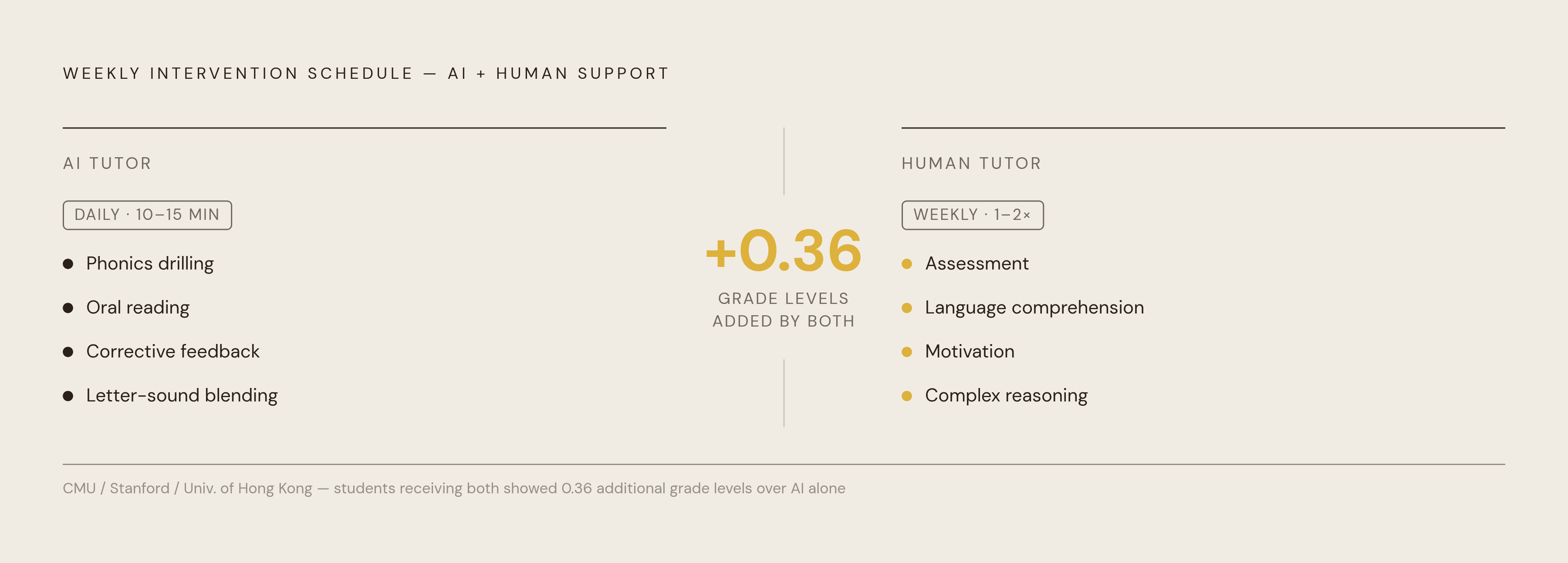
The most direct evidence on this question comes from a year-long study conducted across Carnegie Mellon, Stanford, and the University of Hong Kong. Students who received human tutoring on top of AI tutoring showed an additional 0.36 grade levels of progress compared to AI alone. The two didn't cancel each other out or duplicate effort, they stacked. That's strong evidence that AI and human support are additive tools addressing different parts of the problem, not competing solutions to the same one.
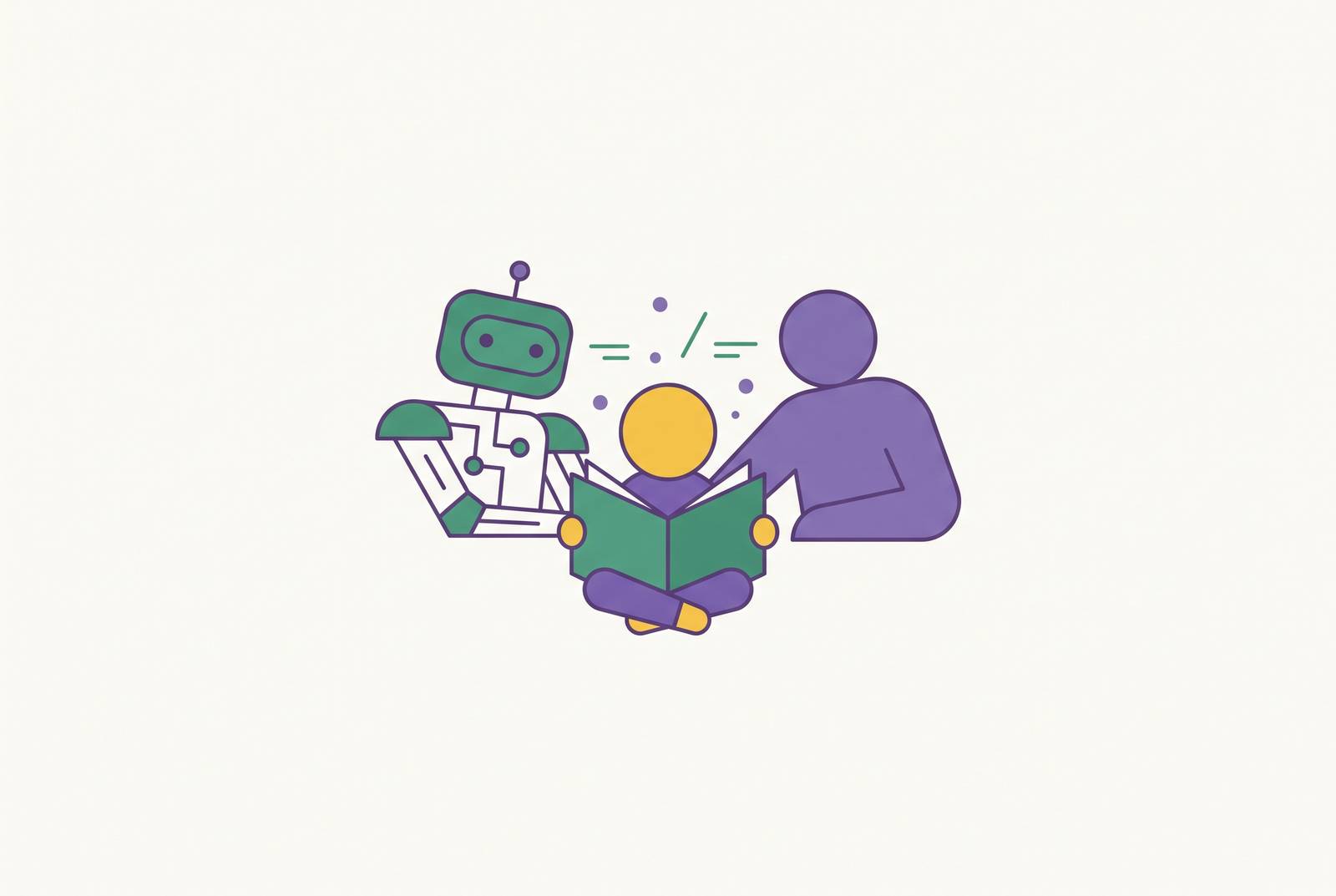
Policy researchers have reached a similar conclusion, describing the optimal setup as a human-AI hybrid where teachers and tutors monitor and guide AI use rather than being replaced by it. Freed from the repetitive work of drilling content over and over, human educators can redirect their time toward activities and projects that build advanced cognitive skills, judgment, synthesis, and argument. The same logic scales down to a kitchen table: a parent or reading specialist doesn't need to run flashcards every night if an AI tool is already doing that reliably.
Survey data backs the direction, not the abolition, of human tutoring: 78% of education experts say AI will augment, not replace, human tutors.
Translated into an actual weekly schedule for a struggling early reader, hybrid looks fairly simple. AI handles the short, daily grind: phonics practice and oral reading feedback, ten to fifteen minutes, low-stakes, consistent. A human tutor or reading specialist handles the weekly or biweekly session that covers assessment, language comprehension work, and the harder job of keeping a discouraged kid motivated.
Criteria for an AI reading tool alongside human support
Not every AI reading product deserves a slot in that daily practice window. A handful of features separate the tools that move the needle from the ones that just occupy screen time.
Look for real-time oral reading with corrective feedback, beyond multiple-choice comprehension quizzes. Look for an explicit, sequenced phonics curriculum grounded in the Science of Reading, not vague "reading games." The difficulty should adapt based on what the child actually did in the last session, reflecting performance rather than following a fixed schedule. Parents should get some visibility into progress. And the tool should be age-appropriate in its design and interaction style, built for six- and seven-year-olds rather than adapted downward from something built for adults.
Another filter is whether the tool ever relies on guessing from pictures or context clues instead of actually decoding the word. That approach, often called three-cueing, is exactly what the Science of Reading research has moved away from, and a tool that still leans on it is teaching a workaround instead of the skill itself.
Tools worth this kind of scrutiny also tend to support English language learners who already have some baseline English, since phoneme-level feedback depends on the learner having some existing sound-letter foundation to build from.
Matching the intervention to what your child needs
The right combination of AI and human support depends less on the product and more on what's actually going wrong for that specific child. Four situations come up constantly, and they call for different mixes.
A child who's behind specifically in decoding and phonics needs systematic, daily, explicit practice with immediate corrective feedback, which is precisely the strength of a well-built AI tool with real oral reading recognition. A human tutor still adds value here, mostly on the motivation side and on language comprehension work that a phonics app was never built to cover.
A child who resists reading or feels shame about being behind is often better served starting with AI, not instead of a human, but as an entry point. The low-stakes, non-judgmental quality of a well-designed AI session can lower the anxiety enough that daily practice actually happens. Human warmth still needs to anchor the bigger picture; AI just removes friction from the daily grind.
A child with suspected or diagnosed dyslexia is a different case entirely. A 2025 review published in Brain Sciences found encouraging results for technology-assisted practice with this population, but these children generally need formal assessment and a coordinated intervention plan from a specialist. AI can support consistent practice between sessions. It shouldn't be mistaken for the assessment itself.
And for a child who's already on track, where parents just want to accelerate progress, AI tools are arguably at their best. No waiting on classroom pacing, no scheduling around a tutor's calendar, just consistent daily sessions that compound month over month.
Effectiveness varies by learner stage and by the specific adaptive engine behind the tool, which is a reason to be selective about which AI product a family uses, not a reason to write off the category.
Kindergarten deserves specific mention here. Early numeracy tends to show its fastest growth in kindergarten, with the growth rate slowing in first grade, and there is reason to think early literacy windows follow a similar pattern. That window matters. Whatever combination of AI, tutoring, or parent-led practice a family lands on, starting it early counts for more than getting every detail of the tool selection perfect.
None of this is really about finding a perfect product. It's about making sure a struggling reader gets enough explicit, responsive, individualized practice to close the gap before it widens into something harder to fix in third or fourth grade. The research, across the Harvard trial and the Carnegie Mellon, Stanford, and University of Hong Kong hybrid study point in the same direction from complementary angles: a well-designed AI tool handling daily practice, paired with a human tutor, specialist, or engaged parent handling the relational and cognitively complex work, is what actually closes gaps. Neither one alone does the whole job.