One-on-One Instruction Research and Why Class Size Affects Reading Outcomes
Personalized attention, not class size alone, drives reading achievement gains.
One-on-One Instruction Research and Why Class Size Affects Reading Outcomes.
Why the amount of attention each child receives is the active ingredient in effective reading instruction
Reading instruction works or fails based on one variable more than any other: how much personalized attention a child actually gets during the time someone is teaching them. That is the thesis this piece sets out to prove, and it explains both why tutoring beats classroom instruction and why class size keeps appearing in achievement data.
The 2-sigma finding has been described as a persistent puzzle for education policy, framed not just as an interesting result but as a challenge to replicate that advantage at scale. A two-sigma effect is a substantial improvement. It is the kind of result that, if it could be replicated for every child in a public school system, would close achievement gaps that have persisted for generations. The puzzle Bloom left behind was never "does one-on-one tutoring work." It was "what part of one-on-one tutoring is doing the work, and can it survive being scaled up?" Answering that question requires looking past Bloom's original number and into more recent research that actually opens up the mechanism.
What a recent large-scale experiment reveals about why one-on-one tutoring outperforms even small-group tutoring
The headline result was blunt. One-on-one tutoring was nearly twice as effective as two-on-one tutoring at improving student learning outcomes. Going from one student to two didn't cut the benefit in half, in other words. It erased most of it.
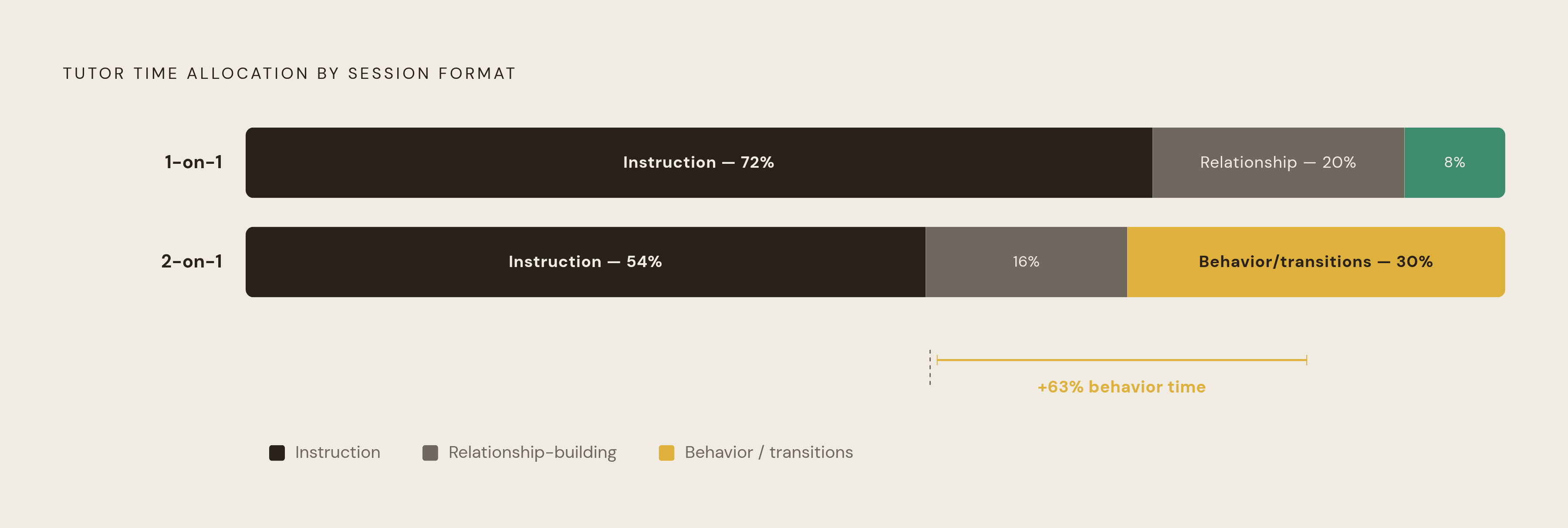
Researchers analysed transcripts from 16,629 tutoring sessions containing more than 3.7 million tutor utterances, using natural language processing and machine learning models to see how tutors were actually spending their time IMSE | institute for multi-sensory education. What they found rules out the obvious explanation. Tutors in both formats devoted similar amounts of time to content instruction and relationship-building, which means the gap in outcomes is not explained by effort or by one group simply covering more curriculum than the other.
What differed was the shape of the attention itself. In two-on-one sessions, tutors constantly switched between addressing both students together and turning to focus on one at a time, and that switching created gaps, moments where a student was waiting rather than engaged, which opened the door to disengagement. The cost of managing two children instead of one appeared directly in the numbers: tutors in two-on-one sessions spent 63% more time managing behavior and transitions, time that came straight out of the instructional minutes a single student would otherwise have gotten. Adding one child to the session didn't divide the tutor's attention in half. It restructured the whole interaction, and the moment-to-moment responsiveness that makes tutoring work got diluted in the process.
The effect-size difference between the one-on-one and two-on-one formats didn't reach statistical significance in this data. The practical signal, backed by the transcript analysis of where time actually went, is strong. But the honest read is that this is a clear directional finding, not an ironclad one, and the piece should treat it that way. In this section, the article introduces Robinson et al.. Robinson et al. (2024) conducted an RCT that compared one-on-one vs. two-on-one virtual early literacy tutoring for students from kindergarten through second grade. The discussion then pivots to the follow-up study that explains why, by Hsieh, Gormley, Robinson, and Loeb of Stanford, EdWorkingPaper 25-1289, published via the Annenberg Institute at Brown University.
How class size in regular classrooms produces similar (though more diluted) dynamics
If moving from one student to two meaningfully erodes personalized attention, the natural next question is what happens in a room with 20, 25, or 30 students and a single teacher. The research on class size has been running for decades, and the consensus that has emerged from it is narrower than either side of the policy debate tends to admit. Smaller classes produce a small but statistically significant benefit for reading achievement, according to the meta-analytic research landscape indexed by outlets including Nature and the Campbell Collaboration, though effects on math achievement are less consistent across studies. Critics of class-size reduction as a policy lever have a fair point here: the Campbell Collaboration's own review found, at best, a small effect on reading achievement, and argued that other interventions might deliver more improvement per dollar spent.
Where the evidence gets more specific, it starts to look a lot like the tutoring data. Bigger reductions matter more than small ones.
The mechanism behind these numbers loops directly back to what the tutoring transcripts showed. Smaller classes give teachers more room for individual attention, more room to give personalized feedback, and more room to manage behavior, the exact same variables that the Hsieh et al. analysis identified. Class-size reduction tends to raise achievement across the board, but it also appears to narrow the achievement gap between higher- and lower-performing students, according to research summarized by Class Size Matters. Smaller classes don't guarantee personalized attention, though. They just make it possible. Class size alone is never the whole story Reading Rockets. Reductions on the order of 7–10 fewer students per class can produce significant long-term effects, per Brookings (Brookings Institution).
What personalised attention looks like in reading instruction (what a tutor or teacher must do in the moment)
Personalized attention isn't a synonym for "more time with a kid." It's a specific, describable set of things an instructor does, moment to moment, in response to what a specific child just did. The Science of Reading is explicit on this point: reading is not something the human brain picks up naturally the way spoken language is, and it requires direct, structured instruction delivered in a predictable sequence of skills, one that has to be adjusted to wherever a given child currently sits. That adjustment is the whole job. The Simple View of Reading captures why: comprehension is the product of decoding and language comprehension multiplied together, so a child who can't decode the words on the page cannot comprehend them no matter how strong her vocabulary is. Every child's starting point has to be diagnosed individually before instruction can target it.
The five foundational skills, phonemic awareness, phonics, vocabulary, fluency, and comprehension, exist in a sequence for a reason, and skipping ahead breaks the chain. A child can't be taught to decode letters into sounds until someone has confirmed she can actually hear and manipulate those sounds in the first place. Fluency sits at the center of this as the clearest test of whether personalized attention is actually happening. Reading a word aloud correctly, and doing it enough times, is what moves that word into automatic memory, and the practice built on this evidence, guided repeated oral reading, has the tutor model a sentence and then has the student read it aloud, according to research from NWEA. That only works if a specific adult is listening to a specific child read specific words out loud.
A teacher cannot catch a child's miscue, model the correct decoding, and have the child repeat it if she is managing 25 others simultaneously. This is also why the retreat from a discredited method matters here: three-cueing, where children are taught to guess unfamiliar words from context or pictures rather than sound them out, was still in use by a large majority of teachers as of a 2019 survey, according to RAND's citation of Kurtz et al., 2020. Oklahoma's Strong Readers Act, in effect starting with the 2025-26 school year, bans three-cueing outright and requires phonics-based instruction instead, a clear signal of where the field is heading. And the person delivering that instruction matters more than the medium. A strong tutor working over video beats a weak one sitting across the table. The delivery channel is secondary. Who is paying attention, and how skillfully, is the variable that actually moves outcomes.
The cost barrier that prevents most families from accessing one-on-one instruction
None of this is cheap to deliver. High-impact tutoring commonly runs $1,200 to $2,500 per student, a figure drawn from Nickow et al.'s 2024 research as cited in the Stanford EdWorkingPaper on tutoring formats. At that price, most school districts and most families simply cannot afford to give every struggling reader a dedicated adult. So the standard response, the one nearly every tutoring program and agency has landed on, is to widen the ratio: move from one-on-one to two-on-one, or push students into small groups, in order to bring the per-student cost down. It's a rational budgeting decision. It is also, per the transcript research described earlier, a decision that directly reduces how effective the tutoring is for each child in the room.
Reading Partners offers a useful counter-example, a case where cost was taken largely out of the equation through a volunteer-delivered model. In the 2023-2024 school year, the program delivered individualized tutoring to 7,231 students across 180 partner schools, and more than 87% of those students met or exceeded their end-of-year reading growth goals, according to the organization's impact report. Its curriculum runs through the same five foundational skill areas the Science of Reading identifies: phonemic awareness, phonics, vocabulary, fluency, and comprehension, which shows that structured one-on-one instruction aligned to the research can be delivered at real scale when the cost structure allows for it. That's the exception, though, not the rule. Most families are not sitting inside a school district that has built out a volunteer network of that size, and the tension between what works and what's affordable has simply been accepted as a fact of life in education for as long as tutoring has existed. Reducing ratios to hit a budget isn't a failure of will on the part of the programs doing it. It's the predictable outcome of a structural cost problem that has never had a real solution, until the mechanism behind one-on-one attention could be delivered by something other than a human being paid by the hour.
How AI changes the access equation for replicating the mechanism that makes one-on-one instruction work
An AI system that can listen to a child's voice in real time, catch errors down to the individual phoneme, and adjust what it teaches next based on what that child just did, can do this for every child at once, which removes the ratio constraint entirely without needing a human tutor assigned to each one. That's a different kind of solution to the cost barrier described above. It isn't a cheaper version of small-group tutoring. It's a way of delivering the one-on-one format itself, at a cost structure that doesn't depend on hourly human labor per student.
The research sets a clear, strict bar for what counts as actually doing this. The advantage of one-on-one instruction comes from moment-to-moment personalized responsiveness, not merely from a child being alone with a device. An AI product that serves up fixed content, runs a student through a quiz loop, or leans on points and badges to hold attention is a digital worksheet with a friendlier interface, not a replication of the mechanism identified in the tutoring research. It's a digital worksheet with a friendlier interface. The Hsieh et al. transcript findings are specific about what needs to be built instead: personalized content targeting, language calibrated to the relationship with that specific student, and real-time feedback are the tutor behaviors that tracked with the one-on-one advantage, and those are things that have to be engineered directly into a system, not things a developer can assume will show up because the app is engaging.
The access question is where this actually pays off for families who've been priced out of the tutoring described earlier. A free tier available on iOS and Android, with no ads and no in-app purchases, is offered. That access extends further in Kenya, where the same instruction is offered free as a way to teach English as a spoken language, with plans to expand across the rest of Africa. That's a direct answer to the cost barrier named earlier in this piece.
One-on-one instruction has always been the gold standard, and the question has always been who gets it (AI purpose-built for teaching is the first mechanism that can make the answer "every child"). AI built specifically to teach, rather than adapted from something built to entertain, is the first mechanism with a real shot at making the answer "every child," instead of the small fraction who could always afford it.
Sources
- VERSION: October 2025 EdWorkingPaper No. 25-1289
- VERSION: September 2025 EdWorkingPaper No. 25-1289
- A Scalable Approach to High-Impact Tutoring for Young Readers: Results of a Randomized Controlled Trial
- A scalable approach to high-impact tutoring for young readers - ScienceDirect
- Class Size Reduction Research | Class Size Matters Class Size Reduction Research | A clearinghouse for information on class size & the proven benefits of smaller classes
- Reading Partners
- The Impressive Effects of Tutoring on PreK-12 Learning
- Bloom%27s 2 sigma problem