How to Match Your Child's Learning Profile to the Right AI Reading and Math App
Discover which learning dimensions matter most before picking an AI app.
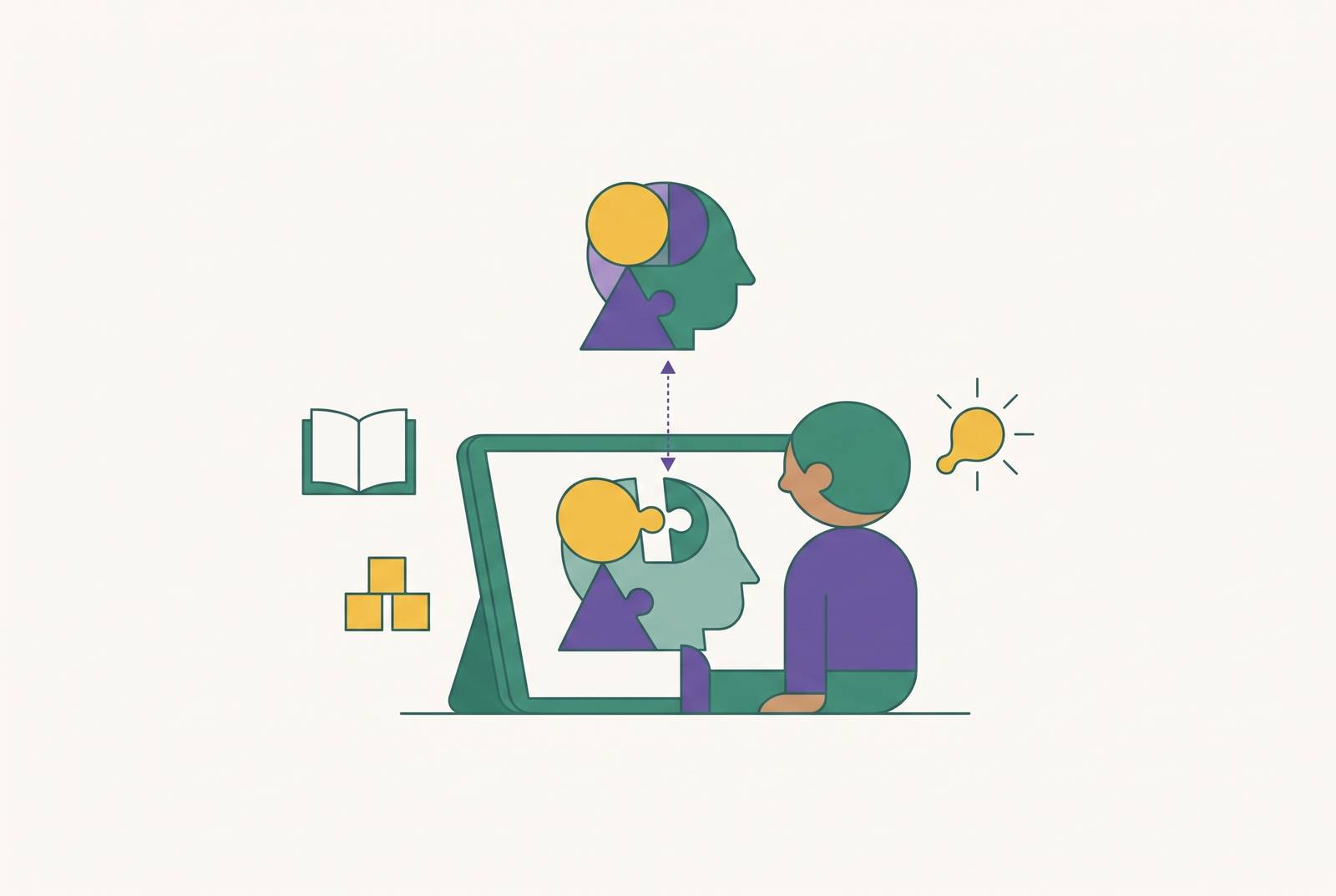
The best AI reading and math app for your child is one that matches their decoding, fluency, numeracy, and engagement needs, then changes instruction as they respond. Choosing a personalized AI tutor starts with understanding that profile. This guide explains how to connect what your child needs with what an app actually teaches.
Why reading and math development follow a sequence — and why that sequence is the right starting point for choosing an app
Reading develops through five interlocking components, which are phonemic awareness, phonics, fluency, vocabulary, and comprehension. These need a planned sequence, but they also develop in parallel. A child can understand what people say but still struggle to turn printed letters into words. That gap changes what instruction they need.
The Simple View of Reading frames comprehension as the product of word decoding and language comprehension. Weakness in either limits understanding. When recognizing words takes too much effort, it consumes the working memory needed to follow their meaning. Math has its own progression, from number sense and counting to addition and subtraction strategies, then place value and fact fluency.
Parents choosing an app should therefore start with their child’s stage. What can your child do reliably, and where does the work break down? An app that starts every child in the same place ignores the sequence it is supposed to support.
What a learning profile actually is — the four dimensions a parent needs to map before opening any app store
A learning profile is a rough map. Before spending money, observe and note your child’s decoding, reading fluency, numeracy stage, and engagement pattern. These four dimensions do not always move together. A child may sound out words accurately but read in a halting way, or understand numbers well but avoid practice. One overall score hides those differences.
For decoding, listen to what happens with unfamiliar words. Does your child sound them out, guess from context, skip them, or stall on longer words? Passing early phonics checkpoints does not rule out later decoding gaps. For fluency, notice accuracy, ease, and expression alongside speed. Quick but flat reading can still come with weak understanding.
For numeracy, note whether your child is building counting and number sense, learning addition and subtraction strategies, or developing place value and automatic recall. Then consider what makes practice difficult to sustain. Work that is too hard, too easy, or too repetitive can produce resistance that looks like defiance. Younger children tend to do better with short spells of focused work than with long ones, especially when they resist.
Interests belong in this profile too. Note which topics and characters keep your child interested, because reading them again helps build fluency. Can an app respond to these needs?
How most children's learning apps handle instruction — and where the gap opens between adaptive and merely digital
Most children’s learning apps are digitized curricula. They move children through the same content, advancing them when a level is complete. In adaptive teaching, a child’s responses change the next teaching decision.
An adaptive system adjusts what it teaches, how it teaches it, and when it moves on. It responds to demonstrated skill. More sophisticated systems also use hesitation, recurring errors, and retry behavior to understand how a child is working. A correct answer and a secure skill are not always the same thing.
Stars and streaks can make this difference harder to see. A child may happily finish work that is too easy to teach them anything new, or struggle through work that is too hard for them to remember. A quiz tool can record a result without helping resolve the error behind it.
For a parent evaluating personalization, the test is what happens after difficulty appears. Does the app teach differently, or just serve another question? The same four dimensions used to map the child now become the standard for judging the app, including decoding, fluency, numeracy, and engagement.
What reading instruction inside an app should actually look like for a child still building decoding skills
For a child still sounding out words, look for explicit teaching within a planned phonics sequence. The app should connect sounds to letters, move from simple patterns to more complex ones, and revisit earlier learning. Exposure to text is not enough on its own. Decodable texts should give the child practice with the patterns being taught and keep words within what that teaching covers.
The starting point changes for a pre-reader in Pre-K or early kindergarten. Can the child hear rhymes, separate syllables, and identify the first sound in a word? Children need to work on those listening skills before letter-sound work builds on them. An app should find and work on gaps in these skills, since doing well at letter-matching games does not prove that the child has a firm grasp of them.
Once the child reads words aloud, feedback becomes central. A useful app listens, catches a misread word, gives a phonics cue, and adjusts the difficulty of what follows. Parents should be able to hear the correction and see its connection to the child’s error. An app that takes only taps cannot give that spoken-reading feedback.
Reading words correctly again and again, with guided practice and feedback, helps a child move from effortful decoding to automatic recognition. That process is called orthographic mapping. For this stage, the important feature is not simply a microphone but instruction that responds to what the child says. As recognition becomes more automatic, however, the reading task changes, and the app needs to change with it.
What a child needs from an app once decoding is stable but fluency and comprehension are still developing
A child who decodes reliably but reads slowly or without expression needs more than continued phonics practice. The priority shifts toward automaticity and prosody. Automaticity means recognizing words without laboriously sounding them out, while prosody means phrasing, intonation, and expression. The goal is easier access to meaning.
Look for modeled reading followed by the child reading the same text aloud. Guided and repeated oral reading supports fluency, and an app that models a sentence and listens to the child repeat it can provide that practice. Its response should address more than the number of words read per minute. Speed alone leaves phrasing and expression out of view, even though they support comprehension.
Once decoding is stable, vocabulary and language comprehension can become the limiting factors. An app should build both. For a fluent child whose understanding lags, questions during reading can reveal whether meaning is being followed.
Interest also has a direct role at this stage. A child who finds every text dull is less likely to do the volume of reading that builds automatic recognition. Texts that interest the child help keep them reading, as long as the words still fit what they can read. Math requires the same link between a child’s current stage and the instruction offered, though its sequence is different.
How to read a child's numeracy stage and what math instruction in an app should address at each level
For children ages 4–9, the useful starting point is what they understand about numbers. A placement assessment should show where the child is in the sequence before teaching starts. Grade level cannot substitute for that assessment. A child still building number sense needs different work from one who understands operations but lacks fluent recall.
At the early stage, observe counting and understanding of number relationships. Mathematical language belongs here too, including words such as “more,” “fewer,” “between,” and “equal.” Language and numeracy support each other, so an app should build these meanings with number sense. Symbol-only exercises do not provide the same conceptual support as visual tools.
For addition and subtraction, look at whether the app teaches strategies or drills recall. Look for instruction in counting on, making ten, and using number bonds. These approaches build understanding of how numbers relate. An app that only asks for answers can record success without teaching the strategy the child needs when an answer does not come easily.
Later, children need to work on place value and fact fluency. Automatic recall helps once children understand the concepts behind it, but drilling too soon can leave them struggling with problems they have not seen before. Visual manipulatives, including number lines, area models, and fraction bars, can support conceptual understanding where they fit the work. They give children more to work with than symbols alone.
The app needs to address the child’s current stage with explanations that help resolve weaknesses. Parents also need to see evidence of that fit in the progress report.
Why progress reporting is the feature that determines whether a parent can act on what an app knows about their child
An adaptive app can learn useful things about a child and still leave parents in the dark. Session time, points, and completed levels measure activity, leaving what the child understands unreported. Most dashboards obscure that distinction. Without skill-level reporting, parents cannot tell whether changing instruction is helping or whether a gap remains unresolved.
Look for reports that name the skills practiced and show where errors occurred. Short vowel patterns, place value, and number bonds to ten are useful categories because each names something the child needs to be taught. A broad accuracy score does not do that. Nor does a level number show whether the child keeps making mistakes with the same skill or with different ones.
Progress also needs to be visible across sessions. A plateau or decline can signal a gap the app has not resolved. It can also indicate that a structured assessment from a reading specialist or educational psychologist is needed. AI apps provide teaching, while diagnosis of dyslexia or dyscalculia requires professional assessment.
For a parent judging a dashboard, the standard is concrete. It should answer three questions in plain language. What specific skills has the child practiced? Where are the gaps? Is the gap narrowing? Those answers make the app’s knowledge useful beyond the session and provide evidence for the final buying decision.
How do you find the best AI reading and math app for your child's actual profile?
For a pre-reader, the priority is sound awareness and letter-sound foundations. For a child still decoding, it is systematic phonics with feedback on spoken reading. For a reliable decoder, it shifts toward guided oral reading, expression, vocabulary, and understanding. In math, the deciding distinction is whether the child needs number sense, strategies, or fluency built on secure concepts.
To apply that profile, ask whether the app listens. Spoken-reading feedback lets it respond to a misread word with a cue. Then ask whether it places the child correctly. An assessment of actual knowledge is more useful than a grade-level default that begins too far ahead or behind.
Next, ask whether the curriculum has a clear foundation. Reading should include systematic phonics, phonemic awareness, fluency, vocabulary, and comprehension in a strategic sequence. Math should align with a recognized standard. Adaptation changes the path through a sound curriculum to fit the learner.
Look for adjustments based on this child’s current response. Parents should see mastered skills, skills in progress, and persistent gaps in progress reports.
This framework also identifies when an app is not the right next step. Consistent plateaus, complete avoidance of sessions, or significant difficulty across multiple months call for a structured assessment from a reading specialist or educational psychologist. Choosing well includes recognizing that limit. The app’s job is to teach the child in front of it.
Sources
- Supporting fluency and comprehension using practices grounded in the science of reading - Teach. Learn. Grow.
- What the science of reading tells us about how to teach decoding—including phonics - Teach. Learn. Grow.
- Full article: Early Numeracy in 3- to 4-Year-Old Children: The Role of Family Variables, Child’s Gender, and Language Skills
- Early numeracy and mathematics development: A longitudinal meta-analysis on the predictive nature of early numeracy.