Math Fact Fluency vs. Memorization in Early Elementary
Strong number sense foundations matter more than early memorization drills.
Prerequisites for fact fluency in children's number sense
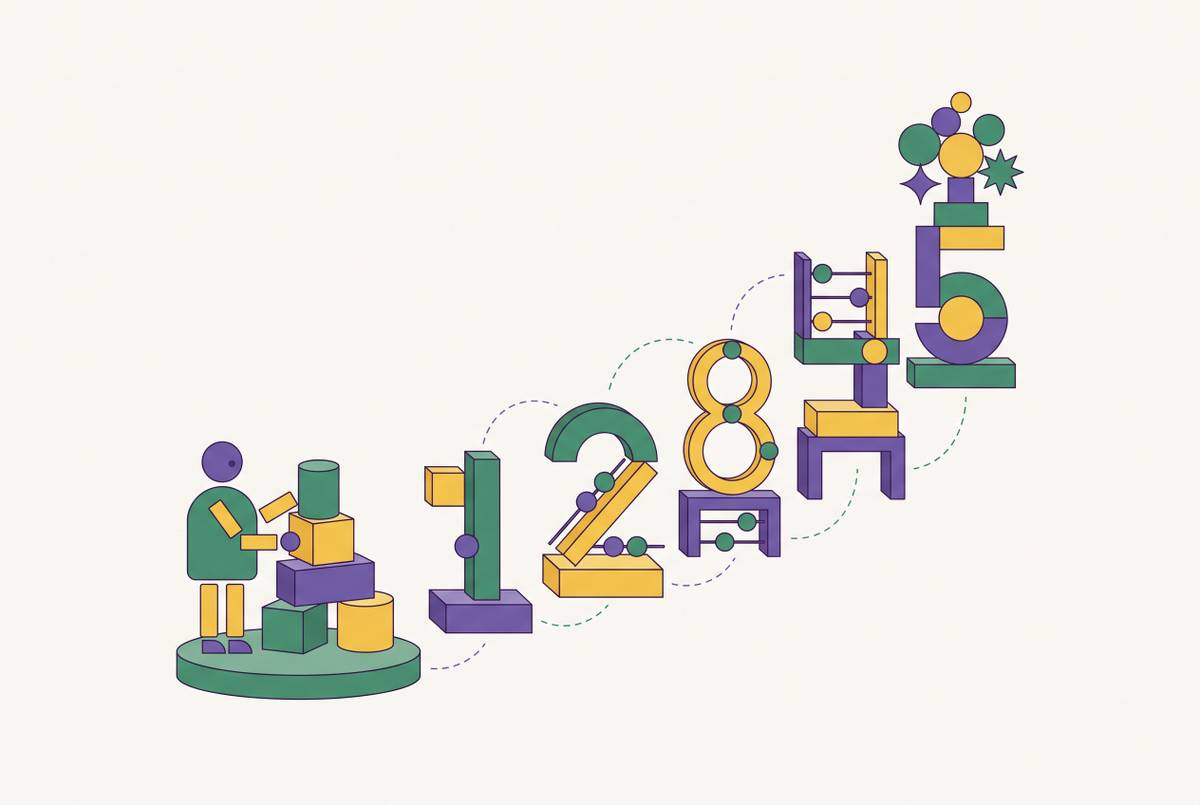
Numeracy doesn't start in kindergarten. It starts well before formal schooling, shaped by the number talk and informal exposure a child encounters at home, long before any worksheet shows up. By the time fact fluency instruction is supposed to begin, a child needs three specific checkpoints locked in already, and skipping them doesn't save time. It just guarantees the fluency work has nothing to hold onto.
Research reviewed by Notre Dame's Nicole McNeil and colleagues, covered in an EdWeek piece, names the three milestones directly. Cardinality comes first: understanding that when you count a set of objects, the last number you say represents the whole group, not just the final item on the pile. Next is comparing written numbers, actually knowing that 5 is less than 6, not just reciting the sequence. Third is counting on, starting from a known number and counting forward to reach a sum, instead of starting from one every single time.
Skip these, and fluency instruction gets built on sand. A child who hasn't nailed cardinality has no real number to attach a math fact to, so drilling that child on sums just teaches them to recite noise back at you.
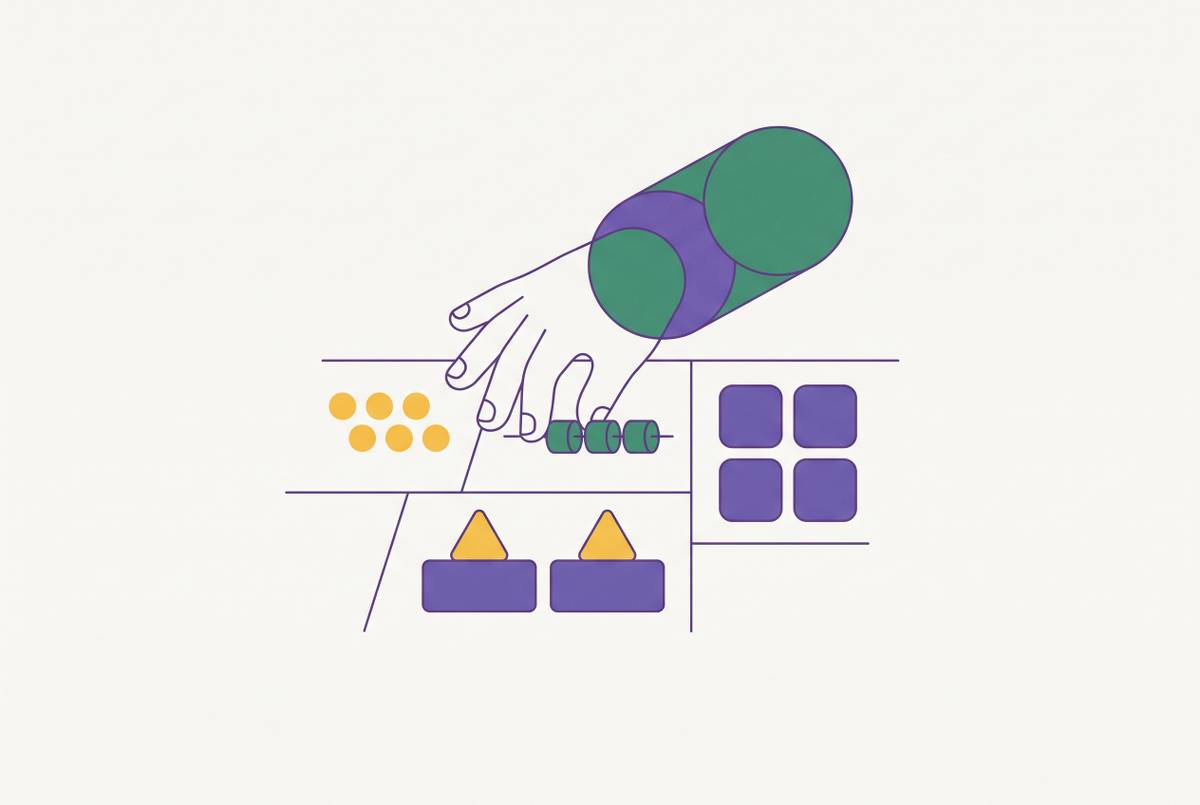
A concrete-to-abstract progression is the bridge early math instruction depends on, and the order isn't a suggestion. Physical objects come first, counters, blocks, fingers. Then pictures and drawings standing in for those same quantities. Only after that should formal symbols, actual digits and equations, enter the picture at all. Rushing to the abstract stage before a child has handled the concrete one is the single most common shortcut in early math instruction, and it's an expensive one: it trades a few saved weeks now for years of shaky recall later.
The gap deserves to be named. Plenty of kids arrive at kindergarten already behind on numeracy, and That gap has drawn growing concern as early schooling disruptions have affected informal number exposure for many children. That's why the foundation stage can't get rushed or assumed, especially for kids who missed the informal number exposure at home that other kids got for free before day one.
The three-phase progression from counting to mastery, including where memorization fits
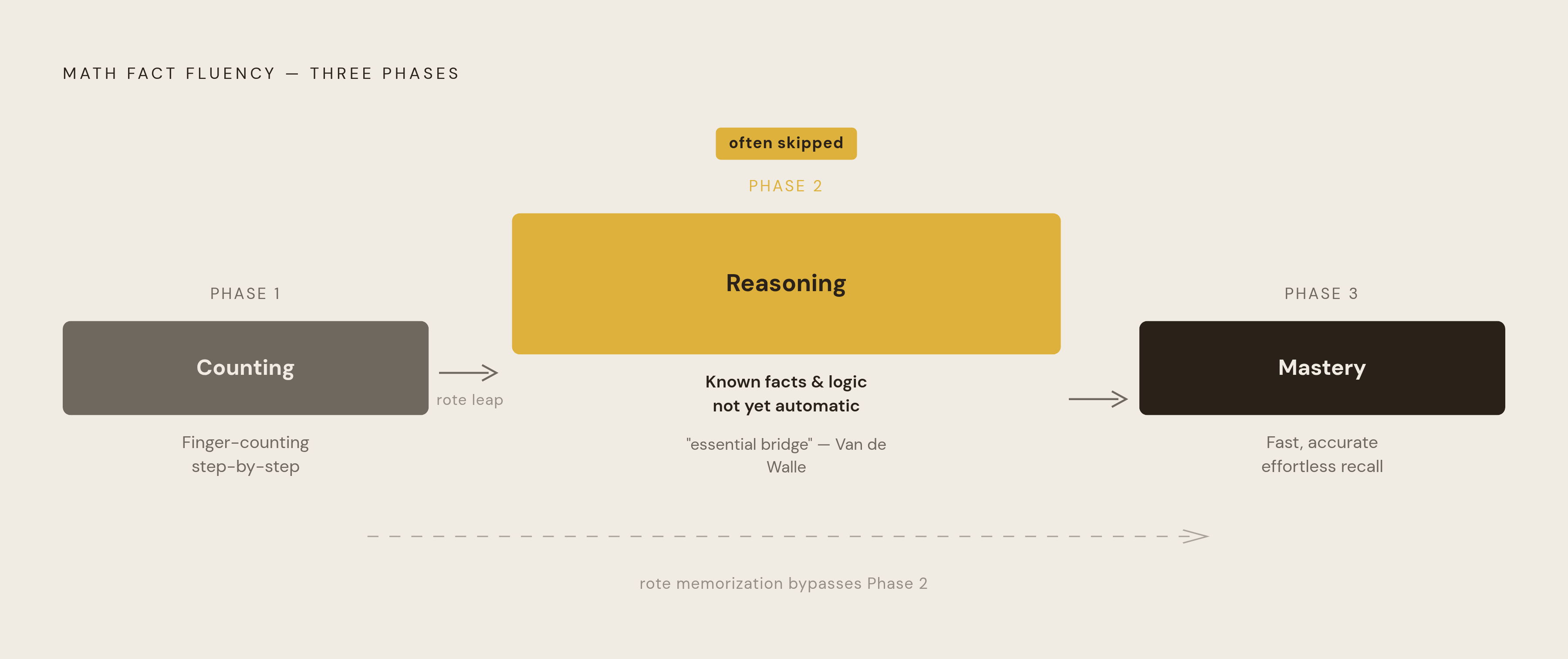
Fluency runs through three phases, and the middle one is where almost every classroom drops the ball.
Phase one is counting strategies, the finger-counting and tally-marking stage where a child works out an answer step by step. Phase two is reasoning: the child starts using logic, known facts, and derived relationships to reach an answer without counting from scratch. Not automatic yet, but no longer counting either. Phase three is mastery, where answers come out quickly and accurately, with minimal conscious effort required.
Van de Walle, a well-known voice in math education research, wrote that phase two "is often under-emphasized or neglected entirely, yet it is an essential bridge between inefficient counting strategies and mastery." Most curricula skip straight past it. So does most home practice. That's not a minor omission, it's the whole hinge the rest of the sequence swings on.
Rote memorization tries to leap from phase one straight to phase three, skipping reasoning entirely, and that's why it produces such brittle results. Conceptual understanding of what addition and subtraction actually do builds what researchers call an organizing framework for storing arithmetic facts. Strip that framework out, and memorized facts float around with nothing holding them together, isolated data points instead of a system. Easy to forget, and useless the moment a task looks even slightly different from the one on the flashcard.
McNeil describes children moving back and forth between deliberate reasoning and automatic access, with good instruction supporting that movement rather than assuming immersion alone will produce it. That back-and-forth is the whole game. It doesn't happen in a straight line, and exposure to numbers by itself doesn't make it automatic.
Why automaticity still matters, and the cost to children who never reach it
None of this argues against automaticity. Automaticity is the actual goal: an answer that's correct, quick, and takes no meaningful conscious effort, because that's what frees up working memory for the harder task sitting on top of the fact. When a basic fact is automatic, a child's working memory is free to tackle the next step. When it's not, that same working memory gets burned computing 6 times 7 instead of thinking through the multi-step word problem the fact was supposed to serve.
The gap this creates appears starkly in a 2018 study by Baker and Cuevas, published in The Importance Of Math Fact Automaticity. They tested 155 students on basic multiplication facts. Only 13% were fluent. Of that same group, only 3% could solve more complex multiplication problems. That's a wall between two skills that are supposed to build on each other, and it isn't budging on its own. That's a wall between two skills that are supposed to build on each other, and it isn't budging on its own.
Walk into most upper elementary classrooms and the residue is still visible: kids counting on fingers, kids leaning on a fact chart taped to the desk. That's incomplete fluency development from years earlier, visible late. It's incomplete fluency development from years earlier, visible late. EdWeek's Research Center has flagged fractions and basic operation fluency as among the topics most confusing to middle and high schoolers, and that tracks: an unresolved gap in third grade doesn't hold steady. It compounds.
The clearest comparison is a marching band. A musician who hasn't internalized their part yet cannot play the music and march in formation at the same time, because both tasks are fighting for the same limited attention. Tool skills, whether that's playing a scale or recalling 8 plus 5, need to become automatic precisely so the learner can turn attention to the bigger task sitting on top. Reading works the same way: decoding fluency, recognizing words without sounding them out letter by letter, frees up attention for actual comprehension. Math facts do the identical job for arithmetic, and nothing about that job changes if you skip the middle step.
How math anxiety enters the picture, and why timed pressure backfires on unprepared children
Math anxiety occurs earlier than most parents assume. Research from Sokolowski and Ansari, cited in work out of WPI, found that children as young as 6 can self-report feeling anxious about math, with first and second graders already describing nervousness in math-related situations. The trouble starts before most kids have even reached the mastery phase for their first set of facts.
Research has documented the mechanism behind why this becomes a trap. Stress during a math task blocks working memory, and working memory is the exact resource a child needs to pull up a stored fact or work through a reasoning strategy. Anxiety doesn't just feel bad, it actively disables the tool needed to perform well, which produces a worse result, which feeds more anxiety. That loop starts building the moment a child feels rushed instead of supported, and it doesn't need many repetitions to set in.
Timed conditions make it specifically worse. PMC research found the relationship between anxiety and performance is stronger under timed tasks than untimed ones, with certain timed tests triggering a sharper choking-under-pressure effect. So a timed drill given before the conceptual and reasoning-stage work is solid isn't measuring fluency at all. It's measuring the absence of anxiety, a different thing entirely, and grading it as fluency is a category error most classrooms make without ever noticing.
Genetics plays a role too. Research indicates that capacity for memorization varies across individuals. Not every child hits automaticity on the same timeline, and treating that natural variation as failure, instead of as a difference in pace, is a reliable way to manufacture anxiety instead of fluency.
None of this makes timed practice inherently harmful, and that distinction matters more than it sounds. Timed practice on facts a child has already reasoned through, facts sitting in phase two heading toward phase three, is a completely different exercise from timed testing on facts that were never properly taught in the first place. One builds speed on a stable foundation. The other just measures panic and calls it a data point.
One wrinkle affects this directly. Cognitive Science research from 2024, using pupillary response data, found young children showed resilience to math anxiety effects in early testing, hinting that anxiety develops through experience rather than arriving hardwired from birth. It gets shaped over time by schooling experiences. The instructional choices made in kindergarten and first grade aren't neutral. They set a trajectory that plays out for years afterward.
What research-backed fluency instruction looks like in practice
Explicit strategy instruction is the middle path the research actually supports, and it looks nothing like pure drill or pure play. It means directly teaching children how to derive facts from ones they already know, rather than betting that repetition or free exploration will get them there on its own.
The 2026 EdWeek piece gives a clean example: solving 9 plus 5 by thinking "10 plus 5 is 15, and 9 is one less than 10, so the answer is 14." That's a taught strategy, not a memorized fact, and it's exactly the phase-two reasoning that builds the organizing framework described earlier.
Good instruction also leans on visual models that make reasoning visible before it disappears into automatic recall: ten frames, number lines, number racks, area models. They're scaffolding, letting a child see the structure of a number relationship instead of accepting an answer on faith.
Pacing matters as much as method, maybe more. McNeil's research recommends introducing only 3 to 4 new facts at a time and practicing those until recall is solid before adding more. Bulk memorization of a whole times table at once works against how the brain actually consolidates this kind of knowledge, full stop. Session length matters too: short bursts of 2 to 10 minutes, done several times a week, are what the research recommends over longer, less frequent sessions.
Sequencing inside a fact set follows the same logic as the three-phase progression itself. Foundational facts come first, doubles, fives, tens, the ones with the clearest patterns. Derived facts get built from those foundations afterward. Common Core already assumes this staged approach, starting in kindergarten with addition and subtraction within five and building grade by grade. The architecture has existed for a while now. What's missing is fidelity of implementation.
A child moving between deliberate reasoning and automatic recall needs instruction that can tell which mode they're currently in and respond to it accordingly. A static worksheet handed to an entire class at the same pace can't do that. Neither can a one-size drill sheet. That's a real constraint baked into a lot of classroom practice, one that sits on the system rather than on any individual teacher working inside it.
Ways parents can support fluency at home without creating pressure
Home environment shapes this more than most parents realize. Research using latent growth curve modeling across 1,252 children, published on ScienceDirect, found maternal education level and migration background both associated with a child's baseline numeracy at school entry. No flashcard app fixes that overnight, but it does mean the informal number talk happening at home before kindergarten carries real weight.
The principle is simple to state and harder to resist in practice: home is for exposure and reasoning, not testing. Creating conditions for phase-two thinking matters far more than drilling for phase-three speed, especially before classroom instruction has built the underlying concepts. Parents who reach for flashcards first, before that concept-building happens, are usually working against the sequence instead of with it.
A few habits line up well with what the research actually supports. Games involving counting, comparing quantities, or spotting patterns build number sense without any performance pressure attached, since nobody's grading a board game on a Tuesday night. Asking "how did you figure that out?" Asking "how did you figure that out?" instead of just checking whether the answer is right treats reasoning as something to talk about, not just a means to an end. Flashcards aren't off-limits, but they work best low-stakes, brief, and introduced after classroom instruction has already built the concept, never as the primary way a child learns a fact in the first place.
A child who pauses to think "9 plus 5 is like 10 plus 5 minus 1" is doing exactly the right thing, even if it takes three extra seconds compared to a kid who's already automatic. That pause is phase two in action, and it deserves more credit than it usually gets from a parent watching the clock.
Some signs point to healthy development: a child using multiple strategies, able to explain reasoning out loud, gradually picking up speed over weeks and months. Other signs call for raising the issue with a teacher directly rather than waiting it out: a child still stuck on finger-counting well into first or second grade, visible anxiety or avoidance around math tasks, or speed that's flatlined despite consistent practice at home.
Fluency built on real understanding holds up under pressure that memorization never survives. It transfers to problems the child has never seen before, it comes back after being forgotten with just a quick refresh, and it doesn't collapse the moment a clock starts running. That durability is the entire point, and a fast answer that produces nothing beyond itself is worth far less than that.