Decodable Books Role in Early Reading Instruction
Early readers need explicit phonics practice through decodable books before moving to other texts.
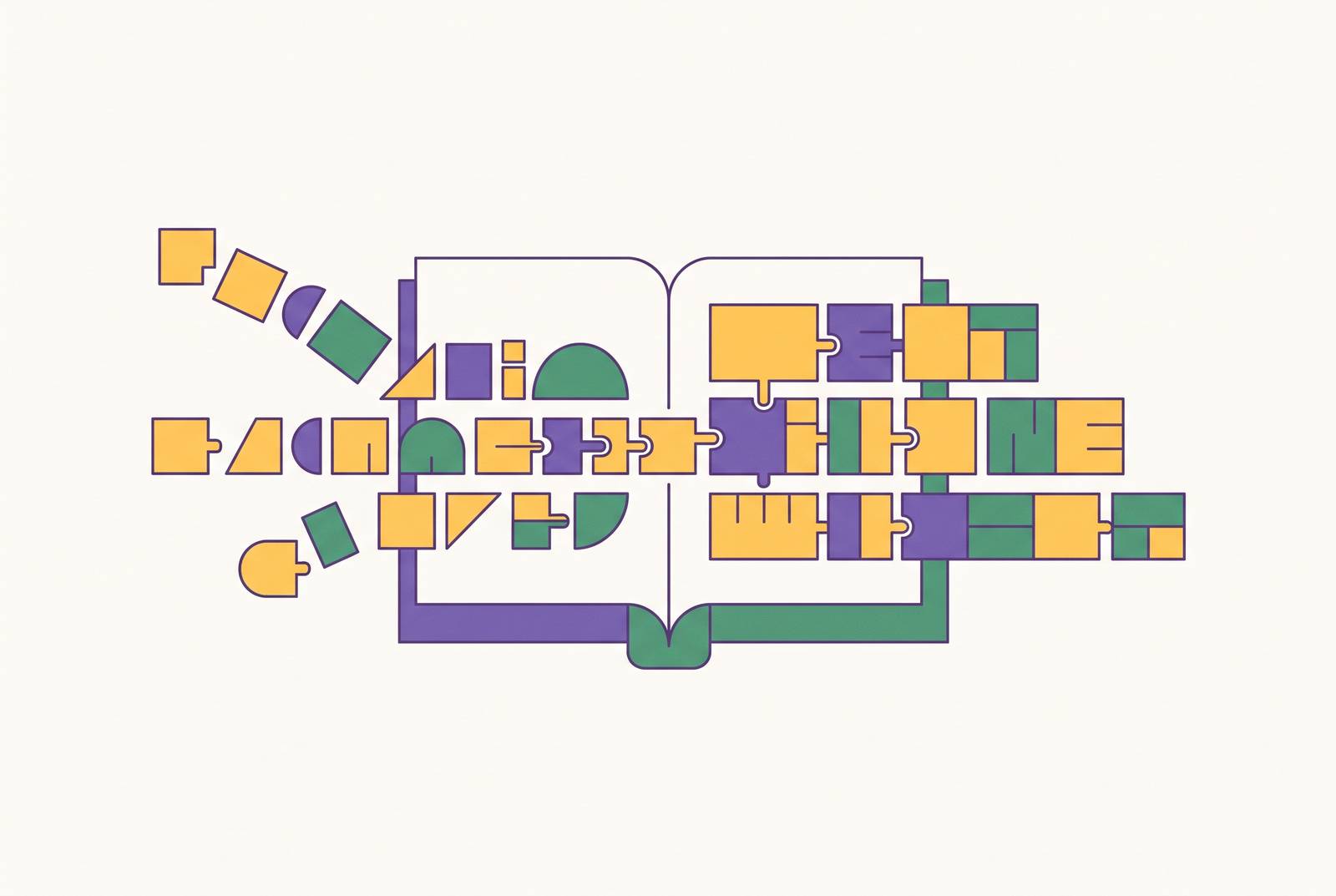
Speech comes naturally to a human brain, but reading doesn't work that way at all. That gap sits at the center of the Science of Reading, and it's why phonics instruction has to be explicit and systematic. Kids don't absorb decoding just by sitting near books, the way they pick up spoken language just by sitting near talkers.
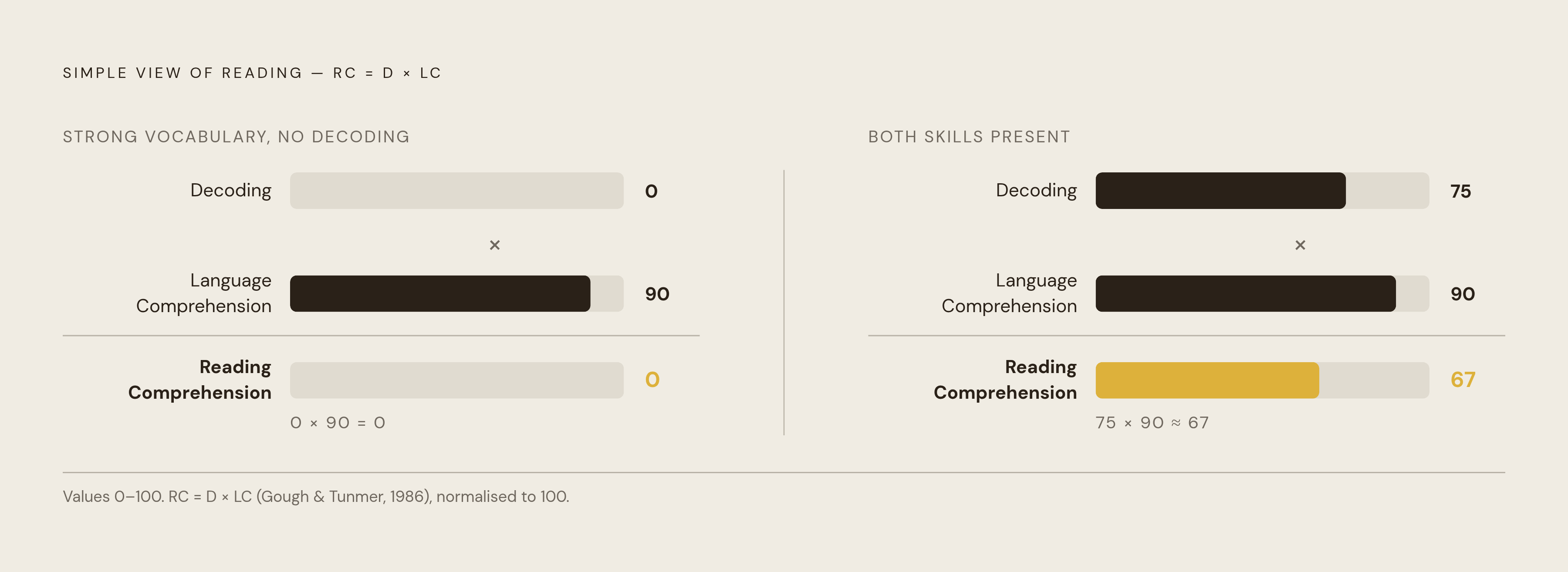
Gough and Tunmer's Simple View of Reading, from the 1980s, still gives the clearest framework: reading comprehension equals decoding skill multiplied by language comprehension. A child can have a rich vocabulary and sharp listening comprehension, but if decoding sits at zero, comprehension of the printed page sits at zero too. It's multiplication, not addition, so neither piece alone gets the job done.
Decoding runs on phonological and phonemic awareness, the ability to hear and manipulate individual sounds inside words. That's the engine driving the whole process, and kids who struggle to isolate, blend, or swap sounds struggle to decode words accurately and fast. Weakness here is one of the strongest known predictors of later reading trouble.
Synthetic phonics trains this directly: letters translate into sounds, sounds blend into words. Doing this well takes letter-sound knowledge and phonological awareness working together, and neither substitutes for the other. Programs that lean on one while shortchanging the other stall out, every time.
Skilled readers decode rapidly through letter-sound patterns. Instruction that skips this pathway teaches kids to guess instead, whether from a picture or from where a word sits in a sentence. Guessing is a habit that's brutally hard to unlearn later; reading intervention past third grade often involves the slow work of addressing habits that formed when decoding was never properly established in the first place.
Call it the "fast and first" problem. Phonics that doesn't get mastered early calcifies into a deficit, and every year of instruction after that becomes an attempt to patch a foundation instead of build on one, and patches simply don't hold the way foundations do.
What decodable books are and how they are built
A decodable book uses controlled vocabulary: words and phonetic patterns chosen because they match what a child has already been explicitly taught, and nothing more.
The governing rule is alignment to a phonics scope and sequence. Every decodable book occupies one rung on a ladder, and a child reading it applies the exact letter-sound correspondences covered in that week's lesson, building the skill through direct practice rather than through memorization, pictures, or context guessing.
These books do three jobs. They build automaticity, moving a kid from slow, effortful sounding-out toward fluent reading, and they give practice applying letter-sound knowledge to common, high-frequency words. They also develop prosody, the natural rhythm and expression of reading aloud, alongside raw accuracy.
Research on decodable lessons points to at least half the time being spent in application, meaning actual reading and writing, because that's where the learning locks in and the skill becomes real.
The books are built to grow with the child. Early titles use short, simple sentences, and complexity ramps up book by book as students move through the sequence. The research on timing matters here: phonics instruction works better when kids apply what they've learned directly to reading immediately, not days or weeks later.
Why decodable books replaced leveled readers at the center of early literacy
Leveled readers used to sit at the center of early literacy instruction, built on the three-cueing system: teaching kids to identify unknown words using meaning, sentence structure, and visual cues, pictures included. Research on how the brain actually processes text exposed how flawed that approach was, and the field has largely moved on from it, for good reason.
Skilled readers decode letter-sound patterns rather than guessing from context or leaning on illustrations to fill gaps. Leveled books aren't organized by phonics skill either, so they offer almost no chance to reinforce whatever decoding pattern a class is working on that week. A kid can "read" a leveled book successfully by memorizing its picture cues and never touch the skill the book was supposedly building.
Policy has caught up to the research. As of 2024, several U.S. states have moved to restrict or outright ban three-cueing instruction in kindergarten through third grade, and since 2013, 42 states plus D.C. have passed laws or adopted policies requiring evidence-based reading instruction. It's a sweeping shift with decodable texts sitting at the center of it.
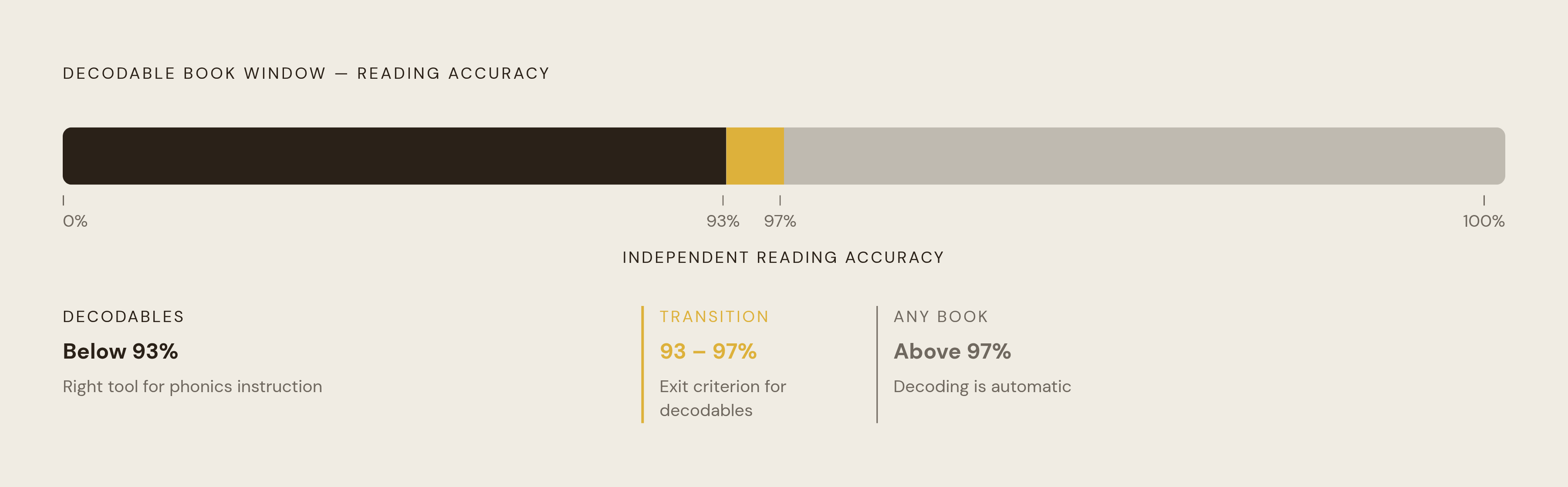
That said, none of this means leveled books deserve permanent banishment. Researchers and groups like The Reading League take a more careful position: decodables are the right tool specifically during the phonics acquisition stage. Once a student can read independently with accuracy between 93 and 97 percent, leveled texts become appropriate again, because the decoding foundation is now secure enough to support them.
The goal is sequencing. Once decoding becomes automatic, every book effectively becomes decodable to that child. The scaffolding was only ever meant to be temporary, and mistaking it for a permanent home is where a lot of well-meaning classrooms go wrong.
The honest limits of decodable books and what they are not meant to do
Decodable books have a real ceiling, and pretending otherwise does kids no favors.
Controlled vocabulary means controlled topics. A kid obsessed with dinosaurs isn't going to find a decodable book about dinosaurs, because most dinosaur names are phonetically irregular messes no early reader could sound out yet. Set next to a rich picture book read aloud by a parent, an early decodable can feel thin, even a little dull. That's a trade-off built into the design, one worth naming instead of hiding behind marketing copy.
Reading researchers have made this point plainly: decodables serve a specific window in a child's development and should step aside once that window closes. The benchmark for mastery is concrete — a child should stay with decodables until they can accurately apply regular sound-letter correspondences and have built a substantial sight vocabulary.
Misused, decodables turn into a genuine problem, and this is where the criticism of the whole approach usually comes from. Treat them as the only reading material a child ever encounters, rather than as the anchor inside a broader reading diet that includes read-alouds, shared reading, and rich spoken language, and they'll stunt the exact things they were never built to grow: deep vocabulary, background knowledge, a love of story. Those come from other books, read alongside decodables.
The goal is a kid who decodes so fluently that any book becomes accessible. Decodables are the bridge, useful for a defined stretch of the journey, and never the destination.
What a well-designed decodable book actually looks like
Not every book with "decodable" printed on the cover deserves the label. Most of the difference between a well-built one and a marketing exercise comes down to four things.
Alignment to a stated scope and sequence comes first: the book should say, explicitly, which phonics patterns it targets and where it sits in a progression. Controlled decodability that actually holds comes second. The overwhelming majority of words on the page need to be decodable using patterns already taught, not a handful of controlled words dropped into otherwise unpredictable text.
Irregular sight words need careful handling too, introduced gradually and flagged explicitly, never relied on to carry meaning before a child has actually learned them. And repetition matters more than novelty here, since patterns from earlier books need to resurface again and again; consolidation takes multiple encounters, not one clean pass through a single text.
A well-built series shows visible progression: sentence length, word complexity, and text structure climb from one book to the next, so a kid can feel themselves getting stronger. Parents and teachers should be skeptical of anything marketed as decodable that's stuffed with untaught, irregular words, or that leans on pictures to carry the story. That's worth calling out for what it is: a leveled reader wearing a decodable's name tag.
Worth saying plainly: quality decodable books are necessary, though they are not, on their own, always sufficient — some kids will need additional, targeted support beyond what any single tool provides.
How AI is entering the decodable books space, and where it runs into trouble
Teachers have started turning to general-purpose large language models to generate decodable passages on the fly, filling gaps between lessons or supplementing a curriculum that's thin in one area. Here's the plain problem with that: a general-purpose LLM was never built for this job, and the evidence on why is specific, not theoretical.
Emerging research has tested publicly available LLMs on exactly this task, and the results raise real doubts about reliability and alignment to a proper scope and sequence. These tools are good at producing text that looks decodable at a glance, but they're far less reliable at guaranteeing that every single word on the page matches what a specific child has actually been taught, which is the entire point of a decodable book. A passage that's mostly aligned isn't a decodable text; it functions more like a leveled reader with better branding, and the remaining gap is exactly where a kid falls back on guessing.
There's a deeper engineering problem underneath this, and it has nothing to do with how clever the language model is. Speech recognition systems need training on children's voices specifically, since kids differ substantially from adults in pitch, pronunciation, and fluency patterns. A model trained mostly on adult speech will misread a child's genuine attempt at a word as an error, or miss a real error entirely, and filtering background noise in a classroom or a living room sits on top of that as its own non-trivial engineering problem, one general-purpose voice assistants were never built to solve.
Reviews of empirical AI research land on a fair, two-sided conclusion: AI can offer genuinely valuable personalized support, but general-purpose AI tools can also reduce engagement, encourage overconfidence, and let kids bypass the cognitive effort that learning to read actually requires. Simplifying text through AI can strip out the productive struggle a child needs to build decoding strength. Easier isn't automatically better when the whole point of the exercise is building a skill through repeated effort.
Education Week's 2025 reporting notes the research on AI reading tools' effect on outcomes for young students isn't conclusive yet, which means the label "AI-powered reading" tells a parent or teacher close to nothing on its own. The real question is whether the AI behind that label does work that actually matches how kids learn to decode, or whether it's a general-purpose tool wearing an education-shaped skin.
What AI can do well when it is purpose-built for early reading instruction
Here's the distinction that actually matters: AI built from the ground up around a phonics scope and sequence, with speech recognition trained specifically on children's voices, is a fundamentally different tool than a general LLM asked to churn out a passage on request. One is engineered for this exact job, while the other is a generalist pressed into service it was never designed for, and no amount of clever prompting closes that gap.
Purpose-built AI does things a printed book simply can't. It listens to a child read out loud in real time and responds to an error the moment it happens, not at the end of a session or the next day, and it adjusts the instructional sequence based on what one specific child has actually mastered, not what the average kid in a class of thirty has mastered. It delivers the exact repetition a struggling reader needs without asking a teacher to somehow manage individualized attention across an entire room, and it hands a parent a clear, specific picture of exactly where their child sits in the progression, rather than a vague progress bar.
The 95 Percent Group cites multidisciplinary research showing that 95% or more of students can learn to read given high-quality, evidence-aligned instruction. That number reframes the whole crisis: it's a delivery problem as much as a knowledge problem, since the field largely already knows what works. AI that delivers that instruction consistently, to each child individually, functions as a genuine equity tool worth building toward seriously, on its own merits.
There's early, tentative evidence this shift is showing up in the numbers. The 2025 NAEP fourth-grade scores rose four points over 2022, a movement that's modest but real, and it coincides with broader adoption of Science of Reading-aligned tools and policy.
So what should a parent or teacher actually look for in an AI reading tool? A few markers separate the real thing from the imitation:
- Built from the ground up on the Science of Reading, drawing on rigorous, evidence-aligned content design
- Listens and responds to a child's actual spoken voice, using genuine speech recognition tuned for young readers
- Follows a genuine phonics scope and sequence with real, built-in review
- Gives parents transparent progress reporting tied to skill mastery
The technology is only as good as the science underneath it, and everything else is just packaging.