The Simple View of Reading Explained for Parents
Both decoding and language comprehension matter equally to reading success.
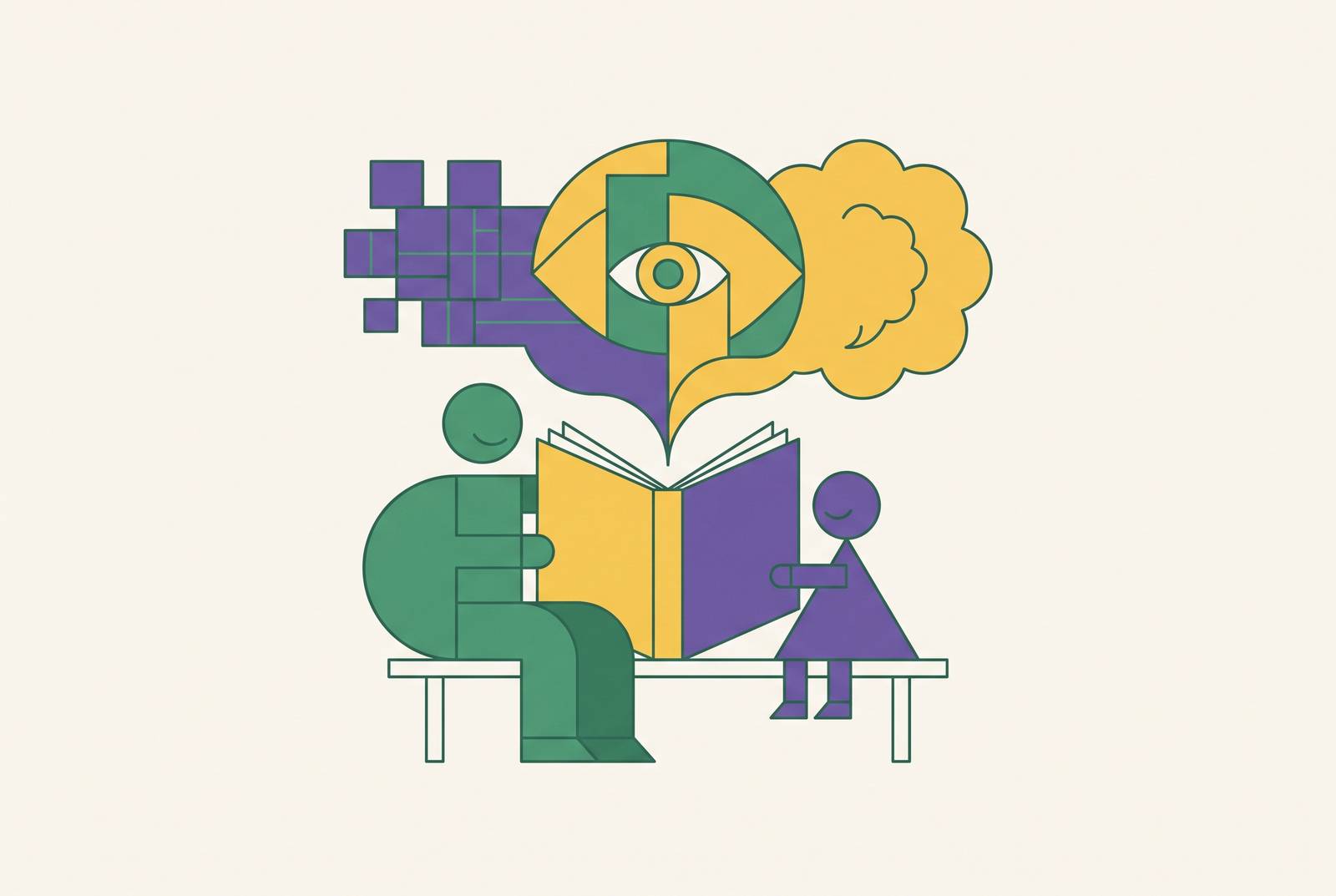
Reading comprehension equals decoding multiplied by language comprehension. That's the entire formula behind the Simple View of Reading, usually written as Word Recognition × Language Comprehension = Reading Comprehension, or D × LC = RC. Philip Gough and William Tunmer proposed it in 1986, and it was meant to settle a long-running argument between "whole word" reading advocates and phonics advocates. Both sides turned out to be partly right and partly incomplete: a child needs to recognize words on the page, and a child needs to understand language, and neither one by itself gets you to comprehension.
The multiplication sign carries the weight of the whole theory. Because the two factors are multiplied rather than added, a near-zero in either one drags the whole result toward zero, no matter how strong the other factor is. A child with excellent vocabulary and a rich base of knowledge still won't comprehend a page of text if they can't decode the words on it. A child who can decode flawlessly still won't understand a sentence if the language itself is foreign territory to them. Consider the sentence "the little dog barked at the big cat." Reading those words accurately is one task. Understanding that "little" and "big" are describing size, that barking is something dogs do, and that there's something notable about a small dog confronting a large cat is a separate task. Both have to work for comprehension to happen.
More recent reading research has sharpened the decoding side of the formula, often calling it "fluent word reading" to make room for automaticity and speed alongside accuracy. Fluent word reading and language comprehension are each broad categories, not single skills. The formula names two buckets. What goes inside each bucket is where the real diagnostic work for parents begins.
What decoding actually requires a child to do
Decoding looks like one skill from the outside: a child either sounds out a word or doesn't. Underneath, it's a chain of sub-skills: a break anywhere in that chain stops a child from reading a word correctly, even if they'd know the word instantly if they heard it spoken aloud.
To decode, a child has to learn three distinct things. First, that spoken words break down into individual sounds, called phonemes. Second, that letters on a page stand for those sounds. Third, that a printed word can be read by blending its letter sounds together smoothly, in sequence. Each of those is a separate cognitive achievement, and instruction that builds phonemic awareness (hearing and manipulating those individual sounds) lays the foundation that phonics instruction then builds on.
Even a short word like "cat" asks a child's brain to run three systems at once: visual acuity to see each letter clearly, auditory perception to produce the sound each letter makes, and a cognitive blending skill to string those sounds into a word. When any one of those systems falters, the word doesn't come out right. And the errors aren't neutral. A child who reads "dig" for "dog," or "baked" for "barked," isn't failing to understand the sentence: the wrong word actively points comprehension in the wrong direction.
None of this develops naturally the way spoken language does. Children learn to talk without formal lessons, simply by being surrounded by speech. Written language is a much newer invention in human history, and the brain has no built-in circuitry for it. Decoding has to be taught, explicitly and systematically. That is why phonics instruction matters as much as it does. As decoding becomes automatic through repeated practice, fluency follows: word recognition stops demanding conscious effort, and that freed-up attention goes toward meaning instead.
For a parent watching a child read, the sign to look for is specific. A child who struggles to sound out unfamiliar words, who guesses based on pictures or context instead of the letters in front of them, or who reads haltingly even on simple, grade-level text, is showing a decoding gap. That's a different problem from a child who reads smoothly but doesn't understand what the words mean.
What language comprehension actually requires a child to do
Language comprehension is the factor most parents don't think to name, partly because it starts developing in infancy, long before formal reading instruction, and partly because it hides well. A child with strong listening comprehension but weak decoding can look like they understand reading, because they understand language in general. A child with strong decoding but weak language comprehension can look like a strong reader too, right up until someone asks them what the story was about.
Listening comprehension, the ability to understand spoken language, starts building from infancy. By preschool, most children can follow multi-step directions, hold up their end of a conversation, and learn new things from being read to. That's the raw material language comprehension is made of. Take the sentence about the dog and the cat again: understanding it requires knowing what dogs and cats are, knowing that barking is a sound dogs make, grasping that "little" and "big" describe relative size, and having enough background knowledge to sense why a small dog confronting a large cat is worth mentioning. None of that information sits in the individual words. It comes from everything the child already knows about the world.
Background knowledge deserves attention on its own, as more than a footnote to vocabulary. A child can decode every word in a passage about the water cycle and still fail to understand it, if they've never had a conversation about rain, evaporation, or weather. Vocabulary gives a child the words. Background knowledge gives a child the framework those words plug into.
As children move through school, language comprehension's share of the reading comprehension equation grows. Decoding is the dominant lever in the earliest grades, when a child is still learning to crack the code of print. But language comprehension is what carries reading ability forward into the upper grades, when texts get longer, more abstract, and more dependent on what a reader already knows.
The sign to watch for here is almost the mirror image of the decoding sign. A child who reads words aloud accurately and fluently, but can't retell what they just read, can't answer questions about it, or can't explain what happened in a story, is showing a language comprehension gap. The words are coming out right. The meaning isn't landing.
The Multiplicative Formula as Diagnosis
Most parents start with the same worry: "my child struggles with reading." The Simple View of Reading takes that worry and turns it into a question with a direction attached: which factor is weak, decoding or language comprehension, and what does that factor need?
The two failure modes don't look alike, and they don't call for the same fix. A child who decodes well but doesn't understand what they've read needs vocabulary work and background knowledge building. A child who understands language well but can't sound out words needs phonics and decoding instruction. Treating one problem as if it were the other wastes time, and it can leave a child more frustrated, not less, because the instruction they're getting doesn't touch the actual gap.
Two real profiles make the distinction concrete. Emilia, a kindergartner, can sound out words several grade levels above her own, but she can't tell you what the story she just read was about. Her decoding is strong. Her language comprehension needs enrichment. Kamal, a second grader, loves being read to and can retell a story in detail after hearing it once, but he struggles to sound out words on his own. His language comprehension is strong. His decoding needs explicit, systematic phonics instruction. Same age range, same broad complaint from a worried parent ("my child isn't reading well"), completely different root causes and completely different interventions. A third profile exists too: children who are weak in both factors at once, which calls for support that addresses decoding and language comprehension together, with even more care given to sequencing and pacing.
Before the Simple View became widely understood, reading interventions tended toward one-size-fits-all, leaning heavily on rote memorization of words regardless of whether a child's actual problem was in decoding or in listening comprehension. That approach helped some children by accident and left others no better off. The Simple View replaced guesswork with a direction: find out where the breakdown is, then act on that specific factor. Asking "where is the breakdown?" gets a parent much further than asking "why can't my child read?"
How the SVR maps onto specific conditions parents already know about
The Simple View gives precise meaning to terms many parents have already heard, even if they've never connected them to a formula. Dyslexia and Specific Language Impairment both describe real, documented difficulties, and the Simple View shows exactly where each one sits in the equation, and why they call for different responses.
Dyslexia is a term most parents recognize, and children with reading difficulties centered on decoding are often the ones who receive that diagnosis. In Simple View terms, dyslexia represents a weakness in the word recognition factor: the letters and sounds aren't connecting the way they need to.
Specific Language Impairment, sometimes called Developmental Language Disorder, is less familiar to most parents but no less serious. A child with SLI can often decode the words on a page accurately and still struggle to understand what those words mean together, because the weakness sits in listening comprehension rather than word recognition. The deficit lives in a different factor of the equation. Treating a child with SLI the same way as a child with dyslexia doesn't work. A child with dyslexia benefits most from explicit instruction in word structure and phonics. A child with SLI needs work on vocabulary and sentence structure instead. Matching the intervention to the actual factor that's weak, rather than applying one standard approach to every struggling reader, is the practical insight the Simple View offers.
The same logic extends to multilingual learners. Research shows that English learners can often achieve solid word reading in English, since decoding tends to be the more accessible entry point for a new language. Their language comprehension in English may lag behind their decoding ability for some time, a gap the Simple View makes visible rather than hiding it behind an overall "reading score." Knowing that the gap sits specifically in language comprehension, not decoding, points directly at what kind of support helps.
Building Each Factor
Once a parent knows which factor is weak, the body of research known as the Science of Reading offers clear direction on what kind of instruction actually closes that gap, and the direction differs sharply depending on which factor needs the work.
For decoding, phonemic awareness, the ability to hear and manipulate individual sounds within words, forms the foundation that phonics instruction is built on top of. From there, fluency develops as accurate decoding becomes automatic through repeated, structured practice, and the cognitive effort shifts away from sounding out words and toward understanding them. Once formal reading instruction starts in school, both word reading and comprehension should be getting daily instructional attention, not one at the expense of the other.
For language comprehension, the levers look different: vocabulary exposure, background knowledge building, and oral language development, built through read-alouds, everyday conversation, and discussion of what a child hears, sees, and experiences. Background knowledge in particular is what lets a child make inferences a text never states outright, and it grows through sheer breadth of experience, across science, history, stories, and the ordinary world around them. Parents have a direct and well-supported role to play here: reading aloud across a wide range of topics, talking through what a child has heard or seen, and asking questions like "what do you think happens next?" rank among the most evidence-backed things a family can do at home.
For multilingual families, instructional routines that draw on a child's home language, existing knowledge, and cultural background support literacy development in English rather than working against it. Using a child's home language to build background knowledge transfers directly into stronger reading comprehension in English, because the knowledge itself, not just the vocabulary, carries over between languages.
Understanding these two tracks gives parents something concrete to look for in a classroom and something specific to ask a teacher about: is the child getting structured, systematic phonics instruction, and is the child getting rich exposure to vocabulary, knowledge, and oral language, every day, not just occasionally.
Where the SVR Has Limits
The Simple View of Reading is a cognitive model, and a precise one, but it was never built to explain everything about how a child becomes a reader. It accounts for early comprehension with real clarity. It doesn't account for the full picture of what shapes a lifelong reader.
One documented critique of the Simple View is that it leaves out social, cultural, and motivational forces that shape how a child learns to read. A child's engagement with books, their sense of themselves as a reader, and their relationship with reading as an activity are all real and powerful influences, and none of them appear in the formula. Two children can have identical decoding scores and identical language comprehension scores and still turn out to be very different readers, because one of them wants to pick up a book and the other has learned to dread it.
Other causes of reading difficulty can exist outside both factors the formula names. The Simple View works best as a starting point for understanding a child's reading, not a final verdict on it. It tells a parent where to look first and gives precise language for what's happening in a child's reading development. It doesn't replace the judgment of a teacher, a reading specialist, or a parent's own close attention to how a specific child is responding to instruction over time. Used that way, as a lens rather than a complete diagnosis, the formula does what Gough and Tunmer built it to do: turn a vague, anxious question into one with a clear, actionable answer.
Sources
- The Simple View of Reading
- LEARNING TO READ: “THE SIMPLE VIEW OF READING”
- What Is the Simple View of Reading? - Evidence Based Early Literacy
- Supporting fluency and comprehension using practices grounded in the science of reading - Teach. Learn. Grow.
- The Simple View of Reading
- Understanding The Simple View of Reading - ALSC Blog
- All about language comprehension: What it is and how it can help your child read - Teach. Learn. Grow.
- Simple, but not easy: What we forget about how reading comprehension develops