How to Evaluate an Edtech App Before Downloading It for Your Child
A framework for checking whether an edtech app actually teaches your child foundational skills.
Choosing an educational app for your child means looking past stars, cartoons, and promises of “smart learning.” The useful test is whether it teaches skills your child can use without it. Six criteria make that judgment concrete, covering instruction, curriculum, adaptation, parent visibility, business incentives, and learning beyond the screen.
Why the app store is a poor guide to educational quality
The familiar routine is simple. Scroll through the app store, see four-and-a-half stars, and download the app. But those stars do not tell you whether a child learns anything. App store rankings reward engagement and downloads, so beautiful animation can win attention without delivering much teaching.
Meyer et al., 2021 found that most of the educational apps with the most downloads taught very little. Kucirkova et al., 2023 found low-quality design in more than half of the apps separately assessed using the EdTech Evidence Evaluation Routine (EVER). That framework checks whether children take an active part, connect what they learn to what they already know and the world around them, interact with others, and practise with feedback more than once. Star ratings do not show these things, so parents need a different guide.
What "learning" actually requires, before evaluating any app
Reading and math have foundations that later skills depend on. Children must be taught how to read, starting with phonemic awareness (hearing and working with individual sounds in spoken words) and alphabet knowledge. Systematic phonics then teaches how letters stand for sounds, which helps with decoding, or working out written words. Fluency and comprehension build on that foundation.
The Simple View of Reading describes comprehension as the product of decoding and language comprehension. Children need both the ability to read the words and the language knowledge to understand them. Fluency is the hinge between the two, because accurate, automatic word recognition frees attention for meaning. It also includes prosody, or reading with appropriate expression and phrasing.
A sound sequence moves from simple patterns to complex ones, with practice that matches what the child has been taught. Decodable texts do that by using words built from the sound-letter patterns the child is learning. Early math has its own foundations, including number sense, counting, and mathematical language, before arithmetic drills. When parents know how these skills build on each other, they can ask whether an app teaches the next skill or skips steps the child needs first.
The first criterion: whether the app teaches or merely tests
An app that presents a problem and marks the answer right or wrong is testing. A quick parent test is to ask the child to explain why an answer was right. If the app supplied only a reward and never a reason, success on the screen says little about the instruction. A star confirms that a button was tapped correctly.
An app that teaches shows how to use a skill, gives the child practice with useful feedback, and has the child do more of the work over time. An app that reads a word aloud and asks the child to repeat it provides a model. Its next job is to help the child understand and practise the sound-letter connections. Feedback should explain the difficulty that prompted another “try again.
Children need repeated practice so they can use what they have been shown. But repetition without explanation can become a series of guesses. The same thing can happen when the app gives hints after every tap and never cuts back on them. Support is useful when it leads toward independence, but permanent support can make shallow learning look like progress.
The second criterion: whether the curriculum follows a real, evidence-based sequence
Good explanations cannot rescue a random curriculum. Letter games and separate vocabulary drills may have things to teach, but they do not add up to a planned course of learning on their own. The sequence needs to connect each new skill to something the child already knows. For reading, the Science of Reading provides the standard of systematic instruction.
Parents can check three things in the app store description or on the company website. First, check whether phonemic awareness comes before phonics. Next, check whether the app uses decodable texts that match skills the child has been taught, rather than words that need skills the child still lacks. Finally, look for fluency practice as well as decoding, so working out each word is not the endpoint.
For math, look for number sense, counting, and mathematical language before practice with operations. In either subject, vague claims such as “brain training” or “fun education” leave the central issue unanswered. A publicly described curriculum, built by teachers and subject-matter experts and tied to a research framework, gives parents something firmer to judge. Yet marketing often says little about how good the curriculum is, so the other checks matter too.
The third criterion: whether the app genuinely adapts to the individual child
“Personalized” can mean little more than adjusting difficulty. That is not worthless, since easier work may be more manageable for a struggling child. But genuine adaptive instruction goes further by changing what is taught, how it is taught, and when the child moves on. The distinction is one of degree and mechanism.
Think of a child who has trouble with multi-syllable words. An app that makes only a small change gives the child easier words, while one that adapts more deeply finds out whether the child has trouble with syllable segmentation or a particular sound pattern and teaches that skill. The input matters too, especially in reading. Listening to a child’s voice can show how well the child reads in terms of decoding accuracy, fluency, and expression, in ways that taps alone cannot.
A strong adaptive tool also reduces hints and prompts as the child gains mastery. Parents can look for a description of that process before downloading, then judge its behavior during use. After two weeks, the useful check is whether the app has changed the teaching in response to the child’s pattern of errors. Even when an app adapts, though, parents have a hard time judging it if they cannot see what it is doing.
The fourth criterion: whether parents can see what their child is actually learning
A learning tool that parents can trust must let them see what their child is learning. Without it, parents cannot tell whether a child is progressing, getting stuck, or practising something already mastered. A useful dashboard distinguishes specific skills that are mastered, in progress, and causing difficulty. Time spent and streak counts do not make that distinction.
The practical checks are straightforward. A clear account should show what the child can do, what still needs work, and what instruction has changed in response. An hour in an app can pass without skill growth, while shorter, targeted practice can be more valuable. Reporting activity is therefore not the same as reporting learning.
This is also where a claim of adaptation becomes accountable. If an app cannot show what it learned about the child or what it changed, parents cannot verify that claim. An absent progress dashboard leaves them without a clear way to judge whether the tool is working. Without that information, parents have more reasons to ask whether they can trust the company, including what it collects and how it makes money.
The fifth criterion: privacy, advertising, and the business model behind the app
The business model shapes what an app is designed to reward. Ads, in-app purchases, and data collection can create incentives that compete with focused learning. An advertisement interrupts the instructional flow and brings a commercial interest into the lesson. For young children, it can also create a route to accidental purchases.
A child who hits a paywall mid-lesson learns something, but not what the app claims to teach. Subscription retention can also become a target that competes with skill growth. Streaks, push notifications, and penalties for missed days deserve scrutiny for that reason, since continued use is not proof of continued learning.
Before downloading, parents should check whether the app has ads or in-app purchases and how it uses the data it collects. That includes who owns information about the child’s voice, behavior, and performance. Voice-based assessment may tell parents more about a child’s learning, but how much it helps the child learn does not establish whether the child’s data is adequately protected. Both the teaching benefit and the data terms need to be clear.
A Public Benefit Corporation structure, a clearly stated free tier, and no ads or in-app purchases are useful trust signals. They can indicate that the stated mission and revenue model fit together, but they do not prove educational quality. The same distinction applies to engagement features. How useful they are depends on whether they help children practise or mainly help the company keep users.
The sixth criterion: whether the app produces real skill transfer, not just in-app performance
The decisive test is whether the child can use the skill when the app is absent. A high score does not establish reading ability if the child cannot decode a new word in a library book or sound out an unfamiliar name. The same applies to math if correct taps do not lead to adding small numbers at the dinner table.
This is why fading support matters so much. Hints and prompts can help a child begin, but they need to give way as the skill becomes secure. Otherwise, the app may be sustaining a dependency. A useful tool should help a child with school reading assignments, family reading time, and real-life problem solving as well as the work in the app.
Fluency research illustrates what transfer looks like. Gains in automatic word recognition from repeated reading of one text can make new texts easier to read. The benefit is not confined to remembering the practised passage.
Parents can test transfer after four to six weeks with a simple task related to the app’s claims. Ask the child to read a short passage from a physical book or solve five problems on paper without the app’s support. If enthusiasm for the app has not been matched by progress in related skills, engagement is not doing the educational work promised. The preceding five criteria are all proxies for this final question.
Putting the framework to work: the six questions to ask before downloading
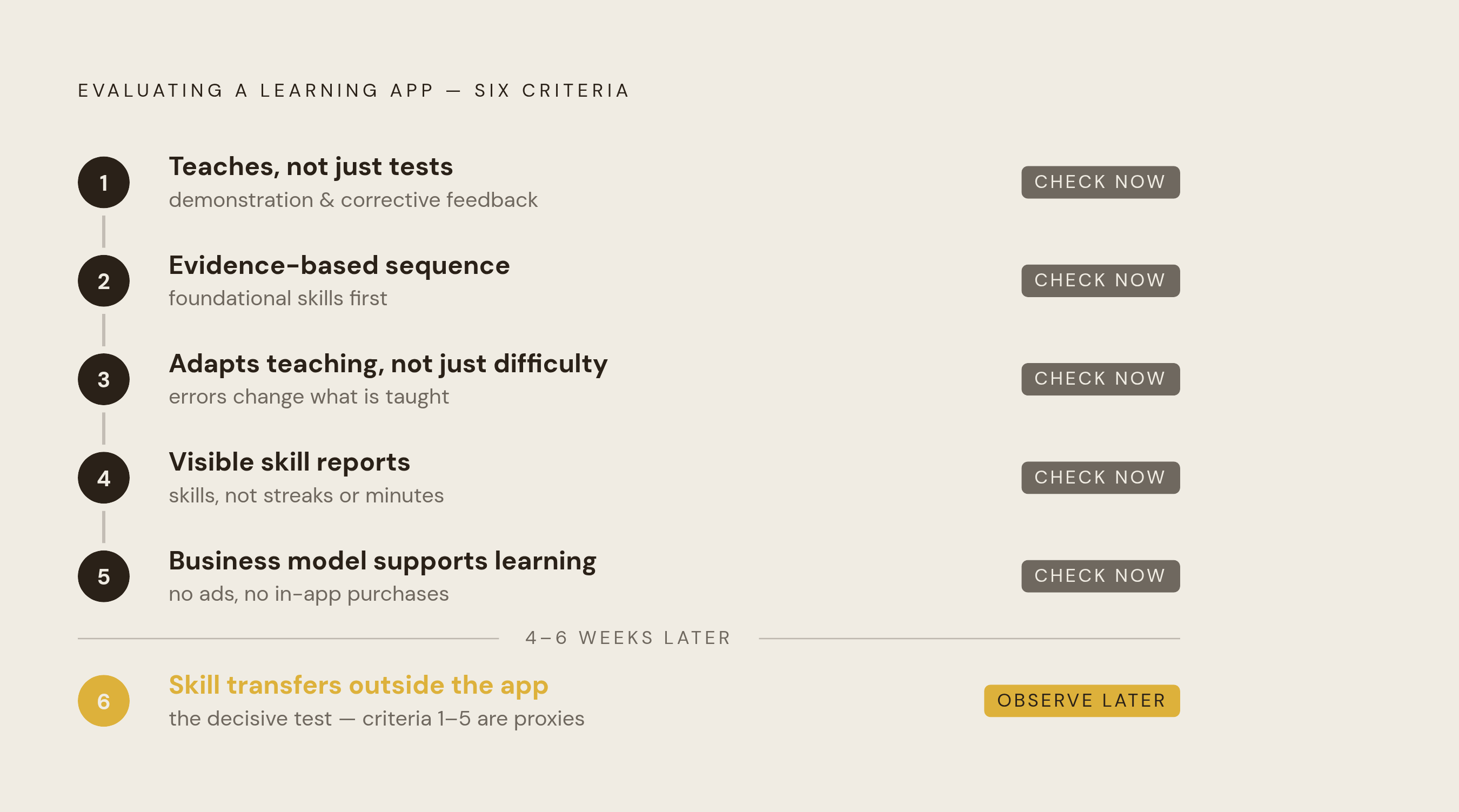
A first check can take under five minutes using the app store description and the company’s website. It cannot prove that a child will learn over time, but it can show where teaching is missing, the curriculum is unexplained, or the terms of doing business are unclear. A short trial session can then show whether the product matches its description. The six questions separate what parents can judge now from what they must observe over time.
First, check whether it teaches or just tests. Look for demonstration and corrective feedback. The second is whether the curriculum follows an established research framework. A stated sequence should show how the app builds from foundational skills instead of treating every activity as interchangeable.
Third, check whether it genuinely adapts or merely adjusts difficulty. Look for an explanation of how particular errors change the teaching, especially whether a reading app can hear the child read. The fourth is whether parents can see what the child is learning. Specific skill reports make that claim meaningful in a way that minutes and streaks cannot.
Fifth, check whether the business model supports learning. Clear data terms, no ads, and no in-app purchases are useful signals. The sixth is whether the skill transfers outside the app, which needs the later real-world check. The choice ultimately turns on one standard, namely whether the app helps the child do more without it.
Sources
- Supporting fluency and comprehension using practices grounded in the science of reading - Teach. Learn. Grow.
- What the science of reading tells us about how to teach decoding—including phonics - Teach. Learn. Grow.
- Early numeracy and mathematics development: A longitudinal meta-analysis on the predictive nature of early numeracy.
- Reciprocal development of numeracy, mathematical language, and general language skills from age 2 ½ to 4 years: A cross-lagged panel perspective - ScienceDirect