Reading Milestones for Kindergarten and First Grade
Know the predictable sequence to spot real reading delays.
Reading development in kindergarten and first grade follows a sequence that researchers have mapped with unusual precision. The skills build in a predictable order: phonological awareness first, then letter-sound knowledge, then decoding, then fluency. When you know that sequence, you can tell whether your child is simply moving at their own pace or signaling that something needs attention.
Why reading development in kindergarten and first grade follows a predictable sequence
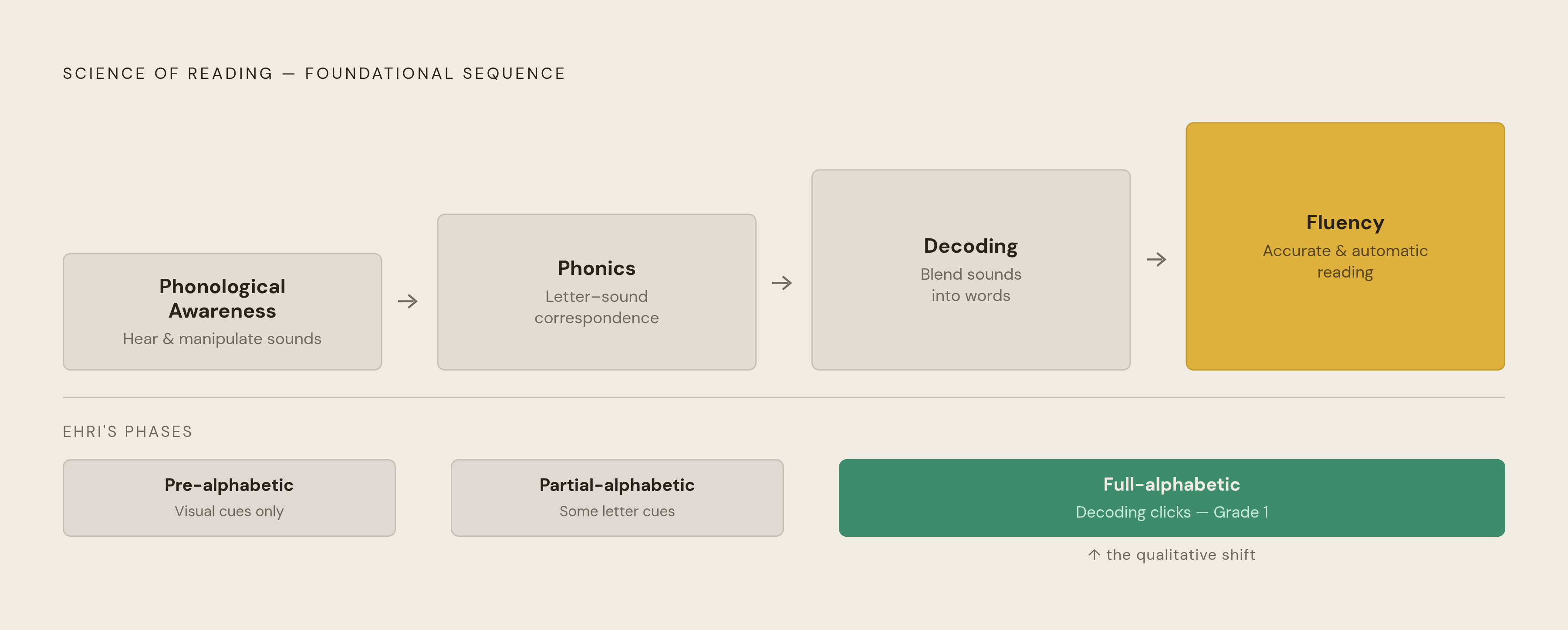
Reading is not a natural process. Children do not acquire it the way they acquire spoken language, through exposure alone. The brain must convert print into sound using letter-sound correspondences, and that conversion requires explicit teaching in an order the brain can absorb. The sequence is well-established. Phonological awareness, the ability to hear and manipulate sounds in spoken language, comes first. Decoding rests on that foundation. Phonics, the system of letter-sound correspondences that enables decoding, is most effectively taught through systematic instruction.
Linnea Ehri's word-reading phases give this sequence a name. Children move from pre-alphabetic, recognizing visual cues with no letter-sound knowledge, through partial-alphabetic, using some letter-sound cues, to full-alphabetic, using complete letter-sound patterns. First grade lands most readers at the full-alphabetic stage. Reading in Action frames kindergarten through third grade as "the most important four years in a child's literacy life," the window when children shift from sounding out letters to reading for meaning. This is the empirical backbone of the Science of Reading: instruction should follow the sequence of phonological awareness, then phonics, then decoding, then fluency, rather than relying on whole-word memorization or context guessing. Because the sequence is known, the milestones are known. And because the milestones are known, the warning signs are known too.
What kindergarten readers are actually building, from August to May
Kindergarten is the year the phonological machinery assembles. Children arrive with a wide range of starting points, and early-year variation is normal. End-of-year benchmarks are the meaningful signal. A child who starts kindergarten not knowing every letter is not necessarily behind. A child who ends kindergarten not knowing them is a different conversation.
At the beginning of the year, children typically bring recognizing some uppercase and lowercase letters, not necessarily all. They can hear and identify sounds in words and recognize and produce rhymes. They understand that print carries meaning and that words are separated by spaces. By the end of the year, the benchmarks are specific. A kindergartner should recognize all 26 letters in both upper and lowercase, all 52 letter forms, and match each to its most common sound. This is the alphabetic principle, and Reading in Action calls it "the single biggest leap of the kindergarten year." The child should identify and produce rhymes, clap out syllables, blend two to three sounds into a word such as c-a-t into cat, and segment words into individual sounds. They should read 20 to 30 high-frequency sight words from memory: the, is, and, you, we. They should retell a familiar story in order, including beginning, middle, and end, track print left to right, understand that spaces separate words, and begin writing simple words using sounds they hear.
Many schools administer DIBELS or Acadience assessments at mid-year. Parents can ask for these results by name and use them as a checkpoint, not a verdict. The red flags at end of kindergarten are worth acting on, not waiting out. A child who cannot recognize most letters, cannot match any letter to its sound, or guesses words from pictures or first letters rather than attempting to sound them out is showing a gap in the sequence. Engaging Reluctant Readers flags the guessing pattern explicitly: "It might look like reading, but it skips important decoding practice."
What first grade readers are expected to do, and why this year is the real test of decoding
First grade is where the alphabetic principle moves from recognition to application. Children are expected to decode words they have never seen before, not just recall ones they have memorized. By the end of first grade, a typical reader should decode regular short-vowel words, the CVC pattern of cat, dog, and run, and consonant blends such as trap and flip, including st-, br-, and fl-. They should recognize common digraphs and word families like -at, -an, and -ing.
Comprehension develops alongside decoding. First graders ask and answer questions about key details in stories, retell familiar stories in sequence, describe characters, settings, and significant events, and distinguish fiction from nonfiction. They make predictions and connect story events to personal experience. The arc of the year is visible in what a child can read. Early first grade sounds like "The cat sat." By spring it sounds like "The brown dog is running to get his red ball." Savvy Learning uses this contrast to show how far the year travels.
Ehri's full-alphabetic stage is the best single indicator that decoding has clicked. By the end of first grade, typical readers are using complete letter-sound patterns rather than memorizing each word whole. This is a qualitative shift, not just a speed increase. The red flags in first grade signal a gap rather than a pace difference. At mid-year, a child who still cannot blend two sounds into a word needs attention. Ongoing over-reliance on guessing, skipping unknown words, or memorizing stories without decoding is a signal. By the end of the year, a child who cannot read any common sight words from memory is not where the benchmarks say they should be.
How to tell normal variation from a signal worth acting on
The milestones describe a range, not a single arrival date. Some departures from that range are genuinely worth acting on rather than waiting out. The central question to ask yourself is not where your child is relative to peers. It is whether they are making progress along the sequence, acquiring phonological awareness before decoding and decoding before fluency, at a recognizable pace.
End-of-year benchmarks are more reliable signals than mid-year snapshots. The question to ask is whether the child has acquired the skills typical for spring of that grade, not whether they match a peer in October. This reframes the comparison trap. A kindergartner who cannot blend sounds in October is within the normal range. A kindergartner who cannot blend sounds in May is showing something worth checking.
The guessing strategy deserves specific attention because it can look like reading to a parent watching at home. A child who studies a picture, grabs the first letter, and supplies a plausible word is not decoding. They are bypassing the decoding practice necessary for automaticity. The behavioral red flags worth watching for are concrete. Watch for a child who guesses from pictures or first letters rather than attempting to sound words out. Watch for a child who avoids reading altogether or shows distress around it. Watch for a child who cannot blend two sounds into a word by mid-first grade.
When the end-of-year benchmarks are not met, start with the classroom teacher and ask about assessment data, naming DIBELS or Acadience directly. Persistent avoidance or distress around reading may warrant a conversation with a reading specialist or educational psychologist. The cost of waiting is real. Gaps in the foundational sequence do not self-correct. A child who exits first grade without reliable decoding will face compounding difficulty as texts grow more complex and the curriculum assumes fluency.
Why explicit, structured instruction produces better outcomes than exposure alone
Children do not acquire decoding through immersion or osmosis. The research consistently favors explicit, systematic instruction over approaches that rely on whole-word memorization or context guessing. Systematic phonics instruction teaches letter-sound correspondences in a planned sequence, building from simpler to more complex patterns. This is the instructional model the Science of Reading endorses.
The evidence is direct. A 2025 Grand Valley State University master's study found that students in the UFLI Foundations program, which uses systematic and explicit phonics instruction for kindergarten through second grade, scored more than one standard deviation higher than control students. Explicit instruction can substantially outperform traditional approaches in early elementary settings.
The objection that some children "just pick it up" is real but narrow. Children with strong phonological awareness and rich home literacy environments may decode early without formal instruction. They are not the children who need the map most. Explicit instruction matters most for children who do not arrive with those advantages. It also benefits children with learning differences. A 2025 systematic review published in PMC found that personalized and adaptive learning systems and game-based learning, the most common AI interventions, reported positive outcomes across all studies reviewed, with dyslexia and other specific learning disorders as the most studied populations.
The practical implication is straightforward. What a child is taught matters as much as how much time they spend. A short session of structured phonics practice is more productive than a much longer stretch of unstructured reading-adjacent activity.
What separates a genuine reading tool from dressed-up screen time
The edtech market is crowded with products that look educational but do not teach. The criteria that distinguish substantive tools from reward-loop entertainment are specific and checkable. Look for clear learning objectives tied to actual grade-level standards, kindergarten and first-grade phonics sequences, not generic "reading skills." Look for adaptive difficulty that responds to the individual child's performance in real time, not a one-size-fits-all progression. Look for meaningful feedback, correction and guidance rather than "Good job!" animations, so the child knows what to do differently. Look for no ads and no in-app purchases, which per Screenwise signal a product designed around revenue rather than learning. Look for a parent dashboard that shows which skills are mastered and which are stalling, not just a streak counter or total minutes logged. Look for short, focused sessions with real instruction rather than long, ad-driven play loops.
The strongest objection to app-based reading instruction for young children deserves acknowledgment. A 2026 Brookings Institution study from the Center for Universal Education, covering interviews, focus groups, and consultations across dozens of countries and a large body of studies, concluded that risks of utilizing generative AI in children's education currently overshadow the benefits. Young children need hands-on, direct experience. AI can supplement but cannot replace play, exploration, or in-person teaching.
The answer to this objection is that the risk is real for passive or generic AI tools. A purpose-built AI reading teacher that listens to a child's actual voice, adapts instruction in real time, and is built on the Science of Reading is categorically different from a content library or a chatbot. The question is not whether to use technology but whether the technology is actually teaching.
How parents can use school assessment data alongside at-home observation
You do not need to become a reading specialist to monitor your child's progress. You need to know which questions to ask and which data points to request. DIBELS, the Dynamic Indicators of Basic Early Literacy Skills, and Acadience Reading are standard screening tools administered at multiple checkpoints across kindergarten and first grade. They measure letter naming fluency, phoneme segmentation fluency, nonsense word fluency, and oral reading fluency. Parents can ask for these results directly. They are not just for teachers. Knowing what Nonsense Word Fluency measures gives the data meaning: it tests whether a child can apply letter-sound rules to made-up words, not just memorized ones.
At home, the signals are specific and observable. In kindergarten, can your child blend two sounds you say aloud into a word? Can they tell you the first sound in a word you say? Can they read their own name and a handful of common words? In first grade, is your child attempting to sound out unfamiliar words, or defaulting to guessing from pictures? Is reading becoming more fluent over the year, or staying choppy and effortful?
Reading aloud together at a child's instructional level, where they can decode most words but not all, is both practice and observation. How a child handles an unfamiliar word tells you more than a completed worksheet does. Do they attempt it, skip it, or guess from context? Whether a child uses a school-assigned platform or a family-chosen app, parent-facing progress data should show skill-level mastery, not just engagement metrics. A streak counter shows that a child opened the app. It does not show whether they are building the phonological awareness that kindergarten benchmarks require.
When data and observation diverge, that is worth discussing with the teacher. School assessments may show on-track performance while a child resists reading at home or shows distress. Fluency scores can mask comprehension gaps or reading anxiety. The through-line is simple. The milestones, the red flags, the instructional principles, and the tool criteria all point to the same practical move: stay close enough to your child's actual reading to notice when something is off, and act early rather than wait for the problem to compound.