Learning Apps Aligned to Response to Intervention Tiers
Use the RTI framework to choose apps that match your child's level of instructional need.
Response to Intervention sorts academic support into three levels of instructional intensity, and a learning app that works at one level can be the wrong tool entirely at another. Parents hunting for a reading app alternative for a child who struggles with phonics, resists dumbed-down apps, or has a language-based learning disability need a way to tell real instruction from busywork dressed up as a game. The RTI framework gives you exactly that filter, once you know what each tier demands.
RTI Tiers and App Selection
RTI exists to catch academic struggles early, before small gaps turn into years of lost ground. Instead of waiting for a child to fail badly enough to qualify for formal testing, schools now build in layers of support that increase in intensity as a student's needs become clearer. That's the whole idea behind the three tiers: not three types of kids, but three levels of instructional force applied to the instruction itself.
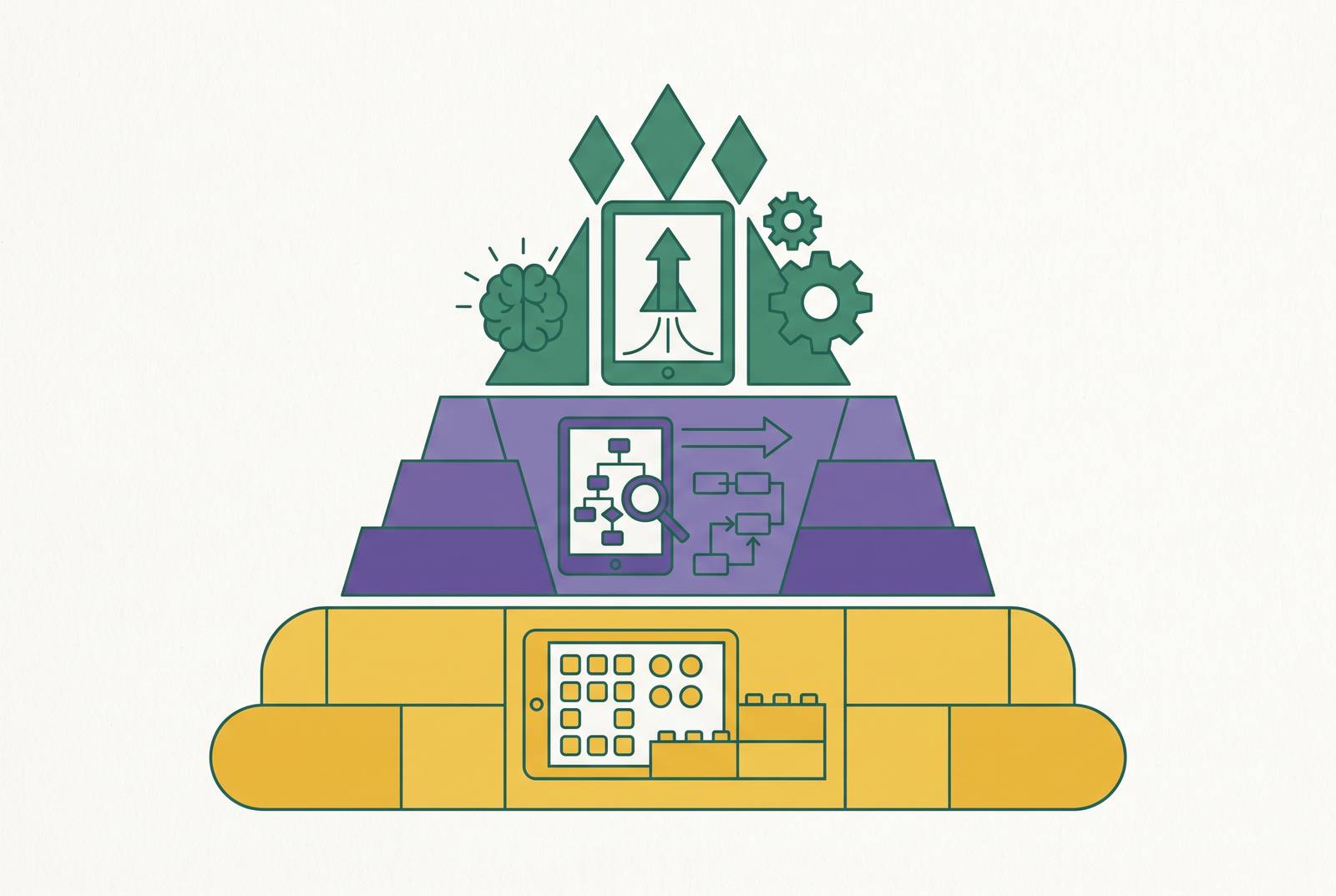
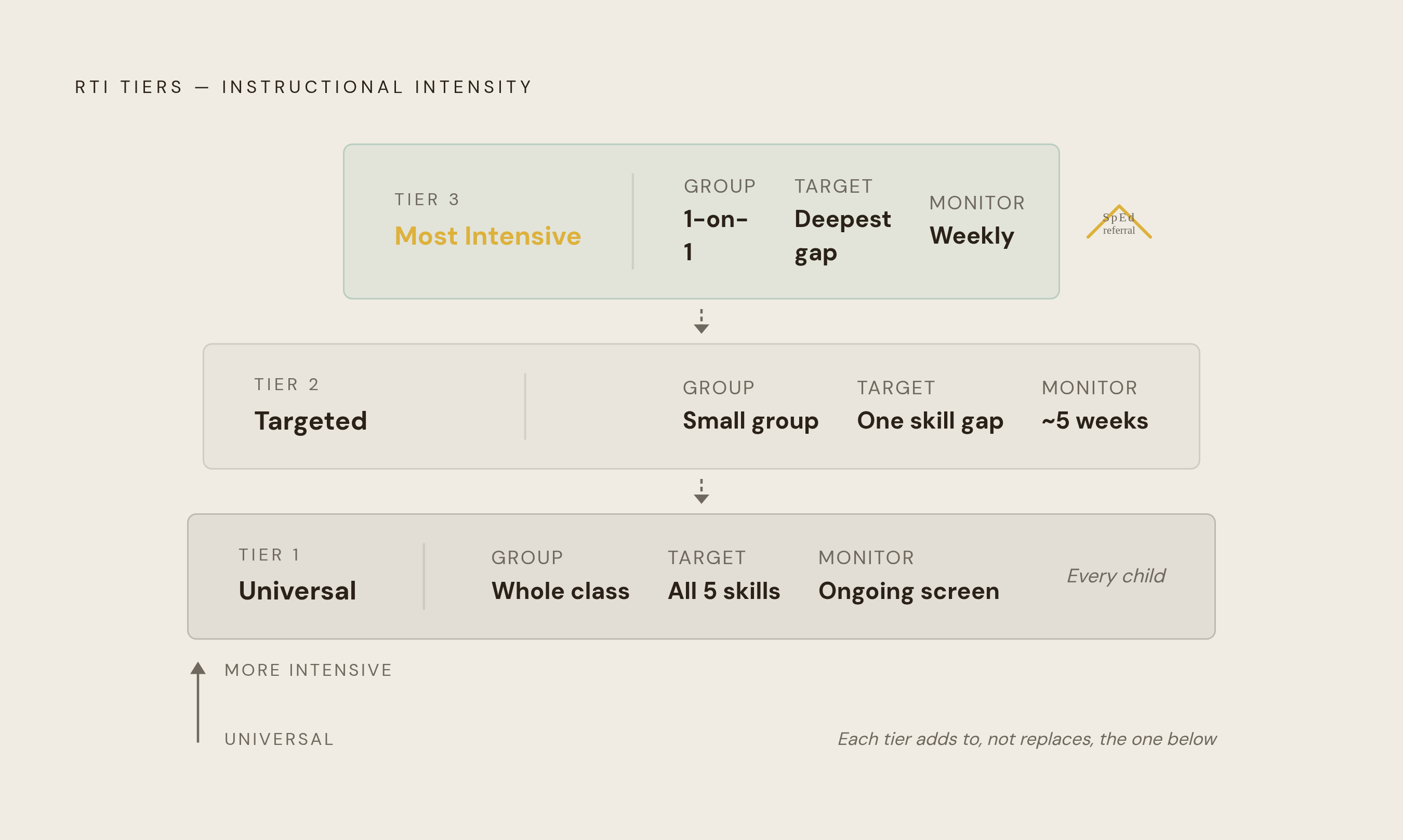
Tier 1 is the instruction every student gets: high-quality, evidence-based, tied to grade-level standards, with early screening built in to flag struggles. Tier 2 adds targeted, small-group support on top of that core instruction for kids with a specific, identified skill gap, with progress checked and reported to parents roughly every five weeks. Tier 3 is intensive, one-on-one remediation for kids who haven't closed the gap at Tier 2, with monitoring tight enough to tell quickly whether the plan is working.
RTI replaces "does this child have a disability?" with "is this child responding to the instruction in front of them? That turns the spotlight onto the quality and fit of the instruction itself, not just the child.
Each tier carries different demands: group size, how narrow the skill target is, how often progress gets checked, how individualized the approach needs to be. An app built for broad, grade-level content might do real work at Tier 1 and fall apart the moment a child needs Tier 2's precision. Picking the right app starts with asking which tier's job it's actually built to do.
What Tier 1 Needs from a Learning App
Tier 1 sounds simple on the surface: give every kid solid, grade-level instruction. But "solid" has a specific meaning here. Instruction has to be evidence-based, tied to standards, adjusted to the individual student, and responsive as that student's skills change week to week.
For reading, one state's education regulations spell out what that means in practice: Tier 1 instruction must include explicit, systematic teaching in phonemic awareness, phonics, vocabulary, reading fluency (oral reading included), and comprehension strategies. Not one or two of those. All five, together. An app that drills phonics decoding and calls itself "phonics-aligned" while skipping vocabulary and oral language work is only doing part of the job. The Science of Reading covers the full range, and a program built around just one strand of it is incomplete no matter how good that one strand is.
Math at Tier 1 carries a similar bar: instruction tied to grade-level standards, built around number sense, and adjusted as a child's understanding develops.
Most apps marketed as "educational" give kids access to content, not instruction that responds to them. A library of videos, a stack of quizzes, a game with stars and levels. That's a shelf of books, not a teacher. None of it tracks whether a specific child is actually gaining ground on a specific skill, and Tier 1 instruction is supposed to generate that signal through ongoing screening and assessment. An app with no way to report progress gives a parent or teacher nothing to act on.
The test for any app claiming to serve Tier 1 comes down to three things: does it teach the full range of foundational skills explicitly and in order, does it adjust to how a specific child is actually performing, and does it hand a parent or teacher data they can use. Ello builds its reading curriculum around the Science of Reading and its math curriculum around widely used grade-level math standards, both written by teachers and subject-matter experts, and because it listens to each child's voice as they read aloud, it adjusts instruction in the moment based on how that child is actually doing, which generates the kind of ongoing assessment data Tier 1 calls for.
The Hardest Tier for an App to Serve
Tier 2 is where most apps run out of road. It's instruction aimed at one specific, already-identified skill gap, delivered often enough and intensely enough to close that gap within a set window of time.
Real Tier 2 support has a few non-negotiable parts. It builds on Tier 1 instruction, adding to the classroom alongside it. Kids get grouped by the exact deficit they share, not a vague label like "struggles with reading" but something specific, like not yet blending phonemes. Progress gets checked on a set schedule. One school district, for example, shares that data with parents about every five weeks, so decisions to push harder, switch approach, or move a child out of the tier rest on evidence. And the approach has to flex: if a child isn't closing the gap fast enough, the plan changes.
This is where the vast majority of apps hit a wall. Most can't pinpoint which specific sub-skill is actually tripping up a given child. They can't narrow instruction down to just that sub-skill. And they can't produce the kind of regular, specific progress data a teacher or parent would need to judge whether the gap is actually shrinking. Handing a child an app and walking away isn't the same as making sure that child gets instruction matched to their specific deficit. Having the app open on a screen proves nothing. What matters is whether the instruction happening inside it is actually targeted.
A tool built for adaptive, one-on-one teaching, rather than a generic platform with some skill modules bolted on, can get closer to that target. It listens for exactly where a child is failing at a specific task and adjusts what it teaches next in response, which produces the granular, responsive instruction Tier 2 is built around. That one-to-one model sits structurally closer to what Tier 2 demands than any group-content library or quiz loop ever could.
Most apps are failing at Tier 2 because they were built to deliver broad content, not to isolate and close one specific skill gap for one specific child, and that's simply a different design problem.
What Tier 3 Demands of an App
Tier 3 is the most intensive rung on the ladder, reserved for kids who haven't closed the gap even with Tier 2 support in place. It targets the most fundamental skills: reading, number sense, writing, English language development, social and academic behavior. Monitoring here is tighter and more frequent than at Tier 2, because the stakes of the decisions resting on that data are higher: whether to continue the intervention, change it, or refer the child for a special education evaluation.
Tier 3 doesn't replace what came before it. It stacks on top of Tier 1 and Tier 2, all three running together, not one swapped out for another.
No app available today, no matter how adaptive, can take the place of a trained interventionist's diagnostic judgment or the relational scaffolding a skilled teacher gives a child with significant learning differences. Any app positioned as a standalone solution at Tier 3 hasn't earned that claim with evidence, and parents should treat that kind of marketing with real skepticism.
That doesn't mean apps have no place at Tier 3. They can offer something genuinely useful between sessions with a human teacher: steady, patient, repeated practice on a narrow skill, with immediate feedback. They can lower the emotional weight of being corrected, over and over, by an adult. They can give a child a private space to get something wrong, try again, and get it wrong a few more times without an audience.
At Tier 3, the question a parent should be asking is how a given app fits inside a structured intervention plan that a qualified teacher or specialist is actually running. Knowing the limits of what an app can do here is what lets a parent use it well.
The progress-monitoring test that separates real instruction from busywork
Across all three tiers, one requirement cuts through the marketing faster than anything else: can the app actually show you what your child is learning, and how fast? Progress monitoring is a built-in requirement of RTI at every level, and an app that can't produce it isn't genuinely serving any tier, no matter what the app store description says.
Real progress monitoring starts with a baseline: where does this child stand against grade-level expectations. From there, it tracks whether the specific intervention in place is actually closing the gap that was identified. The measures that matter are specific to the skill: vocabulary growth, reading fluency, comprehension gains. Not total minutes logged. Not levels cleared in a game.
That data has to reach parents. CMCSS shares progress monitoring updates with families roughly every five weeks, and that cadence matters because parents are supposed to be part of the decision, not bystanders waiting for a report card.
Most apps report engagement, not learning. Minutes played. Levels completed. Stars earned. None of that tells a parent whether their child's phonemic awareness actually improved this month, or whether a specific math gap closed. An app that hands parents skill-specific progress, in plain language, on a predictable schedule, is doing the job RTI asks of it. One that only offers a leaderboard is a closed box, and a closed box can't help anyone make a real decision about a child's education.
Before downloading anything, parents should ask a direct question: what will this tell them about their child's progress on specific skills, and how often will they hear it? If the honest answer is "nothing" or "check the leaderboard," the app isn't aligned to RTI at any tier, regardless of how it's marketed.
Checking an App Against the Tier It Claims to Serve
Turning the RTI framework into a usable filter starts with three questions that apply no matter which tier an app claims to fit. Does it teach skills explicitly, modeling them directly for the child, or does it just hope exposure and repetition will get the job done on their own? Does it adjust to how a specific child is actually responding, or does it march every child through the identical sequence at the identical pace regardless of what they already know? And does it produce skill-specific progress data that an adult can actually use to make a decision?
From there, the fit depends on the tier a parent is actually trying to address. For Tier 1, check whether the app covers the full range of foundational skills, which for reading means phonemic awareness, phonics, vocabulary, fluency, and comprehension together, and for math means number sense tied to grade-level standards, while also differentiating based on what a child demonstrates and generating a signal a parent or teacher can act on. Good Tier 1 instruction is differentiated, tied to standards, and built on evidence, so an app covering only one skill strand or offering no differentiation at all hasn't met the bar, no matter how polished it looks.
For Tier 2, the question narrows considerably: can this app zero in on one specific, already-identified skill deficit, intensify instruction around that deficit specifically, and produce monitoring data often enough to support a real decision about whether the gap is closing. Anything used for Tier 2 purposes belongs alongside classroom instruction, adding to it, never swapped in as a replacement for it.
For Tier 3, the question shifts from what the app does to how it's being used: is it serving as a structured supplement inside a plan a qualified teacher or specialist is actively running, and do the adults managing that plan actually have access to the data the app produces. No app should carry the full weight of intervention at this level on its own. Applied this way, tier by tier, the RTI framework turns from a school district's internal planning language into a plain checklist any parent can use before a single download.