Twice-Exceptional Children and Early Literacy Instruction
Gifted children with dyslexia often hide both traits from teachers.
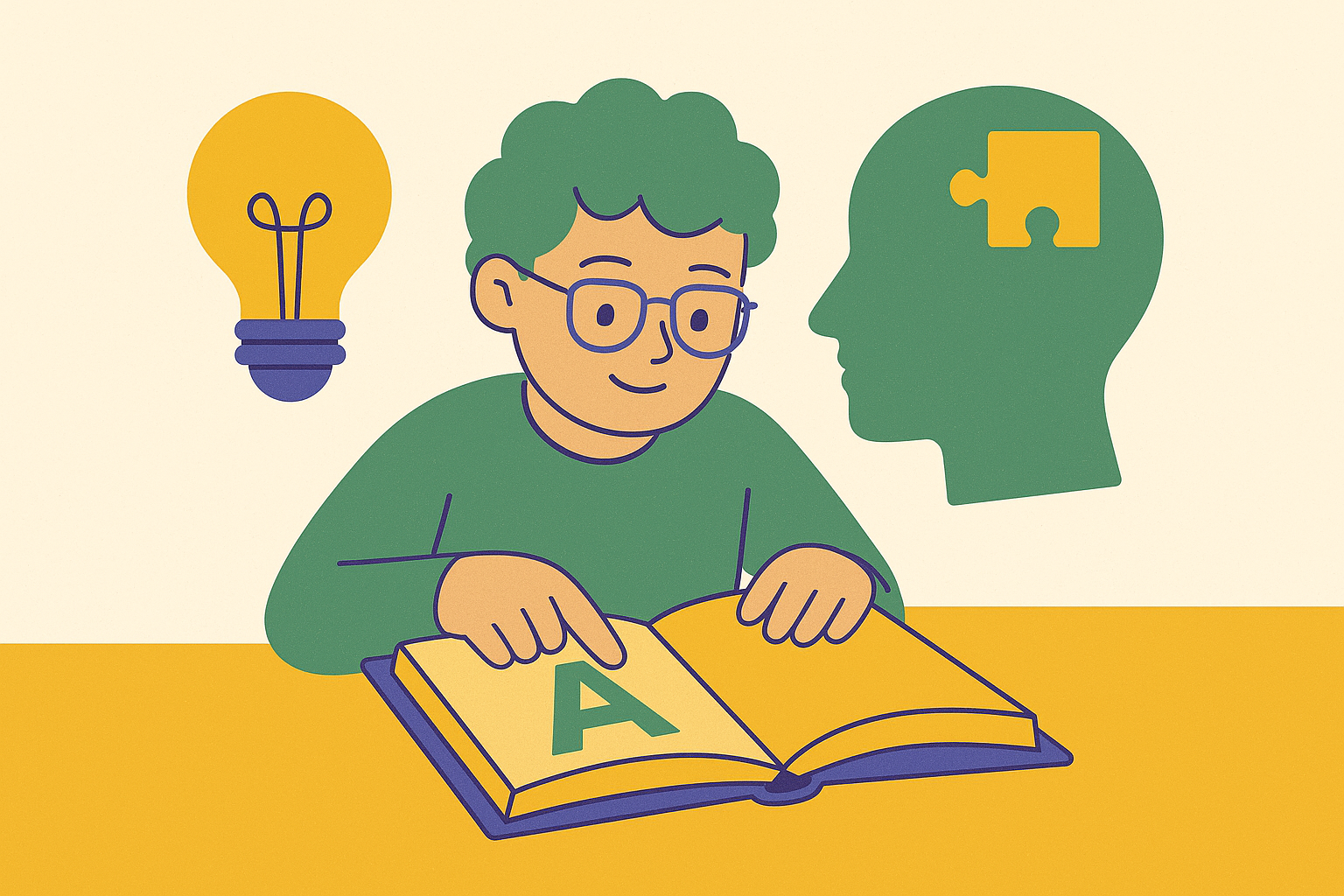
Twice-exceptional, or 2e, describes a child who is both intellectually gifted and living with a learning disability at the same time. These two traits don't average out into something ordinary. They collide and interact, producing a profile that looks uneven rather than balanced: sharp in some areas, genuinely struggling in others, often within the same subject and the same hour of instruction.
Giftedness here has a specific, measurable meaning. It refers to advanced cognitive functioning: unusual efficiency in learning new material, solving problems, and processing information. Researchers typically identify it through standardized cognitive assessments, with an IQ threshold most often set at 130, a cutoff that applies to a small fraction of the school-aged population (Alonso Benito et al., 2026). The 2e population as a whole is estimated at roughly 1 to 5 percent of school-aged children, per the same research.
The pairing most relevant to early literacy is intellectual giftedness alongside dyslexia. A child can reason like a much older student, hold complex conversations, and ask sophisticated questions, while facing a specific, measurable disability in how the brain processes written language. Alonso Benito and colleagues describe the defining trait of this profile as its non-uniformity: strong reasoning and metacognitive skill sitting next to specific deficits in working memory, processing speed, or particular academic skills, in this case, decoding.
It helps to drop the idea of a "gifted half" and a "disabled half" sitting side by side in the same child. That framing implies the two traits stay separate, each doing its own thing, but they don't. The giftedness shapes how the dyslexia shows up, and the dyslexia shapes how the giftedness gets expressed, so identifying either one in isolation tends to fail.
Strengths and deficits masking each other in the classroom
The literacy profile of a 2e gifted-dyslexic child follows a consistent pattern: marked weakness in lower-level processes like phonological and lexical processing, paired with relative strength in higher-order language skills like comprehension and composition. That combination is precisely what allows the child to go unnoticed in both directions at once.
Alonso Benito and colleagues (2026) measured this directly. Students with both giftedness and dyslexia showed difficulties in phonological and lexical processing that put their performance close to peers who had dyslexia without giftedness. At the same time, these same students showed relative strength in text comprehension, oral comprehension, and written composition, areas where their gifted peers without dyslexia also excelled.
That split plays out visibly in a classroom. A child who can discuss a book's themes with real insight, answer comprehension questions correctly when a passage is read aloud, and construct a thoughtful written argument looks, to most teachers, like a strong reader. The decoding problem never surfaces, because the child has built ways around it: guessing words from context, memorizing whole-word shapes, leaning on humor to redirect attention, avoiding read-aloud moments, or perfecting the parts of the work that don't require decoding, and these compensations are what keep the disability hidden. These compensations work well enough, for a while, to keep the actual deficit hidden.
A second failure mode runs the opposite direction. When the decoding difficulty is severe enough that it can't be hidden, teachers often see only the deficit. The child gets placed in a lower reading group, handed simplified material, and treated primarily as a struggling reader. The giftedness goes unrecognized because nobody is looking for it once a disability label is already attached.
Both outcomes carry a cost beyond the academic one. Bright children who have to work much harder than their peers at something as basic as reading often draw the wrong conclusion about themselves: that if a skill requires real effort, they must simply not be good at it (Council for Exceptional Children, 2025). That belief can settle in early and shape how a child approaches every subsequent challenge. Alonso Benito and colleagues describe the broader consequence: these students remain invisible in mainstream classrooms, with their talents untapped and their difficulties unmet.
Decoding as the Weak Link for a 2e Child
The relationship between decoding and comprehension works like a chain. Decoding supports fluency, and fluency is what opens the door to deeper comprehension. NWEA's 2025 research found that for elementary readers specifically, improving word decoding produces a large boost in comprehension, both in the near term and over the longer run of a child's schooling.
For a 2e gifted-dyslexic child, that chain breaks at a specific link. The child's comprehension, when information comes in through listening, can be well ahead of grade level. But the decoding step, converting printed letters into sounds and words quickly and accurately, is where things stall. The child understands advanced ideas just fine when someone reads to them. Decoding grade-level text independently is a different, much harder task, and one their cognitive strength doesn't automatically solve.
Two markers catch this before it compounds: phonemic awareness, the ability to hear and manipulate individual sounds in words, and alphabet knowledge. NWEA's 2025 research found both can be assessed before a child is even reading words on a page, so the warning signs are detectable well before a report card would ever reflect a problem.
Reading dyslexia correctly matters here. One widely used definition frames it as a specific learning disability rooted in neurological differences that affect how the brain processes language, not a reflection of intelligence or effort. That distinction matters most for a 2e child, because the surrounding adults are often the ones most likely to assume the opposite: that a child this sharp couldn't possibly have a real processing disorder, and must just need to try harder.
The stakes of catching this early are higher for a 2e child than for a child with dyslexia alone, because the distance between their thinking level and their reading level is wider. A child whose mind is working three or four grade levels ahead, while their decoding sits below grade level, feels that gap every single day. Reading becomes slow, inaccurate, and tiring, and a child who finds reading exhausting avoids practicing it, which only widens the gap further.
Catching that gap before compensation strategies take hold requires watching how a child actually decodes, not just whether they seem to understand what they've read. Apps like Ello, which listen to a child's voice in real time and track decoding patterns independently of comprehension, can detect a dyslexic profile even when a gifted child is successfully compensating with context clues and reasoning. That kind of moment-to-moment tracking matters precisely because the surface performance, a child who sounds fine in conversation about a book, is the thing hiding the problem.
How standard instruction misses 2e children in both directions
Most classroom differentiation is designed to move in one direction at a time: either remediation for students who are behind, or enrichment for students who are ahead. A 2e child needs both running at once, in the same lesson, and that combination is something most teachers have never been trained to deliver.
Lewis and Milam found that differentiation, while beneficial for all learners, gets applied unevenly. Teachers frequently use it to support students who are behind, but they don't consistently or effectively differentiate for advanced learners. That asymmetry isn't a matter of individual teachers falling short. The structure of most gifted and special education programs keeps the two tracks separate, built on the assumption that a child belongs in one category or the other (Council for Exceptional Children, 2025). A 2e learner doesn't fit cleanly into either box, and the system wasn't built with a third box in mind.
The practical result appears in two predictable ways. A child placed in a remedial reading group gets phonics instruction but faces simplified, low-complexity content, so the giftedness goes unserved. A child placed in a gifted track gets intellectually rich material but no structured decoding support, so the disability goes unaddressed. Neither placement solves the actual problem, and both carry their own emotional cost: one leaves a bright child bored and underestimated, the other leaves a struggling decoder overwhelmed and unsupported.
The research term for the fix is dual differentiation: differentiating for depth and complexity at the same time as differentiating for remediation, rather than choosing one axis and defaulting to it (Lewis and Milam, 2026). It's a deliberate, two-track approach built into the same instructional plan, not an either-or choice between challenge and support.
Teacher training hasn't historically prepared candidates to do this. Lewis and Milam describe an education preparation program that built a specific scenario into its coursework just to give teacher candidates practice with dual differentiation, treating it as a skill gap that has to be filled on purpose rather than something teachers will pick up naturally on the job. Dual differentiation is a trained competency that most classrooms haven't had access to yet, not a soft skill or a matter of teacher intuition.
Reading apps for dyslexia that don't dumb content down
Parents searching for an alternative to a mainstream reading app for a child who resists reading, or who has a language-based learning disability, are usually running into one of the two failure modes above: an app that remediates phonics but flattens the content into something a bright child finds insulting, or an app that offers rich, engaging content but never actually builds the underlying decoding skill. The research points to a clear standard for judging any literacy tool meant for a 2e child: does it address phonological deficits directly and explicitly, while also sustaining the cognitive complexity the child's giftedness demands? Alonso Benito and colleagues (2026) frame these as two obligations that aren't in tension, provided the instruction is designed to carry both at once.
On the decoding side, the evidence-based standard is explicit and systematic phonics instruction. NWEA's 2025 research defines the terms precisely: explicit means the skill is taught directly, through modeling and clear explanation, not picked up incidentally through exposure. Systematic means the skills are sequenced deliberately, moving from simple sound-letter relationships to more complex patterns in a planned order, not scattered across content based on theme or interest.
On the enrichment side, effective instruction has to offer real depth and age-appropriate complexity, not simplified material that waits for decoding to be "fixed" before engaging a child's actual thinking. The Council for Exceptional Children's 2025 guide frames this as a strengths-based approach: building classrooms around professional learning and dual differentiation strategies that treat neurodiversity as a strength to develop, not a barrier to work around.
Identification has to match that same dual standard. Alonso Benito and colleagues call for staged, multidimensional identification procedures that weigh both strengths and weaknesses within one framework, rather than relying on a single global measure of literacy or academic performance that will only ever capture one side of the profile.
For a child whose thinking is already advanced, the frustration of slow, inaccurate decoding is sharpened by the fact that they know they should be able to read fluently. Instruction built for this profile has to be genuinely personalized rather than one-size-fits-all: honoring the cognitive sophistication a 2e child already has, while systematically building the decoding foundation that's missing, calibrated to the child's actual, measured performance rather than their grade level or their reasoning ability alone. An app marketed as an alternative for this purpose should track real decoding accuracy independently of comprehension, and its content should respect a reader's intellectual age even when their decoding age lags behind it.
What Parents Can Do
Most schools aren't structurally set up to deliver dual differentiation on their own. Parents of 2e children often end up doing the work of brokering the right instruction themselves. Knowing specifically what to ask for makes that job far more manageable.
Start with assessment. A single IQ test tells a school about reasoning ability. A single reading assessment tells a school about overall literacy performance. Neither one, alone, captures a 2e profile. Alonso Benito and colleagues' research supports pushing for evaluation that covers both higher-order language abilities, like comprehension and verbal reasoning, and lower-level phonological processing, like phonemic awareness and decoding accuracy. Without both pieces measured side by side, a school will see only the half of the profile that happens to be loudest.
Use the term itself. Naming the profile explicitly, calling a child "twice-exceptional" or "2e" in meetings with teachers and administrators, opens access to both gifted programming and special education services at the same time. The Council for Exceptional Children's 2025 guide states that the two systems are not mutually exclusive, even though most school structures treat them as separate tracks a child has to choose between.
Outside of school, tracking a child's actual decoding performance, not just their comprehension or their enthusiasm for a book, gives parents the kind of evidence that strengthens these conversations with a school. A 2e child needs teaching built around their real, moment-to-moment reading data rather than a one-size-fits-all curriculum, so the decoding gap can close without losing the depth their thinking already has access to. The profile is hard to see because it's built to hide itself in both directions at once. Instruction that can see both sides, and parents who know to ask for both, are what finally catch it.
Sources
- Literacy Profiles in Twice-Exceptional Preadolescents with Intellectual Giftedness and Dyslexia - PMC
- ERIC - ED678674 - Twice-Exceptional Education: Connecting Gifted and Special Education, Council for Exceptional Children, 2025
- ERIC - EJ1496639 - Powerful Learning: Dual Differentiation for Twice-Exceptional Learners, Journal of Advanced Academics, 2026-Feb
- Twice-Exceptional Education: Connecting Gifted and Special Education
- What the science of reading tells us about how to teach decoding—including phonics - Teach. Learn. Grow.
- Reading and Writing Profiles in Twice-Exceptional Adolescents with Intellectual Giftedness and Dyslexia - PMC
- Cognitive and Reading Profiles of Gifted Students with Learning Disabilities: Implications for Assessment and Identification - PMC