Math Apps That Build Number Sense in Early Grades
Strong number sense in early grades predicts math success better than reading ability does.

Number sense is not the same thing as counting. It's a specific set of skills, subitizing, magnitude, number relations, cardinality, and more, and a math app either builds those skills directly or it doesn't. This piece lays out what number sense actually is, why it matters more than most parents realize, and how to tell a real number-sense app from a digital worksheet.
Start with what the term actually means, because "number sense" gets used loosely enough to be meaningless. It isn't rote counting. It isn't memorizing that the numeral "7" is called "seven." It's a cluster of distinct, nameable competencies that develop somewhat independently of each other, and a child can be strong in one and weak in another.
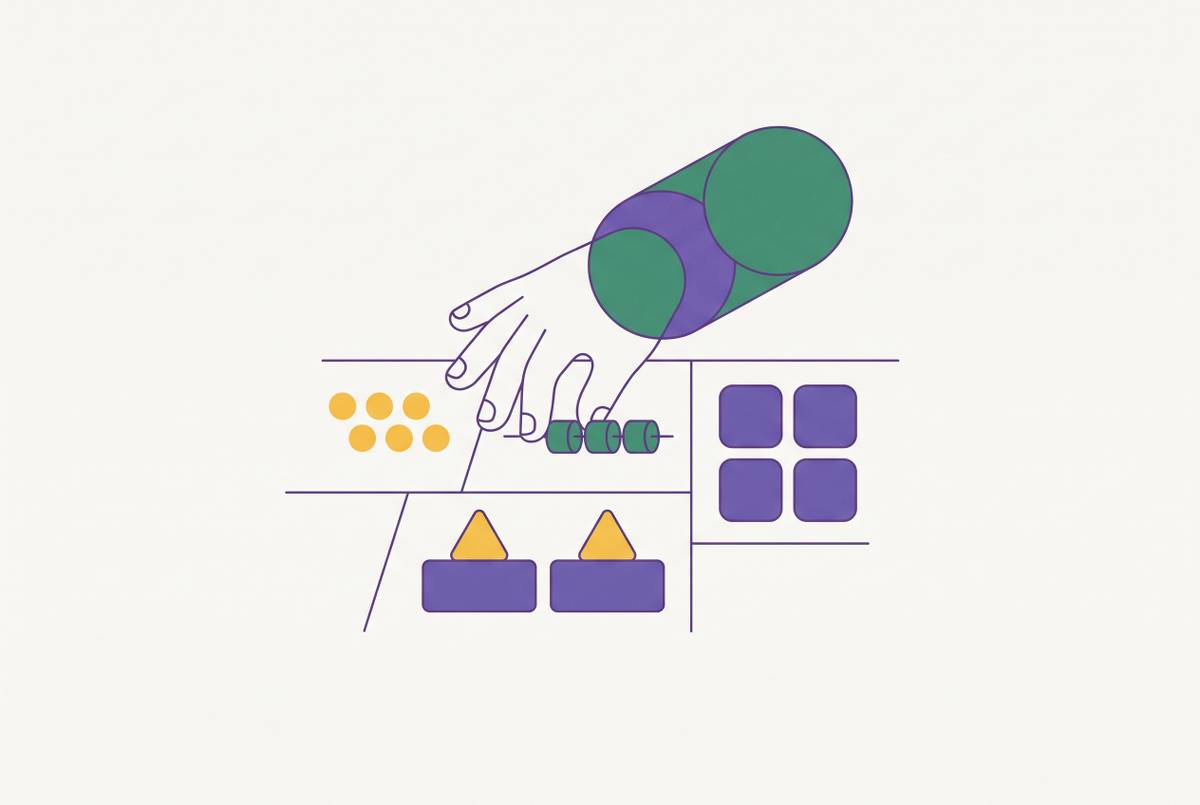
Subitizing is the ability to look at a small group, up to about four objects, and know the quantity instantly, without counting. Show a child three dots and a child with subitizing skill doesn't count "one, two, three." They just see three.
Conceptual subitizing is the next layer up: seeing a larger group as smaller subitizable chunks. Six dots arranged as two groups of three. A child with this skill sees "three and three," not six individual dots.
Cardinality is understanding that the last number you say when counting represents the total group, not just the last item touched. This trips up more kids than parents expect. A child can count "1, 2, 3, 4, 5" across five blocks and, when asked "so how many blocks are there?", start counting again from one.
One-to-one correspondence means matching each counting word to exactly one object, no skips, no double-counts.
Magnitude is knowing which of two numbers is bigger, and having some feel for roughly how big a quantity is without counting it exactly.
Number relations cover how numbers sit next to each other: 3 is one more than 2 and one less than 4. This is the layer that lets a child compare, order, and eventually estimate.
Number operations round it out: an early, intuitive grasp of what happens to a group when you add to it or take away from it, well before formal addition and subtraction show up on a worksheet.
The US National Research Council frames this as three strands that all need to grow together: knowledge of numbers, relationships between numbers, and number operations. None of the three substitutes for the others.
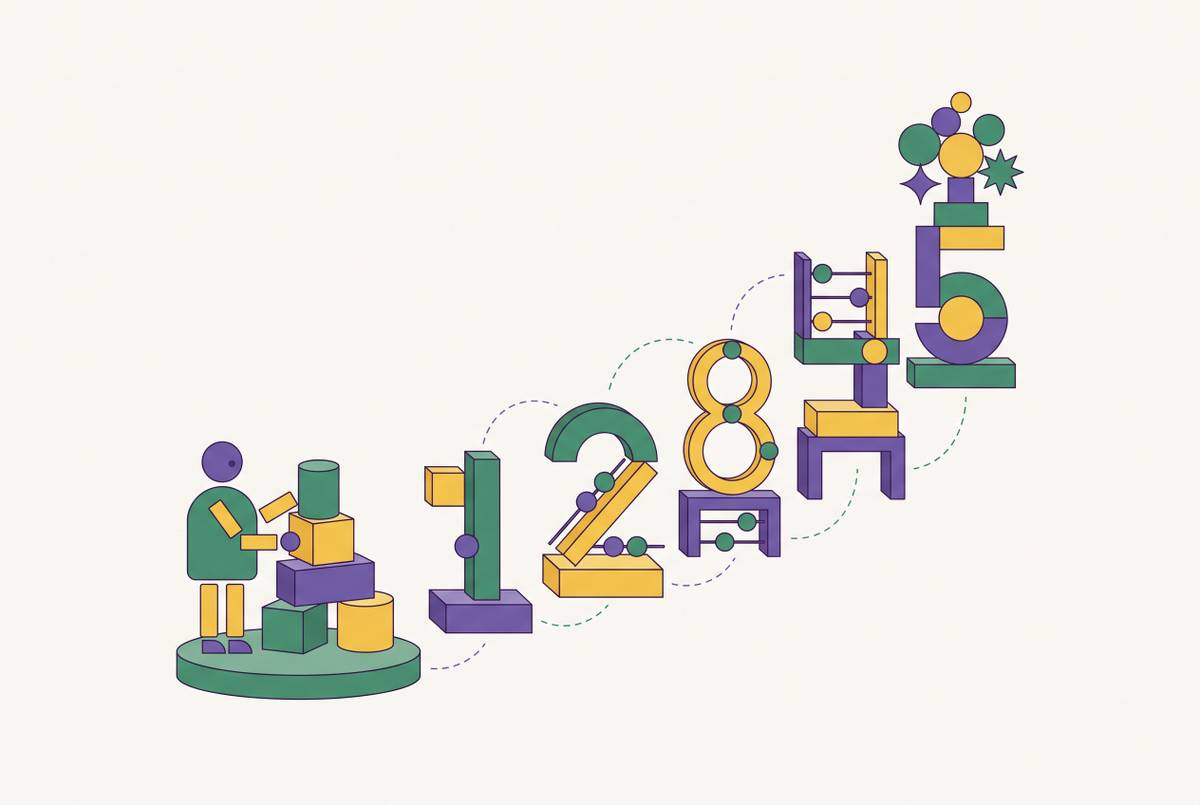
And it starts earlier than most people assume. Long before formal counting, kids are sorting shapes, stacking blocks, and figuring out what fits where, building early intuitions about quantity and size through play, not instruction. Research suggests that children begin associating quantity with counting well before they can count accurately themselves. The window for number sense opens early, and it opens quietly.
A child who can rattle off counting to 20 but can't tell you whether 7 or 9 is bigger has not developed number sense; that is the practical test that separates real number sense from its imitation. They've memorized a sequence of words. That's a real skill, but it isn't this one.
How early number sense shapes the rest of a child's academic life
Early math ability predicts later academic outcomes better than early reading ability does, and that holds true for later reading scores too. That finding tends to surprise people who assume reading is the foundational skill. Number sense, it turns out, does something reading doesn't: it forecasts.
Research has found that strong number sense in preschool reliably predicts math success by third grade. That's a three-to-four year gap between the measurement and the outcome, which says the skill isn't just correlated with later performance, it's laying the groundwork for it.
A study assessed 450 children using something called the Screener for Early Number Sense. It accurately predicted which pre-K, kindergarten, and first-grade students would go on to show math difficulties a full year later. That's not a small claim. It means the gap is visible before it becomes a problem, if someone knows to look for it.
And the gaps show up early. Research has found that individual differences in number sense emerge before kindergarten even starts, and they tend to persist through elementary school. They don't close on their own. Research tracking children forward has found that kids who start school with weak numeracy are significantly more likely to still be struggling years later. The gap doesn't stay the same size, either. It tends to widen.
There's an equity layer here too, and it matters. A 2024 study in PLoS ONE (Jiang & Wang, n=314, children aged 5 to 6) found that family socioeconomic status significantly predicts number sense development, and that this relationship runs partly through parent-child math activities at home. Translation: the gap isn't purely about a child's innate ability. It's shaped by access, exposure, and how much math talk happens around the kitchen table.
The scale of where this leaves things now is not small. The 2024 National Assessment of Educational Progress found nearly 1 in 4 fourth graders and 39 percent of eighth graders scored "below basic," the test's lowest category. The window for intervention is early. The consequences of missing it are long. And the gap, at this point, is measurable well before a child ever sits for a standardized test.
Why number sense isn't getting the same instructional attention as reading (and why that matters for what apps must do)
Reading instruction went through a well-documented reckoning. The Science of Reading identified specific, evidence-based components, phonemic awareness, phonics, and built curricula around them explicitly. Math hasn't had its equivalent moment reach classrooms the same way, even though the evidence base for it already exists.
The parallel is almost one-to-one. Subitizing and groupitizing function for numeracy the way phonemic awareness and phonics function for literacy: foundational, often invisible skills that need direct, explicit instruction rather than incidental exposure. This approach mirrors what Structured Literacy became for reading: explicit, systematic instruction in foundational skills.
What's missing in most classrooms follows a pattern. Students spend less instructional time on foundational numeracy than they do on reading. Elementary teachers, as a group, have historically had more preparation in how to teach reading than math. And the intervention infrastructure for kids who need extra math support has not grown at the same pace as the one built for reading.
Traditional early math curricula lean on rote counting and numeral recognition, calendar time, counting the days of the week, incidental number exposure, rather than explicitly teaching the competencies laid out earlier: subitizing, magnitude, number relations. This gap has been flagged directly by researchers in the field. Counting on a classroom poster up to some large number is not the same as teaching a child to compare two quantities.
Number sense is malleable, which should reassure parents rather than alarm them. It can be taught explicitly, and it can be taught effectively, even to children considered high-risk for math difficulties. Research has found this. The catch is that the instruction has to be explicit, systematic, and aimed at the right specific components, not just "more math time."
This is exactly where apps step in, and it's exactly where the gap between a good one and a bad one gets wide. An app that drills addition facts over and over isn't filling the instructional gap described above. An app that builds subitizing, magnitude, and number relations, deliberately and in sequence, is doing something closer to what the research says actually works.
The framework parents can use to evaluate whether an app actually targets number sense
None of this requires a teaching degree to evaluate. Five questions, applied in the first ten minutes with an app, tell most of the story.
Does it target subitizing and groupitizing, or only counting? Look for dot patterns, ten frames, and quick-recognition tasks where a child has to respond fast enough that counting isn't really an option. If every activity is "tap the number that matches," that's counting practice, not subitizing practice. Visual representations, dots, fingers, ten frames, are backed by 2023 instructional research as especially effective for building early numeracy, so their presence (or absence) is a real signal, not a design preference.
Does it teach number relations, or just isolated facts? Comparing quantities, ordering sets, "more/less/equal" tasks, number lines a child has to navigate. A child who can recite that 3 + 2 = 5 but has no sense that 5 sits between 4 and 6 has learned a fact without learning the relationship underneath it. That relational layer is often the piece that's missing.
Does it actually adapt to where the child is? This is where a lot of apps quietly fail. Static difficulty, the same sequence of problems for every child regardless of performance, is a workbook with a screen wrapped around it. Genuine adaptation means the app changes course based on errors: it stops drilling what's already mastered and shifts toward what's actually shaky. Adaptation is what separates instruction from practice. Both have a place. They are not interchangeable.
Does it use more than one way of showing the same idea? Non-symbolic representations, objects, pictures, dot arrays, and symbolic ones, numerals, number words, both matter, and a strong app moves between them rather than parking permanently in one.
Can a parent actually see what the child learned? Progress reporting isn't a nice-to-have feature buried in settings. It's the mechanism that lets a parent or teacher notice a specific stuck skill and intervene before it compounds.
A 2024 study in the Journal of Experimental Child Psychology found that mathematical language, the actual vocabulary of "more," "fewer," "equal," "greater than", predicted the development of most early numeracy skills, another anchor worth knowing. An app that uses precise math vocabulary out loud, not just pretty pictures, is doing more instructional work than one that isn't.
Apps that genuinely build number sense: what each one targets and where it falls short
Funexpected Math (ages 3 to 7) explicitly names number sense as one of four core areas it targets, alongside logical thinking, spatial skills and geometry, and early algorithms/coding. The app runs more than 10,000 interactive tasks across 675 lessons and over 50 math topics, and it was built in collaboration with researchers from UCL, the University of Chicago, and UC Berkeley. Its digital tutor adjusts challenge level in response to a child's progress, offering hints and guiding questions rather than a fixed script. It's picked up recognition too: Kidscreen's 2025 Best Learning App award for Original Preschool Digital, and an EdTech Breakthrough Award. Funexpected also claims a threefold acceleration figure, roughly 18 months of learning compressed into 6, with two 15-minute sessions a week. That number comes from the company's own promotional materials, and independent replication hasn't been confirmed, so it's worth treating as a marketing claim rather than a settled fact. Against the five-question framework, the app scores well on naming number sense directly and on adaptation. The acceleration number is the one figure to read with a raised eyebrow.
SplashLearn (Pre-K through Grade 5) covers a wide net: addition, geometry, number recognition, and more, through adaptive lessons and gamified activities aligned to Common Core, with a wide library of interactive math games. A free version exists with limited content, and premium requires a paid subscription. SplashLearn's own materials cite figures like 80 percent of children reporting more confidence within four weeks, and over 77 percent showing learning improvement when used more than four times a week in the first two months. Those numbers come from the company, not from independent peer-reviewed research, so they carry the same caveat as Funexpected's figures. On the framework, the breadth and gamification support engagement well. Whether it builds subitizing and number relations depends heavily on which specific games a parent selects, so it's worth checking that the library includes comparison and ordering tasks, not just arithmetic drills dressed up with animations.
DragonBox Numbers and its companion Big Numbers (available through Kahoot!+ Family or Kahoot! Kids) take a different approach entirely: games instead of lessons. Kids manipulate objects and solve puzzles, absorbing number sense and place value without explicit drilling. Later apps in the family extend into long addition and subtraction, algebra, and geometry. None of the early apps require reading, which makes them accessible to pre-readers specifically. The approach has research backing for game-based numeracy learning. On the framework, DragonBox is strong on non-symbolic representation and hands-on manipulation, the puzzle format genuinely builds intuition. Where it's less explicit is individual adaptation: it doesn't respond to a specific child's skill gaps the way an AI-driven tool does.
Moose Math, from the Duck Duck Moose family (ages 3 to 7), runs five multi-level activities: counting, addition, subtraction, sorting and shapes, and number patterns, wrapped in a city-building reward structure. It was developed with a Stanford educator and aligns to Common Core K to 1 standards. It's also completely free, no ads. On the framework, it fits well into the counting and early-operations layer, and the sorting and shapes activities brush up against number relations. Given the free price point, it works better as a complement to a deeper, more adaptive tool than as a standalone number-sense program.
Todo Math (Pre-K through 2nd grade) runs a wide range of activities and stands out on accessibility: multiple supported languages and accessibility-focused design features, and both visual and verbal assistance with customizable difficulty. It holds a strong ratings on major app review platforms. It's made by Enuma, co-winner of the Global Learning XPRIZE through Kitkit School, and it picked up Parents' Choice Awards in 2015 and 2018. On the framework, the accessibility features make it a genuinely notable option for kids who learn differently. The sheer breadth of activities is a plus, but parents should confirm the library actually includes subitizing and number-relations tasks specifically, rather than leaning mostly on counting and arithmetic.
How to match an app to where your child actually is right now
Age three to five is the subitizing, one-to-one correspondence, cardinality, and basic magnitude window. Look for non-symbolic, object-based activities here, not numeral drills. DragonBox Numbers and Moose Math both sit comfortably in this range.
For a child who's behind or visibly struggling, the fix isn't more practice in general, it's targeted practice on the exact skill that's weak. A child who hasn't mastered subitizing doesn't need more addition problems. They need subitizing tasks, specifically, until that skill locks in. Adaptive apps that can identify the actual gap and address it directly do more here than apps with broad but generic coverage.
For a child who's at or ahead of grade level, the goal shifts. It's not about racing through more content faster. It's about depth: teaching the same concept several different ways, and pushing toward estimation and mental math rather than just correct answers on a screen.
None of this happens in a vacuum, either. The 2024 PLoS ONE study found that more frequent parent-child math conversations and home math activities are tied to stronger number sense outcomes. Apps work best as one piece of a broader environment, not as a substitute for it.
A reasonable way to test any app: commit to two or three weeks focused on one specific skill area, then check directly whether the child can do something now that they couldn't do before. Progress in number sense shows up in what a child can actually do, not just in a score on a dashboard.
On frequency, research from the Journal of Experimental Child Psychology (2024) found that more frequent engagement in math activities, digital ones included, tracks with stronger number and spatial skills. A related large-scale study involving roughly 200,000 students found that observed usage averaged 10 to 15 minutes a week, though that number reflects typical use rather than a formal recommendation, most guidance in that space actually points toward 30 minutes or more per week as the real target. Either way, a short, consistent block of time, several times a week, beats one long session on a Sunday. Consistency is doing most of the work here, not duration.
Sources
- Stability of early number sense competencies for predicting mathematics difficulties - ScienceDirect
- The relationship between family socioeconomic status and the young children’s number sense development: The mediating role of parent-child activities
- Improving Preschoolers' Number Sense Using Counting Collections and Ten Frames
- funexpectedapps.com