ADHD and Early Reading Challenges in Young Children
Targeted phonological awareness training with rhythm support helps children with ADHD learn to read.

ADHD creates specific, identifiable obstacles to reading. They are mechanical breakdowns in attention, working memory, and phonological processing, and once a parent understands what is actually happening, the right kind of instruction becomes obvious. A child who struggles to read because of ADHD needs something different from a child who struggles because of dyslexia, and a reading app that genuinely teaches, rather than one that just occupies a screen, needs to be built around that difference.
Why ADHD makes reading hard
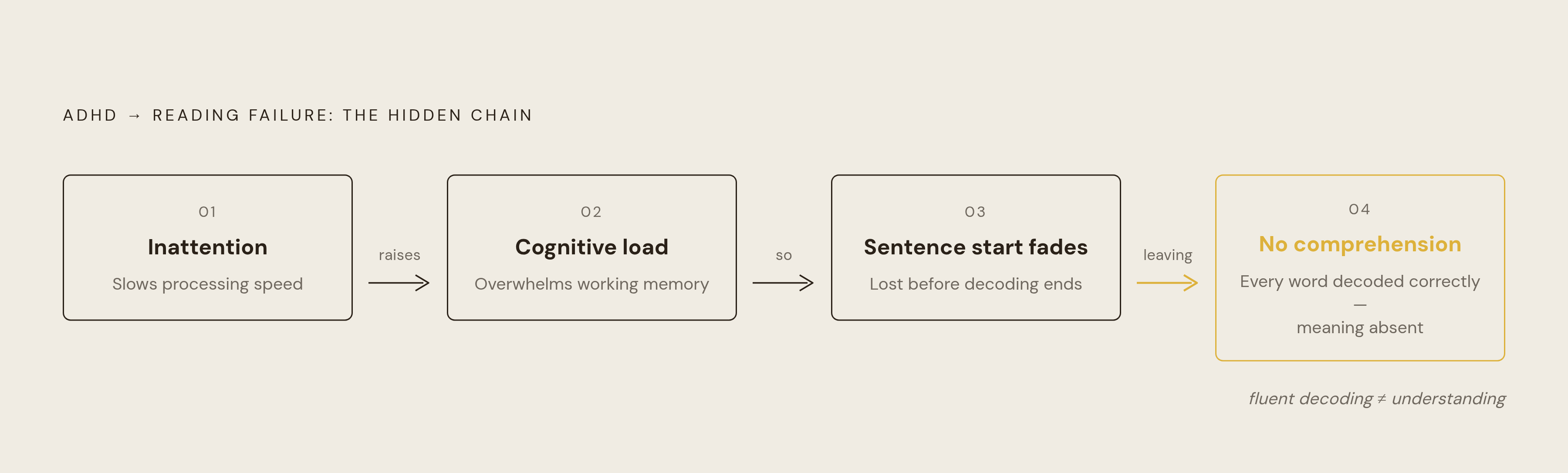
Reading research published in Child and Adolescent Psychopathology points to inattention, not hyperactivity or impulsivity, as the main driver of reading difficulty in children with ADHD. When processing slows, a sentence costs a child more cognitive load to read. That heavier load degrades working memory, the mental workspace a child uses to hold onto the beginning of a sentence while decoding the end of it. Once working memory is degraded, a child struggles to retain what was just read, and the struggle itself adds more load, feeding the cycle further.
That chain explains a pattern many parents find confusing: a child with ADHD can sound out every word in a sentence correctly, out loud, and still have no idea what the sentence said. The sentence did not land.
A second, partly separate vulnerability sits alongside the attention problem. Children with ADHD also face a higher risk of phonological awareness deficits, which is the ability to hear, isolate, and manipulate the individual sound units inside words. It means a child with ADHD can face two distinct cognitive headwinds at once: one in sustaining the attention reading requires, another in processing the sounds that make reading possible.
ADHD is not classified as a learning disability. If evaluations don't screen for each separately, a real reading difficulty can go unaddressed even when a child doesn't meet full diagnostic criteria for a reading disorder.
Why phonological awareness training, the backbone of Science of Reading, is structurally mismatched with the ADHD profile
Science of Reading research has settled the question of what early readers need: systematic, explicit instruction in phonological awareness, the skill of hearing and manipulating sounds inside words, before and alongside phonics instruction. That foundation is not in dispute. The delivery format is the problem, because it runs straight into the specific deficits ADHD creates.
Phonological awareness tasks ask a child to sustain attention over repeated, similar-sounding drills, hold speech sounds in working memory long enough to manipulate them, inhibit the instinct to blurt out a wrong but tempting answer, and repeat variations on the same sound pattern many times in a row. Research by Zhang, Huang, and Li in Frontiers in Psychology describes traditional phonological awareness interventions as built on repeated drills, prompt-based practice, and continuous corrective feedback. For children with ADHD, who are prone to attentional fluctuation and disengagement during repetitive activities, that same format tends to run less efficiently.
The developmental sequence behind Science of Reading instruction makes the mismatch sharper. Decoding has to become automatic, what reading researchers call the "consolidated alphabetic phase," before fluency becomes possible, and fluency has to be in place before deeper comprehension can follow. Reaching that automaticity takes exactly the kind of effortful, repeated practice that draws hardest on the resource ADHD leaves scarcest: sustained executive attention.
That raises a fair question. If systematic phonics is the gold standard for every early reader, and children with ADHD cannot sustain the standard delivery format, the evidence still holds up for this group. Phonics instruction is still the right content for a child with ADHD to receive. The format needs rebuilding, not the content. The Science of Reading research is sound, but when it's delivered through repetitive drills and corrective feedback loops, it can collide with ADHD's attention profile. Adaptive AI teaching apps like Ello fix that mismatch: they deliver phonological awareness training at a pace and rhythm matched to a child's real-time attention and cognitive load, not on a fixed schedule that assumes every child can sustain the same drill at the same speed.
Re-Engineering Delivery: Rhythm, AI Scaffolding, and the 2026 RCT
A 2026 randomized controlled trial by Zhang, Huang, and Li in Frontiers in Psychology tested a direct fix for this mismatch: add rhythm to phonological awareness training and deliver it through an AI-supported interactive model. The trial enrolled 165 kindergarten children with ADHD, stratified by gender and split 1:1:1 into three groups: rhythm-based phonological awareness training, phonological-awareness-only training, and a control group. 146 children completed the study. Both intervention groups received AI-supported instruction for eight weeks, in two 30-minute sessions per week. The control group received AI-supported oral storybook activities instead.
Both intervention groups beat the control group on all four measures of phonological awareness tested: syllable awareness, rhyme awareness, tone awareness, and phoneme-level awareness. So phonological awareness training itself works for children with ADHD when you deliver it consistently. The more striking result came from the comparison between the two intervention groups. The rhythm-based group outperformed the phonological-awareness-only group on character reading, syllable awareness, rhyme awareness, and rhythm discrimination. Rhythm added a measurable benefit on top of standard phonological training, not just a different flavor of the same result.
The theoretical basis for this traces back to a framework proposing that rhythmic processing supports phonological awareness development generally. A predictable beat does that predicting externally, which lowers the cognitive demand of tracking a sequence of sounds in real time.
Delivery mattered as much as content in this trial. Human research assistants handled attention management, device operation, and behavioral support alongside it. Neither component alone was the full intervention. The combination was. The Zhang, Huang, and Li trial shows that when you deliver rhythm-based phonological awareness through real-time AI-supported instruction, children with ADHD get meaningfully better outcomes than with standard phonological awareness training alone, because the AI can adapt around a child's moment-to-moment attention state, not just a fixed ability level. The underlying principle, that rhythm reduces cognitive load and that real-time adaptive delivery outperforms fixed-schedule drills for children with ADHD, applies well beyond that one language and age group.
What distinguishes ADHD reading difficulty from dyslexia
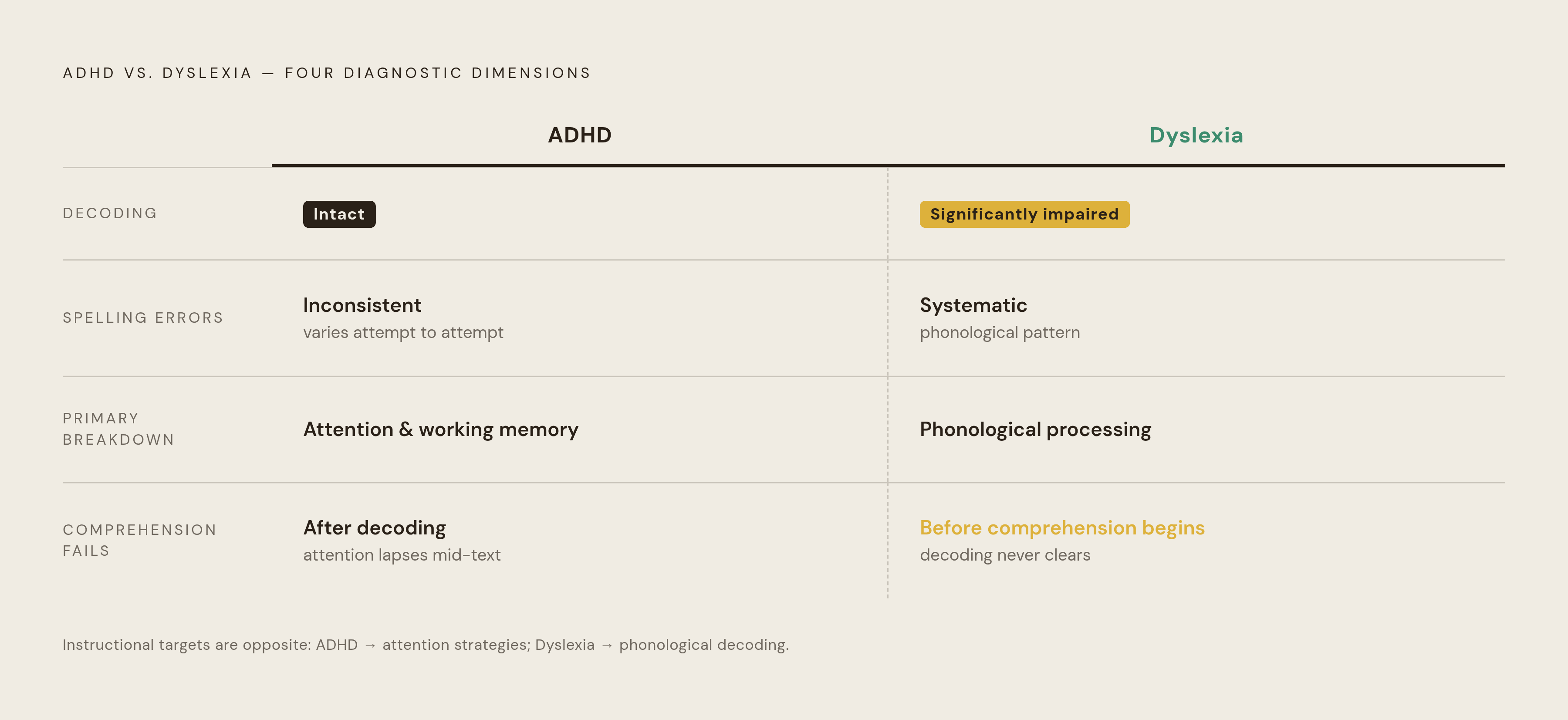
ADHD and dyslexia cause reading failure through different primary mechanisms, so if you treat them as interchangeable, you aim instruction at the wrong target. A child with ADHD typically has intact decoding skills. Spelling errors tend to be inconsistent, varying from one attempt to the next.
Dyslexia works differently. Phonological processing itself is the main challenge, and decoding skills are significantly affected as a direct result. Comprehension breaks down because decoding fails, not because attention lapses. Spelling errors follow a systematic, phonological pattern. ADDitude, writing in September 2025, draws the line clearly: ADHD reading difficulties stem from inattention, while dyslexia-related challenges stem from an inability to decode.
That distinction explains a pattern that confuses a lot of parents and more than a few teachers. ADHD depletes self-regulation, cognitive flexibility, and working memory all at once, and comprehension depends on all three. A child can clear the decoding hurdle entirely and still fail the comprehension test that follows it.
Dyslexia and ADHD co-occur more often than chance would predict. When a child has both, both mechanisms are active at the same time, and both need direct attention rather than addressing one and waiting to see what's left. A thorough evaluation should assess fluency, phonemic awareness, sight word recognition, comprehension, and spelling as separate, distinct measurements. That separation is what makes a child's specific profile visible, and a visible profile is what makes targeted instruction possible instead of a generic reading program applied by default.
Parenting strategies that reduce reading resistance and build genuine reading skill
The home strategies with the strongest backing for ADHD readers all follow one piece of logic: lower the cognitive and attentional demand at the moment a child sits down to read, while keeping the actual phonological and comprehension work intact. None of these strategies lower the bar on what a child is expected to learn. They change how much a child has to carry while learning it.
Build a consistent routine around reading: play, then reading, then free play again, in the same order every time. A predictable sequence removes the executive function cost of transitioning into a reading task. A child who already knows what comes next has more cognitive capacity left over for the reading itself, instead of spending that capacity figuring out what's happening.
Read together, carrying the harder words yourself. If you choose material slightly above a child's independent reading level, you build vocabulary without triggering repeated decoding failure, because you carry the harder words.
Check comprehension by asking a child to narrate what just happened, in their own words. That checks understanding without requiring writing, which adds a separate cognitive load, and it's heavy enough on its own to kill reading motivation. Narration keeps the check inside the same oral, conversational mode a child is already using.
Use audiobooks as a bridge, not a substitute. Children with ADHD can often listen to and understand stories well above the level they can read independently. Audiobooks complement phonics practice. They do not replace it.
Reinforce specific effort over general praise. Children with ADHD commonly carry frustration and self-doubt around reading, built up from repeated small failures. Guidance from the Huntington Learning Center notes that even mild reading skill weaknesses, combined with ADHD symptoms, create real barriers for a child, and telling a child to "try harder" misreads the problem as motivational when it's structural.
AI Teaching Tools and Children With ADHD
AI-powered reading instruction can solve the delivery mismatch described earlier, because it offers consistent pacing, instant feedback, and adaptive sequencing without the fatigue, frustration, or inconsistency that repetitive human-led drill tends to produce over time. That holds only when the tool is built to teach, not simply to entertain or quiz.
The 2026 RCT showed what AI delivery actually contributes: standardized pacing, prompts, target items, and feedback held consistent across every session, without asking a child to sustain social performance in front of another person. That consistency is what repetitive phonological awareness practice requires and what's hardest for a tired human instructor to hold steady across dozens of sessions.
A tool that listens to a child's actual spoken output in real time and responds to it operates on a different level than a quiz app or a library of videos. For a child with ADHD, that moment-to-moment feedback loop is what keeps attention tethered to the task in front of them. Adaptive instruction depends on that same loop: a child losing focus partway through a phoneme task needs a different next prompt than a child who just answered easily. A tool that can't register that difference is self-paced at best. It isn't adaptive.
There's a hard limit here that the 2026 RCT's own design acknowledges directly. A young child still needs a trusted adult next to the screen to handle the emotional and relational layer.
For a parent sizing up a reading app, the real test is whether the tool listens to a child's voice, tracks specifically what that child understands, decides what to teach next based on that understanding, and moves on once mastery is demonstrated. Ello is built on that architecture. It listens to each child's voice in real time, adjusts its instruction moment to moment, and grounds its reading curriculum in the Science of Reading, the same research base behind the intervention evidence described above. Its sessions run short and responsive, and it carries no ads and no in-app purchases, a combination that matches what ADHD learners need: low distraction, a clear task in front of them, and no reward structure engineered to maximize engagement at the expense of actual learning.
How parents can tell whether an approach is working
Progress for a child with ADHD comes unevenly, and parents who know the specific signs to watch for can course-correct early, before a child falls further behind or loses confidence in reading.
Start with a proper evaluation. Without one, "improvement" is just an impression, and a child quietly falling behind can go unnoticed until the gap is large and harder to close.
A few signs point to instruction that's working. A child starts reading with less resistance than before. Decoding errors shift from random to systematic, following a recognizable pattern. A child starts self-correcting mid-sentence when a word doesn't make sense in context, a sign that comprehension is active.
Other signs point to a delivery problem. A child who can perform a skill in isolation but loses it in connected text is being asked to do too much at once. A child who disengages specifically during repetitive drills, but not during novel tasks, is signaling a format problem, not a motivation problem.
Any tool a family uses should report progress in specific terms: phoneme-level accuracy, fluency rate, comprehension retention, the skills actually developing and the ones stuck in place. A streak counter or a generic score isn't progress data. Reading skill underlies success across every other subject a child studies, math, science, history, writing included, and a child who isn't reading fluently by mid-elementary school faces a disadvantage that compounds year over year. Catching the right signs early, and matching instruction to the actual mechanism at work, is what keeps that gap from opening.
Sources
- Frontiers
- Reading Comprehension in Children with ADHD: Cognitive Underpinnings of the Centrality Deficit - PMC
- Performance of Phonological Processing in Children with Attention Deficit Hiperactivity Disorder
- Correction: Effects of a phonics-integrated music rhythm intervention on reading fluency and accuracy with children
- Children with ADHD Symptoms Have a Higher Risk for Reading, Spelling and Math Difficulties in the GINIplus and LISAplus Cohort Studies
- What the science of reading tells us about how to teach decoding—including phonics - Teach. Learn. Grow.