Why Truly Free AI Learning Apps for Young Children Must Include Parent Progress Reports at No Extra Cost
Parent progress reports must be free, not a premium feature of adaptive learning apps.
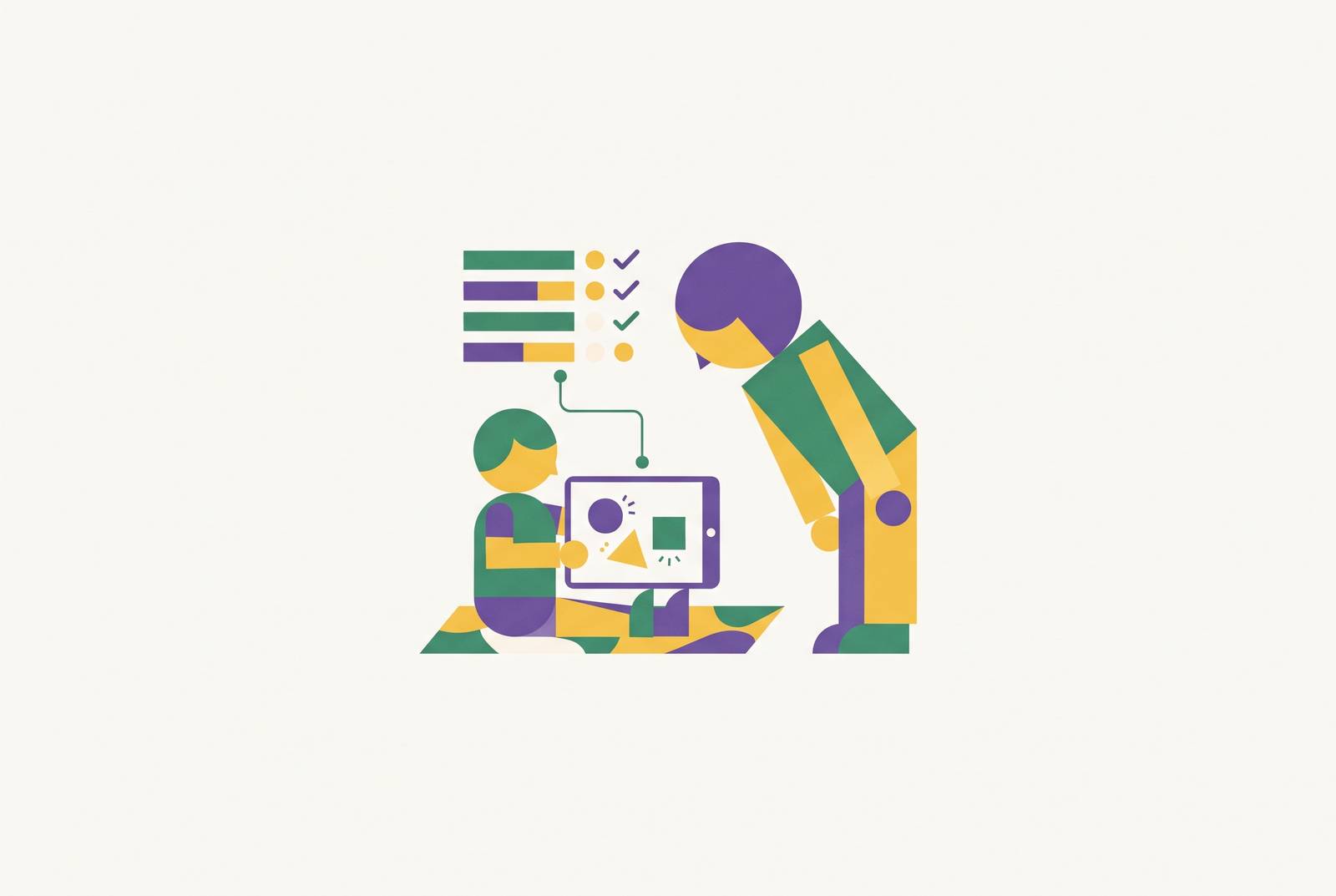
A personalized AI tutor for reading and math should adapt to a young child’s learning level and show parents what is improving, where progress has stalled, and how to help. This article makes a plain case for free parent progress reports. Without them, a “free” learning app leaves a necessary part of teaching behind a paywall.
Why parent progress reports are a structural requirement of adaptive AI instruction, not a premium add-on
An adaptive reading tutor listens to a child read aloud, detects a decoding gap, and adjusts the next prompt. That adjustment depends on a working model of the child’s skills. For apps serving ages 4–9, the model can include which words a child can decode, where fluency breaks down, and which math concepts remain shaky. The next lesson follows from those observations.
But the AI is not the only participant who needs that picture. A parent needs it to understand what the app is teaching and how the child is responding. When the software keeps what it observes to itself, it can still tailor lessons to the child while leaving the parent out of the teaching. The child gets a tutor the parent cannot see. Charging for access to that picture does not protect the information, but excludes the parent from a conversation already taking place with their child.
What adaptive instruction is actually tracking in the skill chain from phonics to comprehension
Action for Children’s science of reading overview describes five interdependent components, which are phonemic awareness, phonics, fluency, vocabulary, and comprehension. They develop together. Phonemic awareness is knowing the sounds in spoken words, while phonics links sounds to letters and letter patterns. Fluency concerns accurate, appropriately paced, expressive reading, while vocabulary and comprehension support meaning.
Decoding is the hinge between recognizing print and understanding it. NWEA’s 2025 analysis says that getting better at word decoding gives elementary readers a big boost in comprehension, both now and over time. Action for Children explains that as children grow more confident in decoding, they build fluency and can give more of their attention to comprehension. That distinction belongs in a useful progress report. A parent needs to know whether a child struggles to understand a passage because they have trouble reading its words or with another part of the skill chain.
These early signs can help before children start to read on their own. NWEA identifies phonemic awareness and alphabet knowledge as predictors that can help flag children at risk of later decoding difficulties. Fisher’s August 2025 GVSU master’s project finds measurable progress in blending, segmenting, and decoding when phonemic awareness and phonics are taught explicitly, including among preschool-age learners. An AI tutor doing this work well generates fine-grained skill data across sessions. A report should show that evidence rather than reduce reading development to completed lessons.
Why early numeracy data belongs in the same parent-facing report
Reading and math do not develop in isolation. Numeracy and general language mutually predict each other from ages 2½–3, while numeracy and mathematical language mutually predict each other from ages 3–4. A parent who sees both areas can understand progress that a reading-only report would leave out. For a tutor offering both subjects, reporting only literacy gives an incomplete account of its teaching. Math needs its own visible skill record.
The pattern over time is especially important. A longitudinal study following children from kindergarten through Grade 1 found strong numeracy growth throughout kindergarten, followed by a flattening curve in Grade 1. Children may still follow different paths from the one the study found. It does show why a record of change can be more useful than a single result. A parent who can see a plateau has a reason to ask questions that a hidden progress record would never prompt.
A combined report therefore needs more than separate reading and math scores. It needs to show which concepts are developing and whether that development is moving forward across sessions. Early numeracy is as predictive of long-term academic outcomes as early literacy, so leaving it out weakens the report’s purpose. The urgency is greater for children who begin school with fewer numeracy skills. Families cannot respond to a pattern they are not allowed to see.
Why the parent's role cannot be delegated to the AI — and what breaks without progress data
A parent downloads a learning app because they want help. The app may offer practice when parental time and energy are limited. But the parent still needs to know whether that practice is helping. An engaging session alone cannot answer that question. Progress information connects the trust placed in the app with evidence of what the child is learning.
Parents also contribute something different from adaptive prompts. Parents read a child’s emotional cues, explain ideas in context, and link what the child learns on screen to real situations. Parental involvement supports early literacy as well as social-emotional development and family connection. An AI can supplement that involvement without replacing it. To do so, it must share enough information for the parent to connect its instruction with life outside the app.
Without that connection, even a parent who wants to help has little to guide them. They cannot coordinate home reading practice with the skill the tutor is teaching, distinguish forward movement from a plateau, or bring a clear concern to a teacher or specialist. A report gives them the information needed to decide what support makes sense. The division of work is practical, with the AI adapting practice and the parent providing context, encouragement, and judgment.
How locking progress reports behind a paywall turns an equity tool into an equity barrier
Families least able to afford a subscription are also less likely to have other sources of support, including tutors, reading specialists, and well-resourced schools. For those families, parent reporting can supply information they cannot readily get elsewhere. A reporting paywall therefore does not affect every household equally. The same fee can separate one family from a convenience and another from a needed view of their child’s learning.
This is especially consequential when children begin school with fewer numeracy skills, as children from lower-income households often do. Seeing progress can help a parent spot an early gap and get help before it grows. An architecture that makes instruction free but charges for reporting splits the service at exactly that point. The child can receive practice, but the parent’s ability to understand its results depends on income. That recreates within the app an inequality personalized instruction is supposed to help address.
An app may deliver useful lessons and still make an unjustified distinction between families who can see progress and families who cannot. A Public Benefit Corporation model that commits to free access, including reporting, is one way to build access into the service. The commitment must include the report itself. Whatever it costs to run the service, its designers still choose which information parents must pay to see.
The strongest objection is that detailed reports can increase parental anxiety and undermine child autonomy
Research on parental math involvement suggests that parents sometimes reduce structured support when children show strength and intensify pressure when children show weakness. Detailed dashboards can make parents worry more about how their child is doing in school. A parent who treats every weak result as a demand for more practice may undermine the child’s autonomy. This is a serious objection to careless reporting.
It is not a reason to withhold reports. The distinction is between exposing raw scores and explaining learning in a form that helps a parent respond constructively. A grade-level ranking invites comparison, while a plain-language description can explain what the child did and what to try next. A trend line puts a difficult session in context. Suggested home activities can connect parental attention to the app’s current teaching without making the score the center of family life.
Good reporting should support judgment. Its language should describe developing skills rather than turn each result into a label for the child. Its suggested next steps should offer useful ways to engage. What parents can see and the parental controls they have are recognized ways to judge children’s AI apps, but how the app explains what parents see matters too. An anxiety-producing dashboard calls for better reporting accessible to all parents.
Why AI transparency in children's edtech has become an ethical and regulatory expectation
The 2025 child-rights audit by 5Rights and a university documented concrete risks in AI edtech tools. It found that a child’s use of a well-known AI classroom service activated commercial advertising trackers. The audit also identified age-inappropriate content, unsafe or misleading responses, and features that foster unhealthy emotional dependency. Wrong emergency helplines given to children in crisis were among the examples of harmful responses. These findings make opacity more than a usability problem.
Parents need enough visibility to exercise protective oversight. Progress reporting provides one view of what an app is doing with a child, particularly what it teaches and how learning changes. It is not a substitute for transparency about tracking, content, or other safety risks.
As more school systems make the Science of Reading a requirement, more teachers expect systematic, explicit phonics instruction. Reports that parents can see can help show whether practice in the app fits those expectations. An app that cannot demonstrate its instruction may be out of step with what a child’s teacher needs to see. These expectations place the demand for free reports within a broader ethical and regulatory movement toward accountable educational AI.
How do parents choose a personalized AI tutor for reading and math with genuinely free progress reports?
Parents choosing an app should require free progress reporting that is built into it. “Genuinely free” means all users can see progress without paying. Parents should take a closer look if reports come as a separate product or download, especially if they must pay to see them. The same is true when the free tier offers lessons but reserves learning data for subscribers.
A useful report names the phonics patterns, decoding skills, or math concepts the child is working on. It shows whether those skills are improving, plateauing, or regressing across multiple sessions. It then connects those observations to an activity or follow-up question a parent can use. For a struggling reader or a child finding math difficult, that combination is more informative than a broad score.
Reports grounded in the Science of Reading or Common Core math can give parents and teachers a shared vocabulary for discussing the child’s progress. Younger learners need visibility into early skills, including phonemic awareness and alphabet knowledge, while children already reading need reporting that distinguishes decoding, fluency, and comprehension. A tutor that teaches both reading and math should also show how numeracy is growing, with enough detail to see it within the overall result. These points can help parents choose an app, though naming one app as best for everyone would require evidence about the products.
Before downloading, the practical question is whether the parent can see what the child is learning and how they are progressing without paying extra. An app that answers yes still needs useful instruction and well-designed reporting. But an app that answers no has made parental participation conditional on payment.
Sources
- What the science of reading tells us about how to teach decoding—including phonics - Teach. Learn. Grow.
- The Science of Reading in Early Childhood: Building Strong Literacy Foundations
- Grand Valley State University Grand Valley State University ScholarWorks@GVSU
- Reciprocal development of numeracy, mathematical language, and general language skills from age 2 ½ to 4 years: A cross-lagged panel perspective - ScienceDirect
- Early numeracy and mathematics development: A longitudinal meta-analysis on the predictive nature of early numeracy.
- Full article: Early Numeracy in 3- to 4-Year-Old Children: The Role of Family Variables, Child’s Gender, and Language Skills
- Parental Numeracy Expectations, Home Numeracy Activities, and Children’s Early Numeracy Skills in Mainland China Across Urban and Rural Areas: Early Education and Development: Vol 37 , No 1 - Get Access
- Parental Anxiety About Children’s Education: Construct Clarification and Scale Development - Guo Xiaolin, Zhang Yifan, Xie Jiajia, He Surina, Su Ti, Luo Liang, 2025