Sight Words vs. High-Frequency Words in Science of Reading Classrooms
Decoding high-frequency words works better than memorization in science-of-reading classrooms.

"Sight word" and "high-frequency word" get used as if they mean the same thing in most classrooms and most homes. They don't, and treating them as synonyms is exactly what leads teachers and parents toward the wrong instructional move: handing kids a stack of flashcards to memorize by shape, when the word actually calls for a completely different skill.
A high-frequency word is defined by the text, not the reader. It's just a word that shows up a lot in written English, regardless of who's reading it. Tiffany Peltier makes this distinction clean in comments to K-12 Dive: frequency is a property of the language, not a property of any particular child's brain.
A sight word is the opposite kind of thing. It's defined by the reader's relationship to the word: any word that reader recognizes instantly, without sounding it out. Under that definition, "elephant" is a sight word for most adults. Not because anyone drilled it on a flashcard, but because a competent reader has decoded it enough times that recognition became automatic.
The overlap between the two categories is real, but partial, and that's exactly where the confusion sets in. "Said" and "the" are high-frequency, and may or may not be sight words yet for a given seven-year-old. "Thank" and "pretty" are sight words for lots of readers, but they don't show up often enough in print to count as high-frequency. Conflating the two categories means assuming every common word needs to be memorized rather than decoded, and that assumption is where a lot of early literacy instruction goes wrong.
The stakes are bigger than terminology. "The" alone appears roughly once every 20 words in written English, making it the single most common word in the language. And a small cluster of words does an outsized amount of work: just 13 words account for around a quarter of everything children read. That's not a decoding problem so much as a glue problem, holding sentences together so comprehension can happen at all. Getting these words automatic matters enormously. The question the Science of Reading actually answers is how.
How Science of Reading research sorts high-frequency words into three instructional categories
The Science of Reading (SoR) doesn't treat high-frequency words as one undifferentiated pile. It sorts them by how regular their spelling is, and that sorting changes the entire teaching plan.
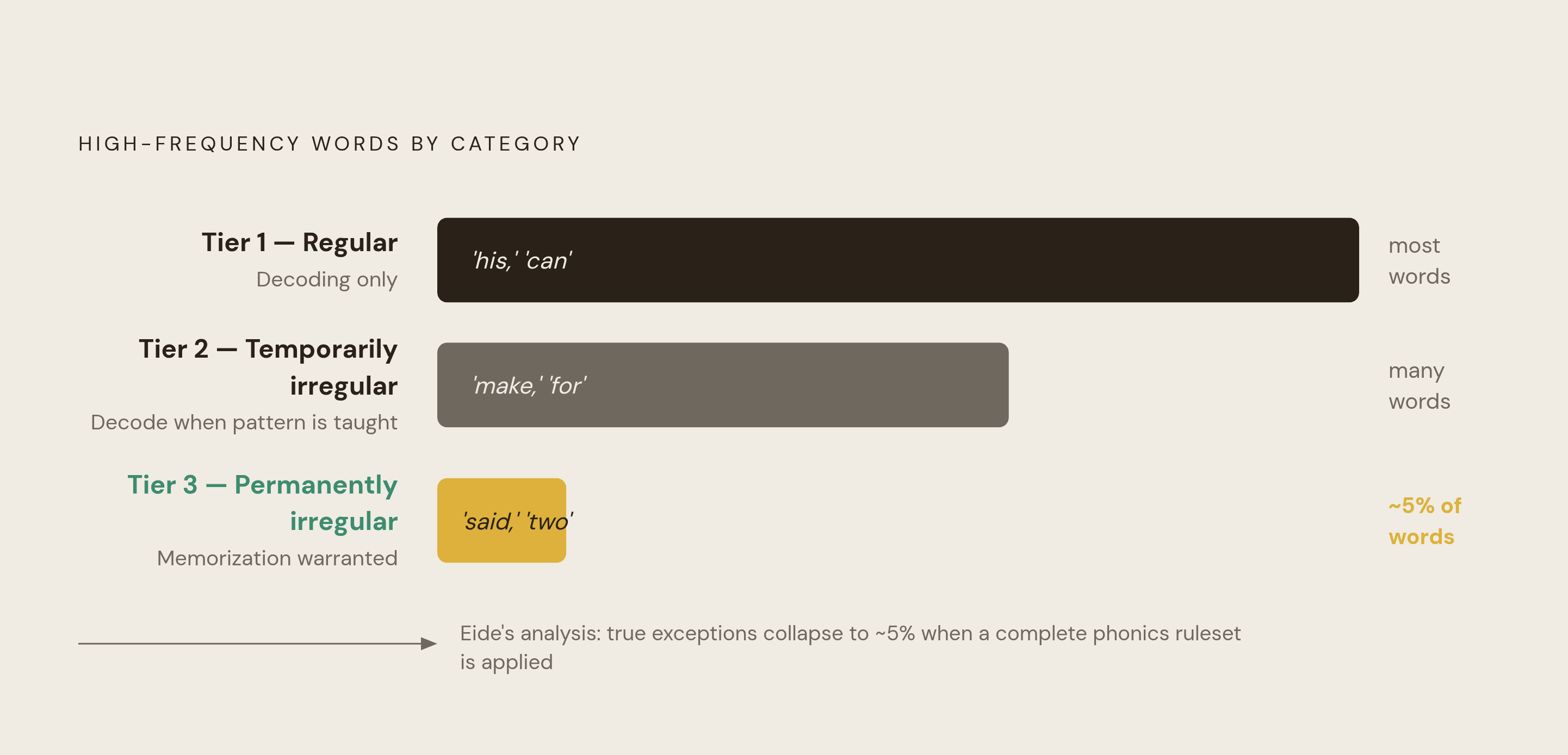
- Regular high-frequency words, like "his" and "can," are fully decodable using phonics patterns kids already know. These get taught through decoding, full stop.
- Temporarily irregular high-frequency words, like "make" and "for," only look irregular because the student hasn't hit that phonics pattern yet in the sequence. Once the lesson plan catches up, the word becomes decodable.
- Permanently irregular high-frequency words, like "said" and "two," genuinely break the sound-spelling rules. This is the only category where some targeted memorization is actually warranted.
That third category is small. Most high-frequency words don't need memorizing at all, they need sequencing: teach the phonics pattern, and the word falls into place on its own.
Here's the problem: the two most widely used classroom resources, the Dolch list (220 words) and the Fry list (1,000 words), predate this research by decades and make no distinction among the three categories. They just list words by frequency and leave teachers to guess at method. Tim Shanahan noted in EdWeek in January 2025 that roughly 300 high-frequency words cover about three-quarters of the words children encounter in print, which means the actual job is bounded and achievable. It doesn't require a thousand-word memorization slog.
A 2024 paper in The Reading Teacher (Green, Keogh, and Prout, doi:10.1002/trtr.2309) went further, arguing that existing high-frequency word lists are "among the weakest in terms of their research foundations." The authors built an alternative from a corpus of thousands of children's picture books, aiming for something methodologically sturdier for the first 100 to 300 words kids actually meet in early instruction.
The brain mechanism that actually turns decoded words into automatic recognition
Automatic word recognition isn't a teaching technique. It's a cognitive process called orthographic mapping, described by researcher Linnea Ehri in 2014, and it happens as a byproduct of decoding, not as a replacement for it.
Here's the mechanism: the brain bonds phonemes (sounds) to their matching graphemes (letters) as a child sounds a word out. Do that enough times, correctly, and the word gets filed away for instant retrieval. That's what a sight word actually is in reading science: not a word a child memorized by shape, but a word the brain has fully mapped through decoding.
Phonemic awareness is the engine driving how fast this mapping happens. Kids with strong phonemic skills map new words two to three times faster than kids with weaker skills, and most children need only one to four exposures to a decodable word before it's stored for automatic recall. That's a strikingly small number. It means drilling and re-drilling a flashcard isn't necessary for the majority of words, structured decoding practice is doing the job on its own, usually within a handful of encounters.
The scale of the endpoint is worth sitting with. A competent adult reader carries somewhere between 30,000 and 60,000 words as mapped sight words, all built from this same process repeated over years. Most kids start applying orthographic mapping in a meaningful way around second and third grade, which means everything taught in kindergarten and first grade phonics is laying groundwork for automaticity that shows up later.
Brain imaging backs this up. Research on reading development shows that skilled readers rely on neural pathways that link letter patterns to sound, building the efficient word recognition circuitry that phonics instruction supports. Phonics instruction isn't just the philosophically nicer option here. It's building the correct wiring.
What rote memorization actually does to beginning readers, and where it breaks down
The old logic wasn't crazy: memorize the most common words early, so kids can read simple books and feel like readers right away. That's a legitimate goal. The method just doesn't hold up at scale.
English has over 170,000 words in common use. Even mastering the entire 1,000-word Fry list by memory covers only a sliver of what a child will eventually need to read. Phonics gives a child a transferable code that generalizes to new words. Memorization gives a child exactly one word, and nothing else. Learning "said" as a visual shape hands a kid zero usable information about "says," "sail," or "air." None of it transfers, because none of it was ever a rule.
Predictable, leveled texts make the problem worse in practice. A page that reads "I see a police officer. I see a firefighter." trains a child to lean on pictures and sentence patterns instead of sounding words out. Peltier flags this directly in published commentary: it reinforces guessing at exactly the moment a child should be practicing decoding.
The harm isn't distributed evenly. Kids with dyslexia already face significant challenges with word recognition, so a strategy built entirely on visual memorization loads maximum weight onto their most vulnerable area. It's the reading intervention equivalent of asking someone with a bad knee to carry the heavy end of the couch.
This connects directly to the three-cueing debate. Some states have moved to restrict reading programs built around three-cueing, the practice of guessing words from context and pictures rather than sounding them out. Whole-word visual memorization is training the same guessing habit through a different door. There's a narrower tool called Paired Associate Learning, pairing a written word with its pronunciation for memorization, that has some legitimate uses. But it stops scaling once word volume climbs, so it can't function as a primary strategy. Per the EdWeek reporting on this topic, kids should know 400 to 500 words through decoding ability alone by the end of first grade. Only a small remainder should ever require rote memorization.
How SoR classrooms actually handle irregular high-frequency words in practice
Under standard phonics programs, somewhere between 30% and 40% of high-frequency words look like exceptions to the rules. That number is misleading. Denise Eide's analysis of English spelling patterns found that teaching a more complete set of phonics rules shrinks the true exception rate down to around 5%. Most of what looks irregular is really just a rule nobody taught yet.
Two specific approaches handle the genuine exceptions:
Heart Word Magic has a student decode the regular parts of a word normally, then explicitly flags the one irregular chunk with a heart symbol, framed as "you need to learn that part by heart." In a word like "said," the "s" gets decoded normally and only the irregular vowel sound gets marked. Decoding stays the default strategy, and only the genuinely broken piece gets isolated for memory work.
Paired Associate Learning pairs the written word with its spoken pronunciation for direct memorization. It has a place for the small set of permanently irregular words, but it was never meant to carry volume.
The stronger classrooms weave high-frequency words directly into phonics lessons rather than running them as a separate track. Teaching the "th" digraph becomes the moment to introduce "them," "these," and "their," so high-frequency exposure happens inside decoding practice rather than off to the side on a flashcard ring (a move Shanahan describes in the same EdWeek piece).
Sequencing carries real weight, too. Peltier's guidance to K-12 Dive is to hold off on any high-frequency word that needs a phonics pattern not yet taught. Kids should be able to decode simple CVC words with short vowels, like "can" or "ran," within about three seconds before moving to trickier high-frequency words. Professional consensus in the field has shifted to disfavor programs that teach high-frequency words as whole units meant for memorization, which tells you where the field currently sits. Still, no research-backed master list exists specifying exactly which word gets introduced in which week. Kari Kurto of the Reading League told EdWeek that call still belongs to the teacher, guided by where a given child sits in the phonics sequence and what they're actually reading.
The evidence base and policy momentum pushing classrooms toward this approach
None of this is a new theory floated by a handful of researchers. The evidence has been stacking up for over two decades.
The National Reading Panel reviewed 38 controlled studies back in 2000 and found systematic phonics instruction produces significant, measurable benefits for reading and spelling, especially in kindergarten through first grade and among struggling readers. The Clackmannanshire Study, a seven-year longitudinal project completed in 2005, found students taught with synthetic phonics were 3.5 years ahead in reading by the study's end, compared with peers taught through analytic phonics and sight word memorization. In 2018, Castles, Rastle, and Nation reviewed the field for Psychological Science in the Public Interest and described the evidence favoring systematic phonics over whole-word memorization as being "beyond reasonable doubt."
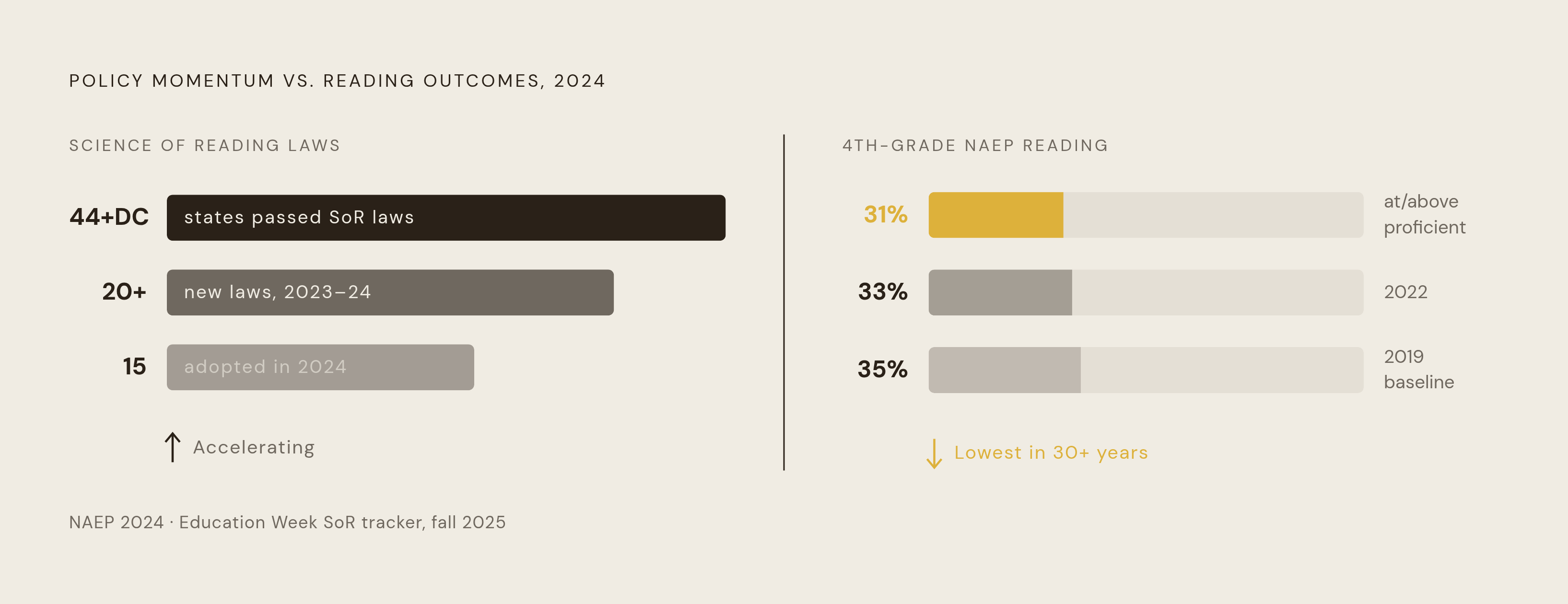
Policy has caught up, and fast. As of fall 2025, 44 states plus Washington, D.C. have passed reading laws aimed at lifting student outcomes. More than 20 states passed new legislation in 2023 and 2024 alone requiring alignment with the Science of Reading, and in 2024 specifically, 15 states adopted SoR-aligned policy: Alabama, Arizona, Delaware, Florida, Georgia, Indiana, Iowa, Kansas, Minnesota, Missouri, New Jersey, Oklahoma, Pennsylvania, South Carolina, and Virginia.
Some of these laws get granular. Indiana's 2023 law actually defines "science of reading" in statute, bans materials built on three-cueing, requires districts to adopt curricula aligned with the research, and tightens licensure through a literacy endorsement. Texas now requires K-3 teachers and principals to complete a reading academy or otherwise demonstrate proficiency. North Carolina mandated LETRS training for all elementary teachers by 2024.
The National Council on Teacher Quality laid out five recommended policy actions in January 2024: tighten standards for teacher prep programs, review those programs for SoR alignment, strengthen licensure testing, mandate high-quality curricula, and fund ongoing professional learning for teachers already in classrooms. The practical upshot for any teacher: mandated curricula increasingly bake high-frequency word instruction directly into phonics sequencing. Knowing the difference between a sight word and a high-frequency word has stopped being a nice conceptual distinction and become something closer to a job requirement.
What falling national reading scores reveal about the gap between policy and classroom practice
All that legislative momentum, and national reading scores are still sliding.
The 2024 NAEP results put only 31% of fourth graders at or above proficient, down 2 percentage points from 2022 and down 4 points from the pre-pandemic 2019 baseline. Average reading scores for both fourth and eighth grade dropped 2 points from 2022 and 5 points from 2019. Students scoring below basic proficiency in both grades posted their worst results in more than 30 years. More than a third of eighth graders now read below even the NAEP's "Basic" level, the largest share ever recorded on that measure. Every state landed below its 2019 level on at least one of the four NAEP reading or math tests, so this isn't a story about a handful of struggling districts.
Laws get passed on one timeline. Classroom habits change on another, slower one. A teacher can work in a state with a brand-new SoR mandate and still reach for a stack of Dolch flashcards out of sheer habit, because that's what the supply closet has and that's what feels like "doing sight words." The confusion between sight words and high-frequency words isn't some abstract academic dispute. It's one small, concrete example of exactly how policy on paper and practice in the classroom can drift apart, and why getting the definitions right actually matters for a kid learning to read next Tuesday.
What teachers and parents should actually do with word lists today
Start by dropping the habit of using "sight word" and "high-frequency word" as if they mean the same thing, whether in lesson plans or in a note home to families. The label a teacher chooses determines the method that follows, so getting it right up front saves a lot of wasted flashcard time later.
From there, audit whatever word list is already in use. Sort it into the three categories: regular, temporarily irregular, and permanently irregular. Teach the regular and temporarily irregular words through phonics, sequenced to match whatever pattern the class is currently on, and save explicit Heart Word-style instruction for the genuinely irregular handful.
The Dolch and Fry lists aren't useless, they're just misapplied. Treat them as a sourcing document for which words matter most in early text, not as a memorization curriculum to work through top to bottom. The 2024 CPB Sight Words list from Green, Keogh, and Prout, built from 2,146 children's picture books, offers a more research-grounded starting point for the first 100 to 300 words of instruction, and it's freely available.
For parents helping at home, flashcard drilling every high-frequency word is neither necessary nor especially effective. Reading decodable books aloud, with the child sounding words out rather than guessing from the picture on the page, lines up far better with how word recognition actually forms in the brain. And if a child keeps leaning on pictures or the first letter to guess a whole word, that's a strategy problem, not a vocabulary gap, and it's worth addressing directly rather than just adding more words to the list.
Sources
- Use sight words within science of reading approaches, researcher advises
- The CPB Sight Words: A New Research‐Based High‐Frequency Wordlist for Early Reading Instruction - Green - 2024 - The Reading Teacher - Wiley Online Library
- Does Teaching 'Sight Words' Contradict the Science of Reading?
- Sight Words vs. Phonics: What the Research Actually Says
- Sight Words vs. High Frequency Words: What's the Difference?
- Should You Rethink Sight Words In a Science of Reading World? - Ignite Reading
- keystoliteracy.com
- readingrockets.org