Structured Literacy Programs for Early Elementary Students
Teaching the six components of reading explicitly, systematically, and from the start works.
Structured literacy teaches six components of language on purpose: phonology, sound-symbol association, syllable patterns, morphology, syntax, and semantics. None of it gets left for a kid to absorb by osmosis, and that's the entire point of the approach.
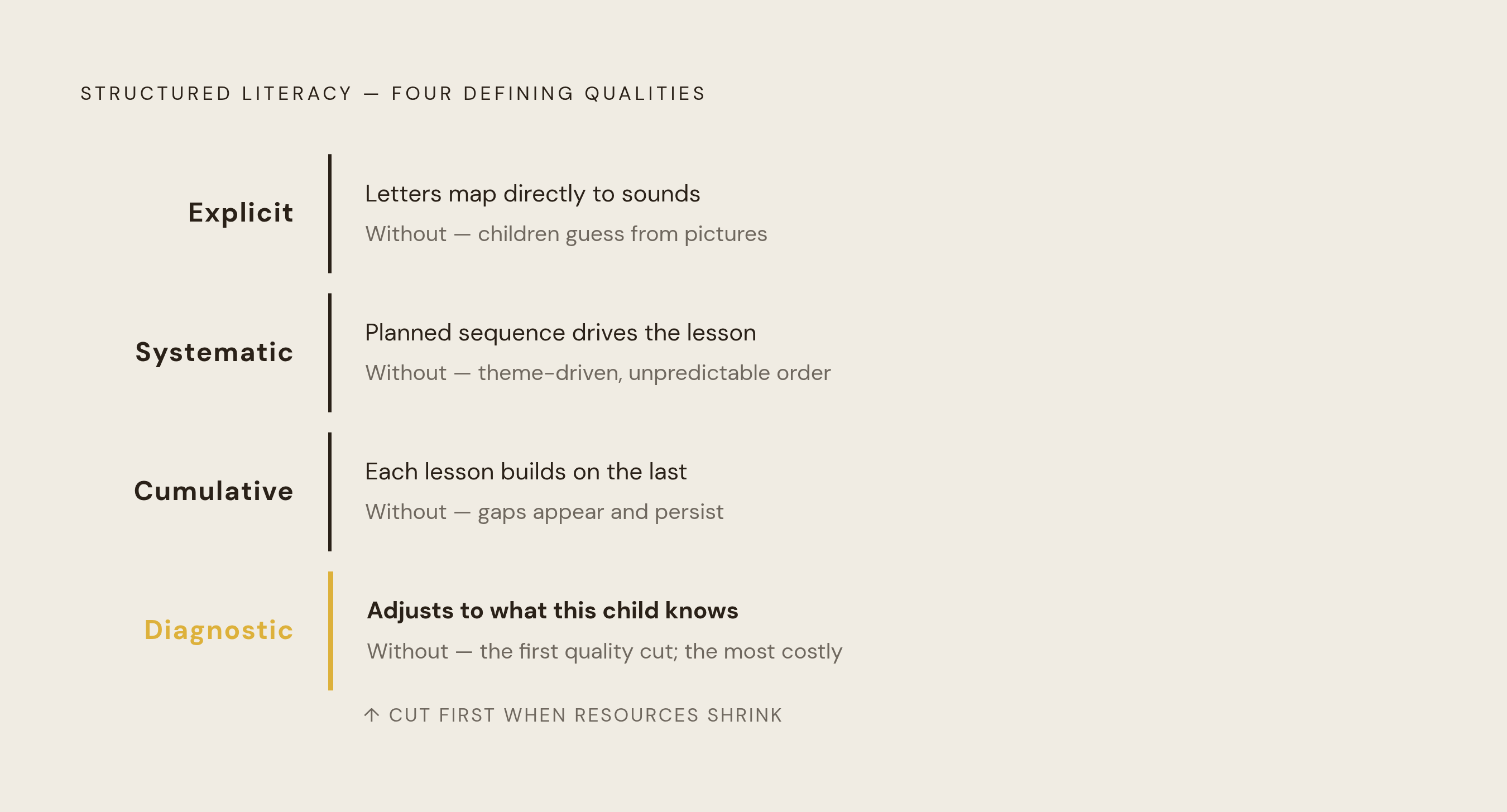
Four qualities make instruction count as structured. It's explicit, telling a child directly how letters map to sounds. It's systematic, following a planned sequence rather than whatever theme the classroom happens to be covering that week. It's cumulative, so each lesson leans on the one before it. And it's diagnostic, adjusting to what a specific child actually knows rather than marching every student through the same material at the same speed.
People sometimes call this whole approach the instructional application of the Science of Reading, the umbrella term for decades of research on how the brain decodes and comprehends written language.
Balanced literacy is the approach most schools ran with for years, and it deserves the criticism it gets. It leans on leveled readers, picture clues, and context guessing, betting that kids will eventually absorb the code through enough exposure. That bet pays off for some kids, but it fails the rest badly, because balanced literacy stays vague about the actual mechanics of decoding and encoding, how sounds become letters and letters become words. Kids who figure that out intuitively do fine under either approach. Kids who don't get left with no tools and no mechanism to catch the gap until they're already behind.
How the brain learns to read, and why sequence matters
Reading is a taught skill, unlike speech. Brains are wired for spoken language the way they're wired for walking, but written language is a human invention layered on top of speech, and every brain has to be taught that code explicitly. Nobody absorbs the alphabet the way they absorb their native tongue just by sitting in a room where it's spoken.
That's why phonemic awareness comes first, before letters even enter the picture. A child needs to hear and manipulate individual sounds in spoken words, the way "cat" breaks into three distinct sounds, before those sounds can map onto letters at all. Castles, Rastle, and Nation's 2018 research names early phonological awareness as one of the strongest predictors of whether a child decodes words accurately down the line. Skip it, and everything built on top wobbles.
Synthetic phonics does the mapping. It teaches a child to translate letters into sounds and blend them: "c-a-t" becomes "k," then "æ," then "t," then blends into "cat." That's concrete and teachable, the same sequence every time.
Timing matters more than most people assume, and here's where the biggest mistake happens: schools that delay phonics, hoping a child will catch up later through exposure, are betting against how reading skill compounds. If a child hasn't mastered the code in the first couple years of school, the gaps get harder to close, not easier. Early elementary isn't a convenient window; it's the only one that closes on schedule.
Decodable texts exist to give that skill somewhere to practice. Built entirely from sounds and patterns a child has already been taught, they reinforce decoding instead of inviting a guess from the picture on the page.
Nothing here works if a step gets skipped. The code runs from sounds, to letters, to syllable patterns, to word parts, to sentence structure, and each layer depends on the one below it holding. Rushing ahead doesn't speed a child up; it creates holes that surface later, usually somewhere much harder to patch.
Fluency and comprehension come after decoding turns automatic. A child still sounding out every word has no mental capacity left over to think about what the sentence means. Decoding has to become close to effortless before comprehension can take the wheel.
What structured literacy programs look like in practice
Orton-Gillingham is the framework most structured literacy programs trace back to, and it's multi-sensory by design. A student sees a letter, says its sound, hears it, writes it, often within the same few seconds. That layering hits multiple pathways in the brain at once, which is what makes the sound-symbol connection stick.
Diagnostic checking sits at the center of good instruction. Instruction doesn't run on a calendar; it follows what a child has actually demonstrated, so gaps get caught before they compound into something bigger.
Dictation shows up constantly, and for good reason. A student decodes, then encodes, spelling out loud what she hears. Reading and spelling are two sides of the same code, so drilling one reinforces the other.
Wilson Language Training's Fundations program, used in grades K through 5, is one of the more widely adopted classroom examples, now running in more than 5,000 districts across all 50 states. In New York City, educators using the program as part of the NYC Reads initiative drove a 12.9% increase in ELA proficiency. That's a real number from a real rollout.
Smaller intervention studies point the same direction. Recent phonics research has found positive outcomes tied to 15 to 30 minutes of explicit, code-based instruction, four to five days a week. That's a specific, checkable benchmark: is this happening daily, in short focused blocks, or is it occasional and diffuse?
A handful of visible markers separate the real thing from the imitation. Decoding taught explicitly and in sequence. Decodable texts actually in use, distinct from leveled readers with new branding slapped on. Progress tracked in a way that shows up on paper, with instruction that changes when that tracking says it should.
Why states are rewriting reading laws — and what the gaps still are
Thirty-eight states plus the District of Columbia have passed laws or adopted policies requiring evidence-based reading instruction, according to a 2024 Education Week analysis. That's most of the country moving the same direction inside a handful of years, which is fast for education policy, an industry that usually moves like a glacier with a grudge.
The laws share a few pillars. Universal screening to flag struggling readers before third grade. Mandated use of materials that are actually evidence-based, beyond being labeled that way on the cover. Intervention requirements, with some states attaching grade-retention rules for third-graders who aren't reading at proficient level.
Mississippi is the case that got this whole movement moving. Starting in 2013, the state overhauled its reading curriculum, retrained teachers, and added instructional coaching across its districts. By 2019, Mississippi posted real, measurable NAEP gains: proof that policy change, taken seriously, shows up in outcomes.
Massachusetts is the more recent example. Governor Healey's five-year early literacy plan put $30 million into the 2025 budget specifically to align instruction through third grade with evidence-based practice.
Here's the gap the laws haven't touched: only about half of pre-service teacher training programs actually cover the Science of Reading. So even in a state that now requires structured literacy by law, plenty of classrooms are staffed by teachers trained under balanced literacy, with little formal exposure to anything else. The law changed, but the workforce teaching under it, in large part, hasn't caught up yet.
That leaves parents in an odd spot. A state law is a floor, and legal compliance at the state level says nothing certain about what's happening in a specific classroom with a specific teacher on a specific Tuesday. Parents can't assume the law already did the work for them, so they need their own sense of what good instruction looks like, and a plan for what happens if their kid's classroom isn't delivering it.
What makes a structured literacy program genuinely effective for a specific child
The diagnostic piece is the part that gets cut first when a program gets watered down for scale, and it's also the most important piece. Explicit, systematic instruction only works if the sequence lines up with where a particular child actually is. A program can check every box on paper and still fail a kid if it never adjusts to that kid specifically.
Kids don't move through phonics at a uniform pace, and pretending otherwise is the second big mistake schools make after delaying phonics itself. Some need extra reps on consonant blends before it clicks. Others sail through blends and stall completely on vowel teams, the notoriously messy patterns like "ea" and "ough." A program running on a fixed pace leaves both kids behind, just in different places and for different reasons.
Children with dyslexia and other reading differences benefit the most from structured literacy, but only when the diagnostic component is actually running, and not merely present in the marketing copy. Drop a dyslexic child into a one-size-fits-all group pace, and the explicit, systematic instruction stops mattering, because none of it is calibrated to what she specifically needs more time on.
English language learners face a related problem. Explicit phonics instruction helps these kids enormously, since they're often building phonemic awareness in a language they're still acquiring. Still, a program also has to track oral language separately: a child can decode a word perfectly and still not know what it means if the English vocabulary underneath hasn't caught up.
A program that's aligned with structured literacy and a program that's genuinely adaptive are two different things, and conflating them is where most parents get fooled. The first teaches the right content in the right order, necessary but not sufficient on its own. The second decides, continuously, when a child's ready to move on, what needs revisiting, and what to try next when the first attempt doesn't land. Progress monitoring is the mechanism that makes every other piece actually work. Strip it out, and even a beautifully sequenced, fully explicit curriculum is just a guess about whether anything got learned.
How to evaluate any program claiming to teach reading through structured literacy
Six questions cover most of what matters, whether the thing under review is a school curriculum, a tutoring service, or an app.
Does it teach phonemic awareness and phonics explicitly, naming and sequencing the skills, or does it assume kids will absorb them along the way? Is the sequence cumulative, so each lesson builds on knowledge that's been confirmed rather than assumed? Does it use decodable texts matched to what's already been taught, instead of leveled readers that quietly invite guessing from pictures? Does it track a child's progress in real time and adjust what comes next, or does every kid move through the same material at the same clip regardless of how they're actually doing? Does it cover all six components, phonology through semantics, or does it stop at phonics and call that the whole job?
Skepticism is warranted, and it should run in one direction specifically: toward anything leaning hard on "phonics" or "Science of Reading" as marketing copy while offering thin instruction underneath. A static lesson sequence with no real-time listening, no adjustment based on actual performance, and no visibility for the parent watching from outside amounts to phonics-flavored worksheets with better branding. The label on the box matters far less than whether explicit, systematic, cumulative, and diagnostic are all present at once and actually doing their jobs. Miss the diagnostic piece, and the other three are just decoration.