Dyscalculia Signs in Young Children
Early signs of number trouble often show up at snack time, not in math class.
Dyscalculia doesn't wait for a math class to reveal itself. The signs show up years before a child ever sits at a school desk, in how they count blocks, sort toys by size, or guess which pile of crackers has more. Knowing what those signs look like, and when they cross from "normal variation" into a real red flag, gives parents the earliest possible window to get a kid help.
Why the signs appear before school math does
Dyscalculia isn't a problem with times tables or long division. It's a disruption in something more basic: number sense, the gut-level feeling for quantity that most kids build before they can even talk in full sentences. That means its effects show up in a toddler stacking blocks or a preschooler dividing up snacks, long before anyone hands them a worksheet.
Research points to the intraparietal sulcus as a key brain region involved in number sense, working alongside other processes that help kids hold a quantity in mind while comparing it to another. When that system is wired differently, it doesn't wait for first grade to make itself known. It shows up at snack time, at bath time, during a board game.
Most kids start recognizing numbers and counting before age 2. By age 4, counting to 10 is typical. Those two milestones give parents something concrete to measure against, and that matters, because research on early numeracy shows that number skills at ages 5 and 6 predict how a child performs in math years later. A gap that goes unnoticed at four doesn't stay small. It tends to widen once formal instruction starts piling new concepts on top of a shaky foundation.
Part of the reason parental observation matters so much right now: the science of identifying dyscalculia is still catching up to where dyslexia research stood years ago. There's no equivalent yet of the screening tools that catch early reading struggles with real precision. So for now, watching how a child handles everyday quantity, not just isolated flashes of trouble, but a pattern across multiple situations, is one of the more reliable signals available.
The six early signs that appear in preschool-age children
Clinical child psychologist Dr. Erik Newman, writing for Havern School, lays out six signs that tend to show up in the preschool years. Each one points to a different piece of how the brain processes number and quantity, so a family might see one clearly and miss the others entirely.
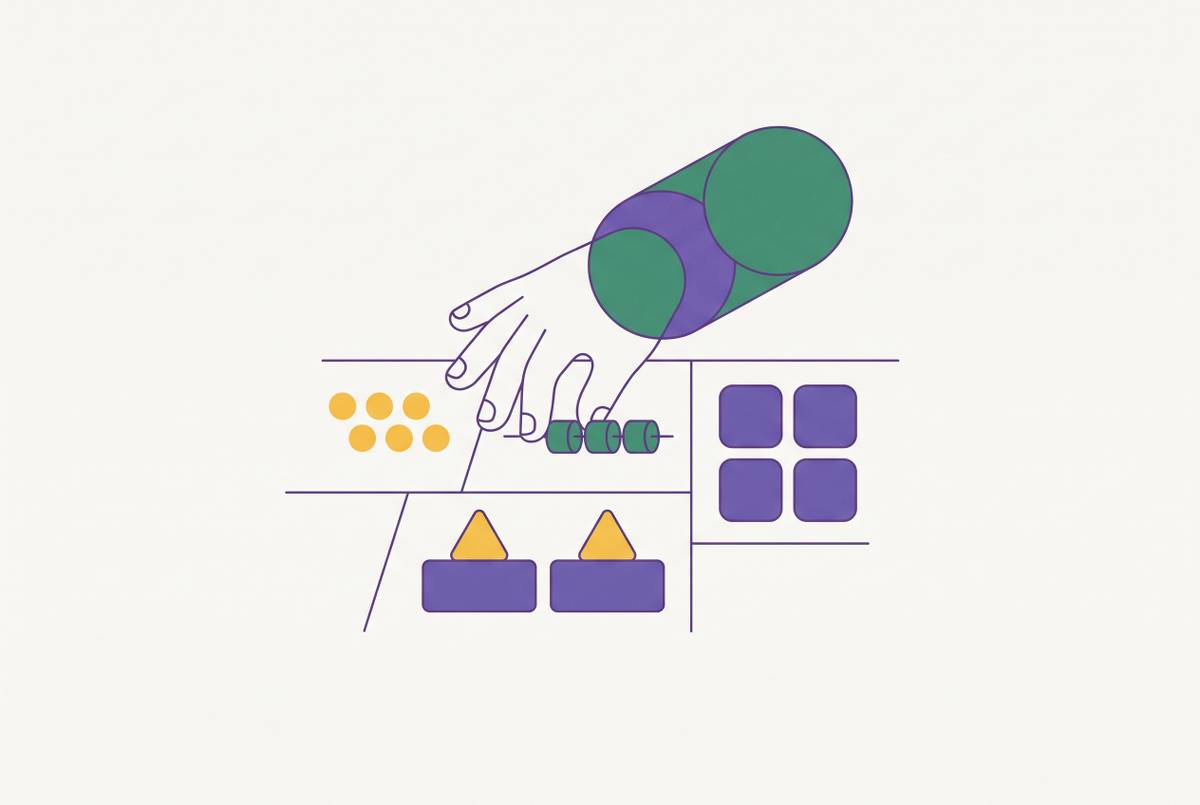
1. Trouble recognizing small quantities at a glance. Most kids develop a sense of "twoness" or "threeness" without counting, a skill called subitizing. A preschooler who has to count out two or three objects every single time, with no instant recognition at all, is missing a skill most peers pick up early.
2. Poor quantity estimation. Kids without dyscalculia can guess at larger amounts well before they can count them precisely. If a child past age 3 still can't make a rough call about which of two piles looks bigger, that's worth watching.
3. Weak quantitative comparison. Recognizing that 7 candies is more than 4 candies shouldn't require counting once the groups are clearly different in size. A child who consistently can't tell "more" from "less" between two obviously mismatched groups is showing a specific kind of struggle.
4. Delayed or effortful number identification. Given that most kids start recognizing numbers before age 2 and count to 10 by age 4, a child who's still skipping numbers in sequence, can't recognize written numerals, or confuses similar-looking numerals well past those ages is showing a pattern worth tracking.
5. Difficulty matching a number to a quantity. Counting five objects and then knowing the group has five, a concept called cardinality, is a major milestone. A child who counts out loud correctly but then can't say how many total, or hands over a random fistful when asked for a specific number, hasn't locked in that connection yet.
6. Trouble with number line estimation. By early grade school, kids should be able to guess roughly where "5" sits on a line running from 0 to 10. Per Havern School, persistent trouble with this task by second grade points toward the kind of numerical processing issues associated with dyscalculia.
None of these signs, on their own, on any single day, means much. A tired kid miscounts. A distracted kid guesses wrong. What matters is whether the pattern holds up across several of these tasks, over time, not just once.
Additional signs that emerge once a child starts structured counting and sorting
Once a child moves into more structured activities, sorting shapes, lining up objects by size, playing simple counting games, a few more signs tend to surface.
Sorting and pattern trouble shows up first. A child might struggle to group toys by color or shape, or fail to arrange a set of objects from smallest to largest. Trouble connecting written numbers to their meaning follows closely: a child sees "7," but can't reliably link it to the word "seven" or to seven actual objects sitting in front of them.
Persistent finger counting is another marker that reviews of common dyscalculia signs identify. Using fingers to count is normal for a while. But when a child relies on it well past the age or grade where classmates have moved on to doing simple sums in their head, that points to real difficulty performing the calculation mentally rather than just a habit that hasn't broken yet.
Watch for inconsistency too. Not the occasional wrong answer, but a child giving different answers to the exact same simple problem on different days. That kind of unstable recall is different from a normal mistake.
Emotional reactions matter here as well. A kid who melts down during board games, or avoids anything that involves keeping score or counting turns, might be dealing with more than stubbornness. Dyscalculia isn't math anxiety, but the two show up together often enough that they're worth separating carefully rather than assuming one explains the other. Around this same age, some kids also start showing trouble judging how long a task will take or how far away something is, a kind of estimation struggle that runs on the same mental circuitry as number sense.
What typical early number development looks like, so parents have a reference point
Numeracy doesn't grow in isolation. Words like "more," "less," "first," and "last" start showing up in a child's vocabulary around age 2½ to 3, and they're doing real cognitive work: a 2026 cross-lagged study found that this kind of mathematical language predicted numeracy growth between ages 3 and 4. Between 2½ and 3, the relationship runs both directions, with general language and numeracy feeding each other and both feeding later math vocabulary.
Preschool isn't a holding pattern before "real" learning starts. Research on early numeracy shows that foundational number skills in the preschool years forecast math achievement down the road, which means what happens at home with a 4-year-old carries more weight than it might seem to at the time.
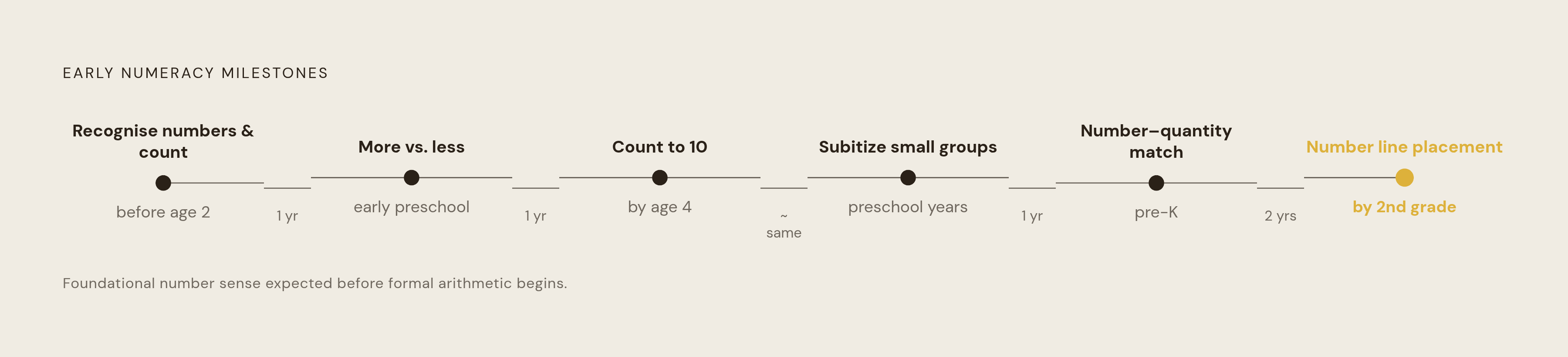
A rough timeline, for reference:
- Recognizing numbers and starting to count: before age 2
- Counting to 10: typically by age 4
- Subitizing small quantities without counting: develops across the preschool years
- Telling "more" from "less" with clearly different groups: early preschool
- Matching a number to a quantity (cardinality): emerging in pre-K
- Placing single digits on a number line: expected by 2nd grade
A Vanderbilt University study of 616 U.S. parents of 3- to 5-year-olds built and tested a way to measure how much parents actually know about early numeracy and patterning skills. Turns out, not knowing these milestones off the top of your head is common, not some parenting gap.
So what separates dyscalculia from a kid who's simply a slower starter? Breadth and persistence. A slow starter catches up with normal exposure and repetition. Dyscalculia shows up across several number-related tasks at once, and it doesn't close on its own no matter how much ordinary practice a child gets.
Why dyscalculia often hides behind other labels, or goes unnoticed entirely
Dyscalculia rarely travels alone. A January 2025 review in Developmental Cognitive Neuroscience, led by Starling-Alves and colleagues, found that roughly 40% of children with a math disability also have a reading disability. It shows up alongside ADHD and other neurological differences often enough that isolated, math-only struggles are the less common case.
Daniel Ansari, Professor and Canada Research Chair in Developmental Cognitive Neuroscience and Learning at Western University, put it plainly: "very specific profiles of children who will only struggle with math and nothing else, they're more the exception." Most kids with dyscalculia carry overlapping challenges, not a single isolated one.
That overlap runs deeper than behavior. Research finds real similarity in the neural profiles across different learning disorders, with overlapping brain-based differences turning up in multiple conditions, not just dyscalculia. Practically, that means a child evaluated for dyslexia or ADHD might get real, effective support for reading or attention while the underlying number-sense trouble goes completely unaddressed.
Part of the problem is cultural, too. Math struggles carry less stigma than reading struggles. "I've never been good at math" is a phrase adults say all the time, half as a joke, and it quietly normalizes what might actually be a real processing difference in a child sitting nearby.
The DSM-5 classifies dyscalculia as a specific learning disability with impairment in mathematics, and a formal diagnosis requires that symptoms persist and cause real impairment before it applies. That threshold is useful for parents deciding when to stop just watching and start seeking an evaluation.
How early identification opens the door to targeted support
Catching this early means a child gets support before repeated failure starts wearing down their confidence and their sense of who they are as a learner. That's not a small thing. Kids who get help early tend to develop coping strategies before math becomes something they've decided they're just "bad at."
Two evaluation paths exist. A free school-based psychoeducational evaluation is one option parents can pursue. A private evaluation through a clinical child psychologist or neuropsychologist runs alongside that option and tends to produce a more detailed profile of exactly where the difficulty sits. Either way, the first practical step for a parent is simple: write down the specific behaviors observed at home, and bring them to the child's teacher, anchored in the concrete signs above rather than a vague sense that "something's off."
Dyscalculia qualifies as a disability under IDEA and under Section 504 of the Rehabilitation Act, which can entitle a child to an IEP or to 504 accommodations at school.
On the instructional side, what helps isn't more worksheets. It's explicit, structured teaching that builds number sense from the ground up, quantity, place value, magnitude, the concepts a dyscalculic child's brain isn't picking up automatically the way most kids' do. Drill without that foundation just repeats the same gap louder.
Because dyscalculia doesn't look the same in any two kids (one struggles with subitizing, another with memory for basic facts, another with placing numbers on a line) instruction that adapts to a specific child's profile works better than a generic, one-size-fits-all approach. And parents benefit from being able to see that progress directly: knowing whether a specific gap is closing lets a parent or teacher adjust course in real time, rather than waiting for the next report card to find out whether something worked.
None of this is about curing dyscalculia. It's about building the strategies, the vocabulary, and the confidence a child needs to engage with math on their own terms, and that work goes further, and faster, the earlier it starts.