How Word-by-Word Listening Makes an AI Reading Tutor Different From a Quiz App
Real-time listening reveals specific decoding errors that quiz scores simply cannot capture.
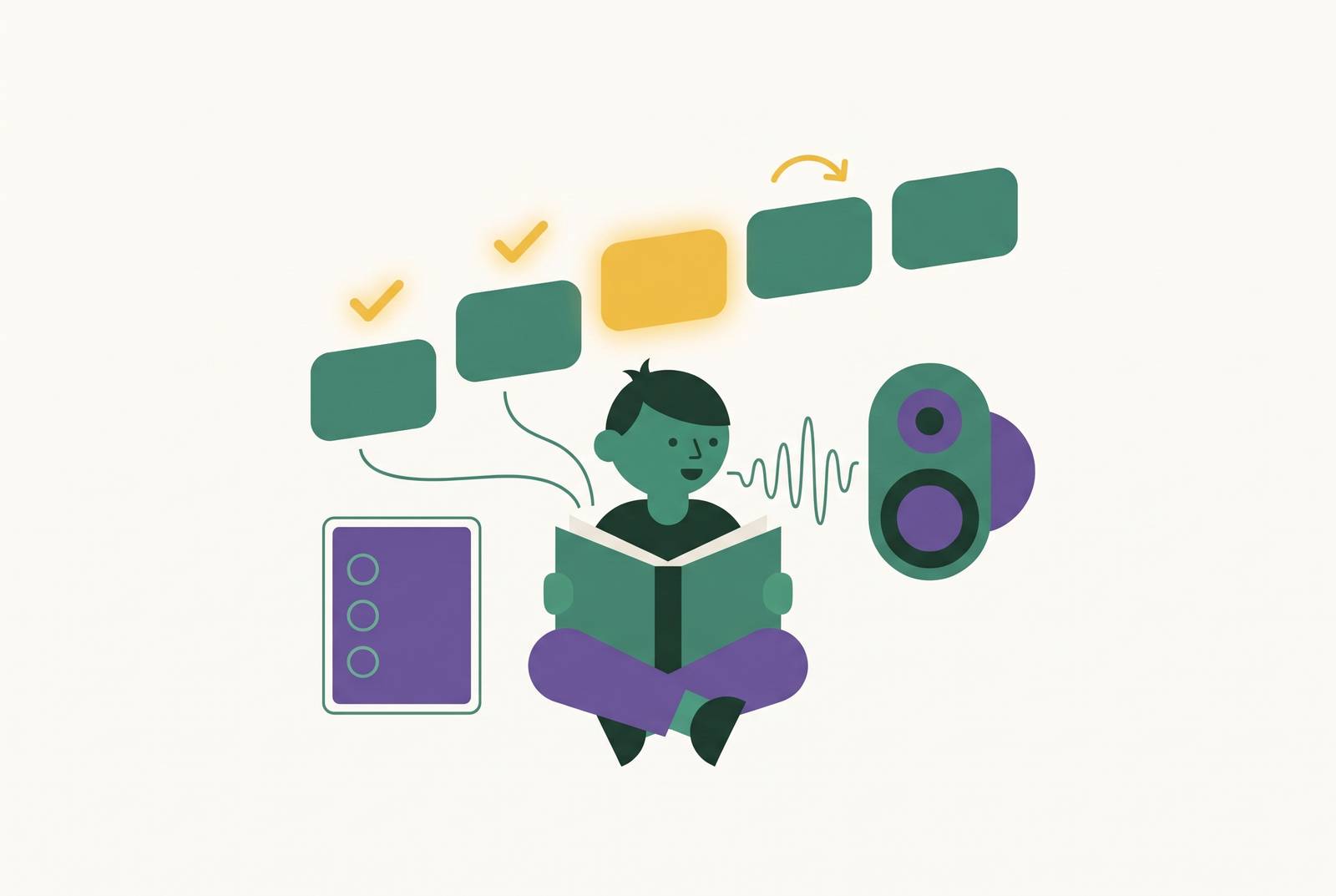
An AI reading tutor that listens to children read aloud in real time can catch a specific word error and give feedback while the child is still working through it. A quiz app sees only the answer. That is the difference this article explains, and why word-by-word listening can support teaching where a right-or-wrong score can only test.
Why reading aloud is the act that teaching must reach
Children must be explicitly taught how written code maps onto spoken sound. That connection is not learned naturally just by seeing words. In early decoding, a child translates graphemes, the letters or letter groups, into phonemes, the speech sounds they represent. The child then blends those sounds into a spoken word, which may connect to a meaning already known through conversation. Reading aloud makes that sequence available for someone else to hear.
The Simple View of Reading frames comprehension as the product of decoding and language comprehension. For young readers, decoding is often the bottleneck. A child may understand a word when someone says it but still struggle to read it on the page. Better decoding thus helps with comprehension, though it is not enough on its own. Recognizing words and understanding what they mean remain different parts of the job.
Fluency helps bring those parts together through accuracy, automatic word recognition, and prosody. When sounding out words takes less effort, a child can give more attention to what they mean. Steklács and Vuong's 2026 scoping review describes fluency as a multidimensional bridge between decoding and comprehension whose role changes with development. Its audible features include intonation, phrasing, and pacing in connected text. A correct answer cannot reveal how a child used them.
What a quiz app actually sees when a child "reads"
A quiz app follows a different sequence, in which the child completes an activity, earns a reward, and advances to another screen. Its main observation is the answer selected. If a child chooses the wrong picture for “ship,” the app can register the mistake. It cannot hear whether the child confused the vowel, skipped the final consonant, or guessed from context.
Two children can choose the same wrong answer because one confuses sh- with ch- while the other misreads the vowel. They need help with different sounds, but they get the same score. The reverse is just as true for correct answers. One child may decode a word correctly while another uses a picture clue, and both get the same credit.
This is a limit of the instrument. A better question still cannot supply a voice signal that was never captured. Adaptive quizzing adapts to the endpoint by changing the difficulty of the next question based on earlier scores. That can help with testing without showing where the child needs help with decoding.
What word-by-word listening makes visible that a score cannot
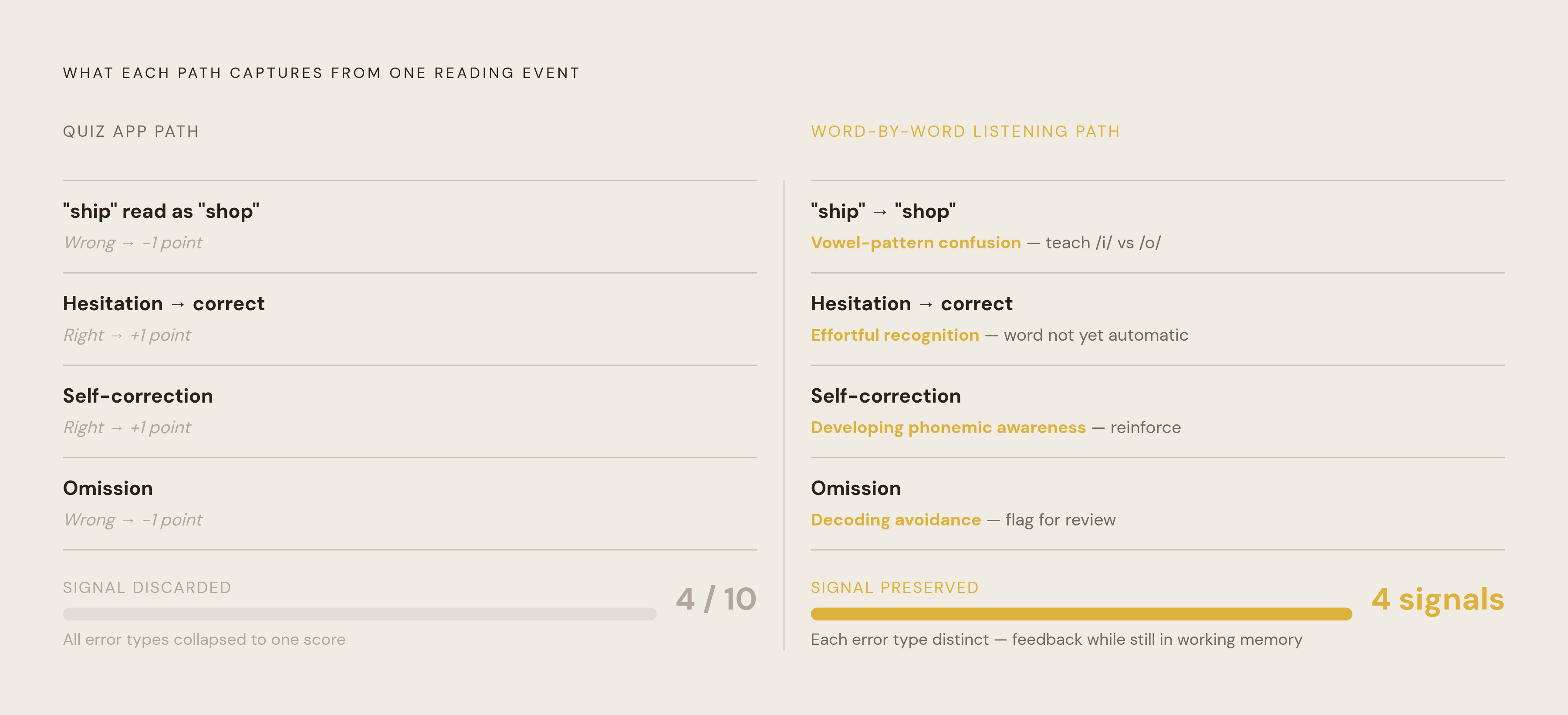
Word-by-word listening makes substitutions, omissions, hesitations, and self-corrections observable as they happen. These events call for distinct interpretations. Reading “ship” as “shop” points to a vowel-pattern confusion, while skipping a word may signal low automaticity or working-memory overload. A hesitation followed by a correct reading suggests that recognition is still effortful. A self-correction shows that the child noticed a mismatch and repaired it, a sign of developing phonemic awareness.
The distinction changes what help can follow. A vowel substitution calls for help with phonics, while a successful self-correction shows that a child is checking their own reading. These signals guide instruction without making every stumble a diagnosis. Word-level tracking uses forced alignment to pinpoint which written word the child is on, providing the location needed for word-by-word feedback. The useful output is not merely a transcript, but an error attached to its place in the text.
Through orthographic mapping, words a child has correctly decoded become ready for automatic recognition after the child has seen them repeatedly. A listening system can confirm that a correct oral reading happened and track those exposures. Across connected text, it can also capture pacing, phrasing, and intonation as signals of sentence-level understanding. None of those features is contained in a passage score.
Why the timing of feedback changes what a child can learn from it
Reading moves forward, and the child's attention moves with it. By the end of a sentence, the sound-level breakdown behind an earlier stumble may already have passed out of working memory. A prompt such as “Look at the first sound” can attach to the live attempt instead. It redirects attention while the child is still working on the word. That gives the child a chance to repair the reading before rehearsing the wrong pattern.
A score after the activity can report an incorrect result without recovering the word, sound, or decision that caused it. Guided repeated oral reading works differently, using the spoken exchange “I read, then you read” to support automaticity. The model and the child's attempt are part of the same learning sequence. Feedback is useful because it reaches the act being learned.
However, listening in real time need not mean interrupting every error. Sometimes a correction costs more in lost flow and confidence than it gives back. Reading “home” for “house” can be allowed to pass when it does not change the meaning. A listening system has the signal needed to make that selective judgment in the moment. A quiz app never reaches that decision because it did not hear the substitution.
Why neurodiverse and struggling readers have the most at stake in this distinction
For children with dyslexia and other reading differences, miscues that keep happening can show more than single wrong answers. Consistent substitutions, reversals, and phonological confusions form patterns in oral reading. Quiz scores do not show those patterns directly. Continuous listening can show what keeps going wrong, rather than only how often the child misses a question. That distinction is especially important when two children with similar scores need different support.
A 2026 arXiv preprint on AI-driven reading scaffolds for neurodiverse learners finds that no single scaffold modality is universally effective for this population. The best help depends on each child's diagnosis and how complex their clinical needs are. A system may hear the same confusion again and again but lack the diagnostic depth to explain every cause.
Children often grow reluctant to read around ages 6–8, when they move from learning to read toward reading to learn and their struggles show as they compare themselves with peers. A phonics gap can harden into a reading identity. Help with reading words early on can close the gap before that pattern takes hold. Screening for phonemic awareness and alphabet knowledge also looks for early signs of trouble, before a child falls behind. For a child who already resists reading, another penalty adds to the sense of failure, while feedback on a specific vowel confusion gives them something to work on.
What the research actually supports about adaptive listening tools — and what it does not
The evidence supports a useful supplement to human teaching. Listening-based AI tutors can help children make gains that matter in some reading skills under some conditions. A meta-analysis of studies on personalized and adaptive learning technology for reading found a small effect size of g = 0.29. Because the research covers personalized and adaptive technology, the figure should not be treated as a result for every listening tutor.
The conditions of use belong in the claim. Supplemental use, appropriate dosage, and teacher or parent awareness of what the tool reports all affect how useful the support can be. There is still little evidence comparing rule-based adaptation with AI-driven adaptation. The advantage proposed for AI-based personalized learning is theoretically coherent, but is still being established empirically. Hearing a reading attempt gives a system more evidence of how a child reads, but does not prove that every system uses it well.
The human gaps are just as plain. An AI tutor cannot replicate the emotional warmth of a parent reading with a child, the diagnostic depth of a trained literacy specialist, or the social learning of a classroom. Behavioral, cognitive, and environmental factors also affect reading outcomes beyond what a tool can address. Those limits put a boundary around what access to the reading process can accomplish on its own.
What word-level data lets a parent actually see about their child's reading
A listening-based tutor can report substitutions, omissions, and hesitations against specific words. That gives a parent a more precise view of the difficulty. Instead of showing only that a child struggled with a passage, the data can reveal which vowel patterns, consonant clusters, or syllable types are not yet automatic. The useful unit is the recurring pattern. A single score compresses those differences into one result.
your child scored 60%” contrasts with “your child consistently substitutes short-e for short-i in CVC words. The second report locates a particular sound confusion in consonant-vowel-consonant words. It gives a parent or teacher a focus for the next instruction. The first report cannot distinguish that need from a different cause of the same score. More detail earns its place when it makes the next teaching decision clearer.
Progress can also appear in how words are read. A child who first hesitates and later recognizes a word automatically has changed something that a correct-answer score may miss. Listening-based reporting can track that growth in fluency over time. As automaticity grows, a child puts less effort into word recognition and has more room for comprehension. It is evidence of developing reading skill.
How can a parent tell whether a reading app is actually listening?
Does it require the child to read aloud, and does it respond differently depending on which specific word the child mispronounced? Requiring speech is only half the test. The response must show that the system used the reading attempt to identify a particular difficulty. Otherwise, an oral activity may still end in the same score-and-reward loop.
The strongest signals are specific words in the report, feedback during reading, and changes to subsequent teaching based on error patterns. Selective correction is another useful sign when the system lets a small error pass because meaning is preserved. By contrast, feedback that always arrives at the end gives no evidence of in-the-moment coaching. Levels completed and stars earned do not supply a word-level breakdown. If the app would function identically with typed answers, speech is not doing the instructional work described here.
The prerequisite is instruction grounded in the Science of Reading, including explicit, systematic phonics, phonemic awareness, and fluency practice with connected text. Systematic phonics moves through a planned sequence from simple patterns to complex ones, giving the listening system a structure to diagnose against. Real-time feedback cannot repair a poorly sequenced curriculum by itself. Look for an app that both hears where the child is struggling and uses that to guide what it teaches next.
Sources
- Frontiers
- Supporting fluency and comprehension using practices grounded in the science of reading - Teach. Learn. Grow.
- What the science of reading tells us about how to teach decoding—including phonics - Teach. Learn. Grow.
- End-to-End real time tracking of children's reading with pointer network
- 8 science of reading strategies - Teach. Learn. Grow.
- Improving Child Speech Recognition and Reading Mistake Detection by Using Prompts
- Prompting Whisper for Improved Verbatim Transcription and End-to-end Miscue Detection
- Tailoring AI-Driven Reading Scaffolds to the Distinct Needs of Neurodiverse Learners