Concrete Pictorial Abstract Progression in Early Math Instruction
Touching real objects before symbols helps young learners grasp math concepts deeply.
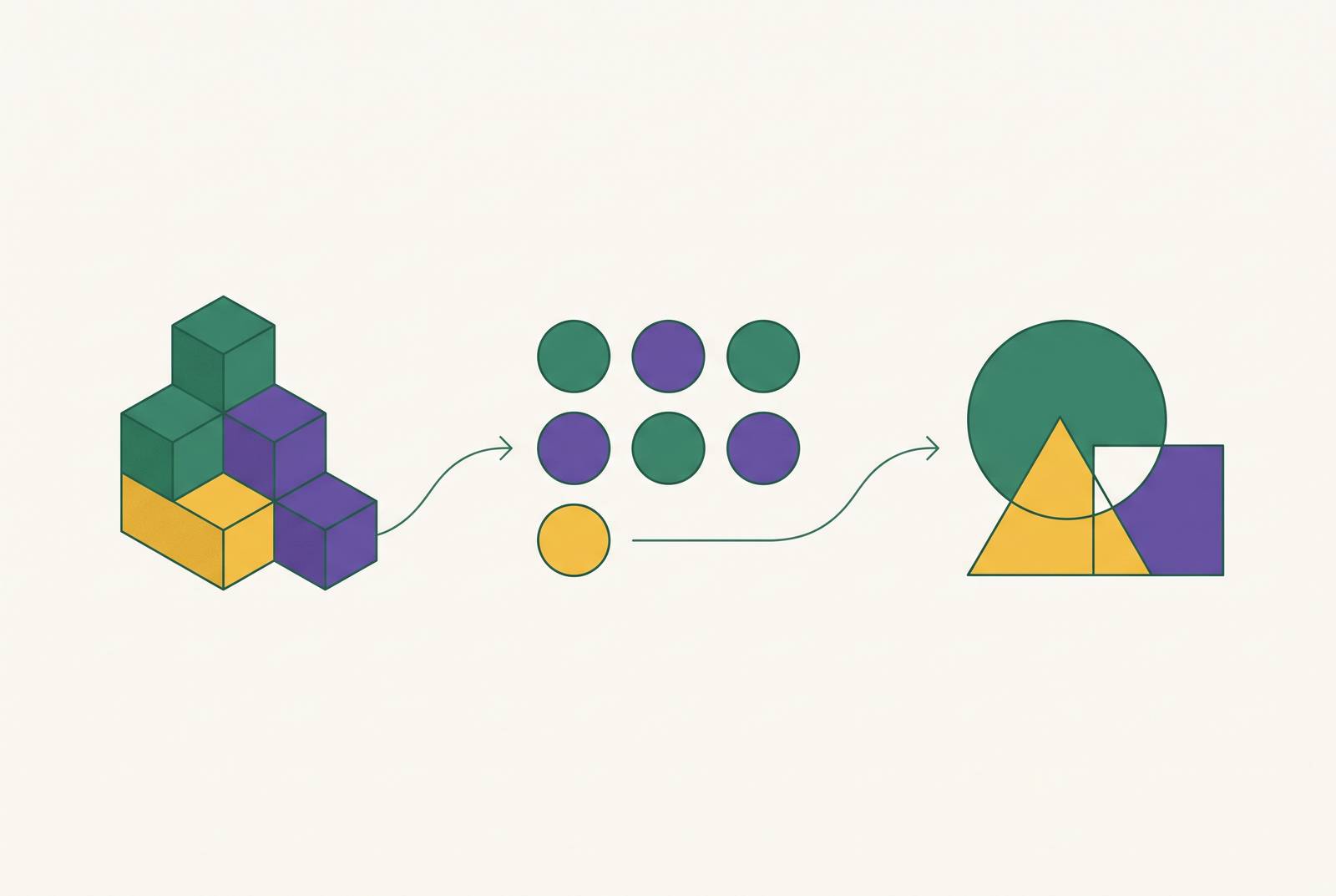
Math instruction has a sequencing problem, and it's been solved since the 1960s. The Concrete-Pictorial-Abstract progression, first mapped out by psychologist Jerome Bruner, holds that children learn number concepts best by moving through three stages in order: touching real objects, then drawing or viewing pictures of those objects, and only then working with numbers and symbols on a page.
Bruner called these stages enactive, iconic, and symbolic representation back when he developed the framework, and "concrete, pictorial, abstract" came later as more teachable, parent-friendly labels for the same idea. He's also the person who gave us the word "scaffolding," though that came out of a separate 1976 study with two other researchers, not the CPA work itself. Most parents already know the word "scaffolding" and don't realize it traces back to the same researcher. Singapore built this sequence into its national math curriculum in the 1980s, and English-speaking countries picked up the pace on adoption decades later, as international comparisons drew attention to Singapore's strong math outcomes. If the research literature calls it CRA (Concrete-Representational-Abstract) or CSA (Concrete-SemiConcrete-Abstract) elsewhere, that's the same framework wearing a different label. Same idea, different acronym.
Why young children need to start with their hands
Number learning starts earlier than most parents assume, and it starts in a strange, disconnected way. Toddlers around ages 2 and 3 recite number words, "one, two, three, four," well before they understand that those words correspond to actual quantities. Verbal counting comes first. Meaningful counting, the kind where a child understands that "three" means three actual things, comes later.
A set of specific sub-skills produces that gap, and researchers track them closely: verbal counting, counting forward and backward starting from numbers other than one, catching counting errors, cardinal number knowledge (knowing the last number counted tells you the total), estimation, enumeration, and subitizing.
Subitizing is a word most parents don't know. It means recognizing a small quantity instantly, without counting. Show a child three dots arranged like the pips on a die, and a child who can subitize says "three" immediately. No counting required. This skill is getting more attention in early childhood research because it turns out to be a real predictor of number sense down the line.
And the stakes here are not small. Foundational math knowledge at school entry predicts later achievement consistently, and that predictive power doesn't fade after a year or two. It persists through both primary and secondary school. This is exactly why the concrete stage isn't a nice-to-have warm-up before the "real" math starts. The framework's core claim is that no learner, at any age, outgrows the need to begin new material at the concrete stage. For a five-year-old encountering the concept of "seven" for the first time, that claim carries even more weight than it does for an adult learning a new proof.
How each stage works in an early math classroom
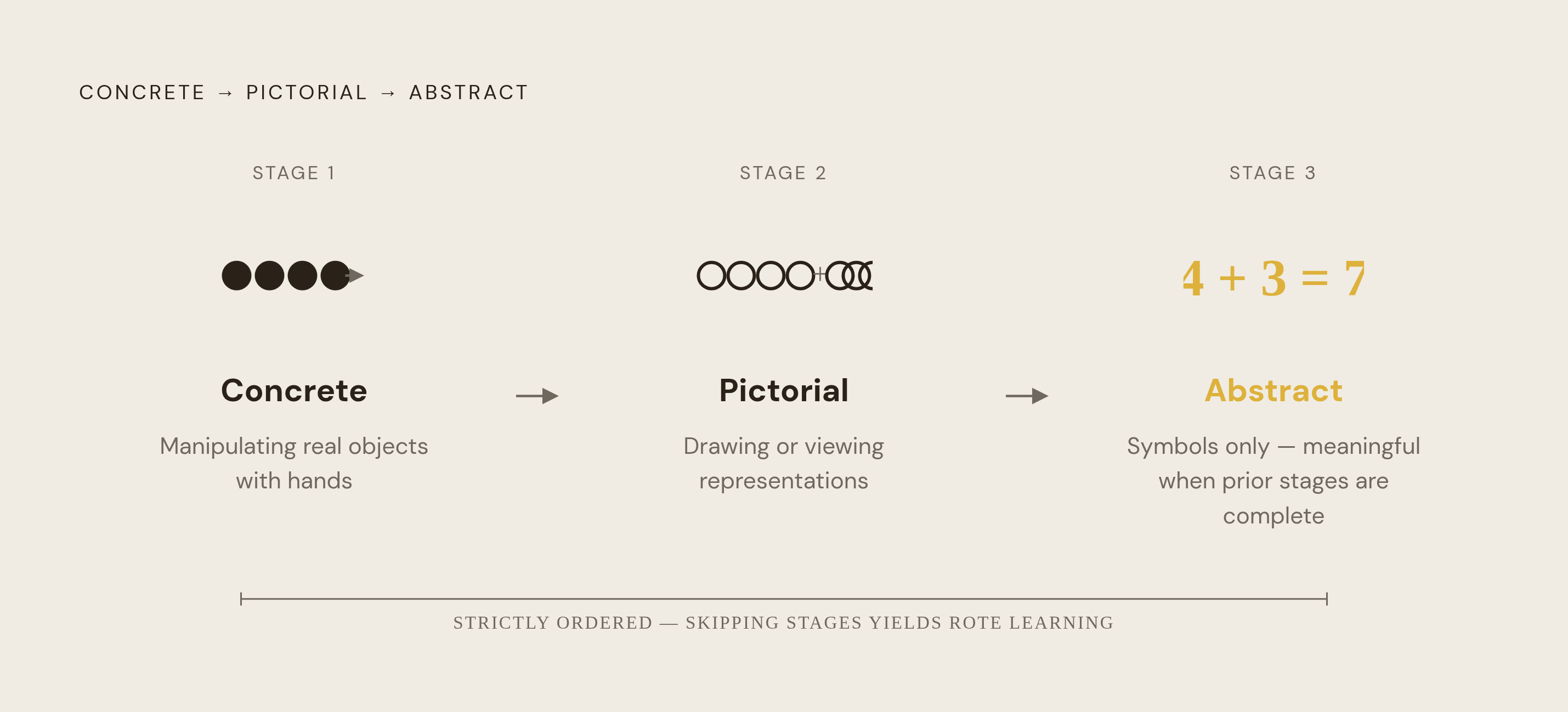
Concrete stage, in a real classroom: a child gets a pile of counters, or base-ten blocks, or multi-link cubes, and physically builds the problem. If the problem is 4 plus 3, the child pushes four counters together with three counters and counts the whole pile. The math lives in the child's hands at this point. It has not been represented yet. It's happening.
Pictorial stage moves that same action onto paper or a whiteboard, as a drawing. A teacher might draw four circles, then three more circles, and have the child count all seven. The drawing has to mirror what the manipulative was doing. This transition from object to image is something a teacher builds deliberately. It doesn't happen just because a worksheet shows up.
Abstract stage swaps the drawing for numerals and operation signs: 4 + 3 = 7. A child who moved through the first two stages can look at that equation and actually see the four counters and the three counters behind it. The symbols mean something.
A 2024 study out of Rwanda, published in the African Journal of Empirical Research and covering 540 students and 6 math teachers, found that students were noticeably more engaged, more active, more talkative during the concrete and pictorial stages than during the abstract stage. Participation visibly drops once the objects and pictures disappear. That's not necessarily a problem, since quiet, focused symbol-work is its own kind of engagement. A child who suddenly seems checked out once the worksheet turns into pure numbers may be showing this pattern.
Good CPA teaching also builds in checkpoints, sometimes called "check readiness" and "check mastery" moments, where a teacher confirms a child has actually internalized a stage before moving to the next one. Skip those checks, and the three stages start feeling like three unrelated lessons instead of one connected idea, which raises the mental load on the child and can leave them dependent on the blocks rather than free of them. The research backs this approach in both general education and special education settings alike, which matters for parents of kids who learn differently. CPA is how the underlying concept actually needs to be taught, for nearly everyone. It's how the underlying concept actually needs to be taught, for nearly everyone.
What happens when children skip straight to symbols
Skip the concrete and pictorial stages, and children default to rote learning: memorizing steps without understanding what the steps mean. A child can learn to "carry the one" without any idea of what's actually being carried, or why.
Rote learning has a ceiling, and it's a low one. A child can imitate a procedure they've seen an adult do. What they can't do is transfer that procedure to a problem that looks even slightly different, or explain in their own words why the method works. They can produce the answer. They can't defend it.
This is the real difference between procedural fluency (being fast and accurate at a method) and conceptual understanding (knowing why the method works). Both matter, and nobody's arguing procedural fluency is bad. But CPA builds conceptual understanding first, which makes the procedural fluency that comes after it far more durable.
The stakes become stark in resource-constrained settings. The Rwanda research (Iyamuremye & Burns, published in Cogent Education) points out that when instructional materials are scarce, teachers often default to abstract-only instruction, simply because that's what a chalkboard and a textbook allow. The result tends to be low performance and disengaged students. The useful finding buried in that same research: the concrete and pictorial stages don't require expensive materials to work. Bottle caps, stones, folded paper. Cheap materials, real cognitive shift.
None of this means every child who skips straight to symbols is doomed to struggle. Some kids pick up abstraction quickly and fill in the conceptual gaps on their own. But as a general sequencing strategy, the developmental case for CPA is strong, and the cost of ignoring it is measurable.
What the research shows about CPA's effectiveness
The evidence base is not thin. A systematic literature review following PRISMA methodology covered 39 studies published between 2010 and April 2023. One researcher, Margaret M. Flores, PhD, BCBA-D, authored 17 articles on CPA, making her by far the most prolific individual voice in the field.
The headline finding from that review: CPA shows a positive effect on students both with and without learning disabilities, and on students considered at risk of academic failure. That's a wide net. It's not a niche intervention for one type of learner.
Most of that research, though, focuses on elementary-age students, and the review itself flags that CPA's effects outside elementary school need more study. That's actually good news for the argument here, since early childhood is precisely where the existing evidence is strongest.
The most recent large-scale study is the Rwanda RCT from Iyamuremye and Burns, published in Cogent Education. It used a pretest-posttest experimental design across 730 eighth-grade students in rural Rwanda, testing CPA instruction on factorizing algebraic expressions. The CPA group showed substantial gains over the control group, and students in the CPA condition showed measurably improved engagement alongside their achievement results. The results pointed to meaningful shifts in how students related to the material.
The Rwanda study itself notes that most prior CPA research focused on urban settings in developed countries, leaving rural and under-resourced contexts understudied. The trend line is consistently positive. The evidence base outside wealthy, urban school systems is still being built.
The parallel between CPA in math and the Science of Reading in literacy
Anyone who's followed the Science of Reading movement in literacy will recognize this shape immediately. The Science of Reading identifies key components of how children learn to read, phonemic awareness, phonics, fluency, vocabulary, and comprehension, each building on what came before. Each stage depends on the one before it.
Line that up against CPA and the match is almost exact. Phonemic awareness, working with sounds before any print is involved, mirrors the concrete stage: pure sensory experience, no symbols yet. Connecting sounds to letters mirrors the pictorial stage, the bridge between raw experience and abstract code. And fluent, automatic reading mirrors the abstract stage, where the symbol system has become so internalized it's nearly invisible.
Fluency sits between decoding and comprehension in reading much as the pictorial stage sits between handling objects and working with symbols in math: each serves as a bridge rather than an endpoint. Neither framework treats that middle stage as optional filler. Skip it, and everything built on top of it gets shakier.
Science of Reading advocates have pushed to widen the conversation beyond phonics alone, bringing in language development, comprehension, and the social context kids read within. CPA is undergoing something similar. It was never just about handing a kid some blocks. It's about the entire cognitive path from touching something real to reasoning about something symbolic. Rush that path in reading or in math, and the learning that results tends to be fragile: it looks fine on a quiz and falls apart the moment the numbers or wording change.
Supporting CPA thinking at home without a curriculum
None of this requires a curriculum, a workbook, or a subscription. The concrete stage can happen with buttons pulled from a sewing kit, Lego bricks lying around from an unrelated project, or orange slices at the breakfast table. The material just needs to be countable. It just needs to be countable.
Getting to the pictorial stage at home is as simple as asking a question: "can you draw what you just did with those buttons?" That single request moves a child's thinking from their hands onto paper, without any formal lesson.
The abstract stage comes last, and it should come after, not before, a child can already explain the idea in their own words and show it in a drawing. At that point, introducing the written equation can be framed simply: "here's a quick way to write what you just showed me." The equation becomes shorthand for something the child already understands, rather than a foreign code they're memorizing cold.
The same check-readiness logic that works in classrooms works at the kitchen table. If a child looks lost staring at 4 + 3 = 7, go back to the drawing. If the drawing itself seems shaky, go back to actual objects. It's just good teaching, whether it's coming from a certified teacher or a parent standing at the counter. It's just good teaching, whether it's coming from a certified teacher or a parent standing at the counter.
Subitizing can get practiced almost like a game: flash a small handful of objects for a second or two and ask "how many, without counting?" It builds a skill that appears repeatedly in early numeracy research, and it takes about ten seconds a try. Parents don't need to become math teachers to do any of this. They need to trust that hands-on play with quantity is doing real mathematical work, even when it doesn't look like "math" in the traditional sense.
Signs of an edtech tool that supports rather than skips this progression
A lot of math apps operate almost entirely in the abstract stage. Symbols show up on screen, the app asks for an answer, and speed gets rewarded. None of that builds the conceptual layer that makes the symbols mean anything. It's digital rote learning with better graphics.
A tool actually built around CPA principles looks different in a few concrete ways. It uses visual, pictorial representations as an actual bridge to understanding, not just as decoration around a math problem. It adapts to where a specific child sits in the progression, rather than marching every user through the same steps at the same pace regardless of what they've already mastered. It responds to a child's input in real time, rather than just marking answers right or wrong after the fact. And it checks for genuine readiness before pushing a child into the next stage, the same "check mastery" instinct a good classroom teacher relies on.
Well-designed adaptive systems can pursue this kind of personalization by adjusting the path a child takes based on how they're actually responding rather than a fixed script. That's the same iterative, assessment-embedded logic that makes CPA work in a physical classroom, just running through software instead of a teacher's eye.
A short list of questions applies to any tool, digital or otherwise. Does it show a child's thinking, or only their final answer? Does it change course when a child struggles, or just repeat the same prompt louder? Is it building toward understanding, or optimizing for a fast correct click? Those are CPA questions, just asked of a screen instead of a classroom, and they separate tools that build real number sense from tools that only look like they do.
Sources
- (PDF) Concrete-Pictorial-Abstract instruction: enhancing students’ learning motivation and achievement in mathematics
- Concrete-Pictorial-Abstract instruction: enhancing students� learning motivation and achievement in
- ajol.info
- (PDF) Research trends on learning mathematics with the CPA (Concrete-Pictorial-Abstract) approach
- scholars.uky.edu